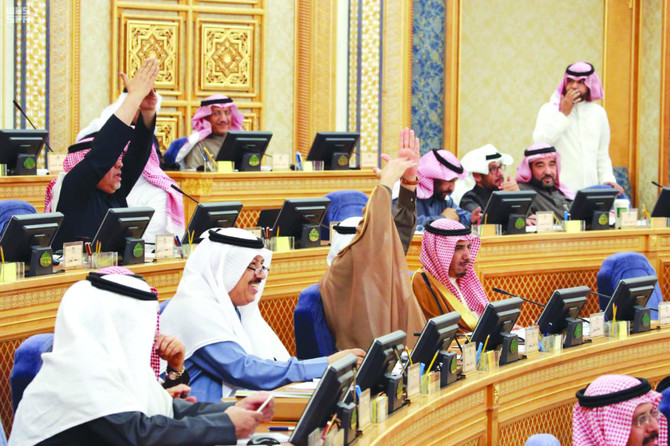
RIYADH: The Shoura Council has approved a recommendation for the reduction of working hours to at least 40 hours a week, with one additional paid day for employees working in activities targeted for localization.
The decision came on Wednesday after members deliberated on a report from the House Committee of Social Affairs, Family and Youth on amendments passed by the Council of Ministers.
The Shoura had given full power to the Council of Ministers to reduce working hours for Saudis working in localized jobs and activities.
In another decision, the Shoura Council asked the Ministry of Culture and Information to upgrade the performance in electronic media in all its channels so it could become an effective and interactive national tool.
On Tuesday, the Shoura Council called for greater partnership between the Ministry of National Guard and other relevant government agencies to bolster electronic security and protect the ministry from any electronic threats.
The decision came after members considered a report from the House Committee of Security Affairs, based on the annual report of the Ministry of National Guard.
The council also asked the ministry to promote functions of the Janadriyah Festival and develop training centers to cover the ministry’s needs for qualified and efficient staff.
In another decision, the council asked the Social Development Bank to open women’s branches so that females will be able to get loans easily.
The council also called on the Ministry of Education to boost digital awareness and the culture of innovation and entrepreneurship in general and in higher education.
It asked the ministry to raise safety procedures in buildings and school buses and to ensure full compliance to these procedures in all educational institutions. Specialized research centers relevant to technical, scientific and human products should be expanded, it said.
The council also called for equal opportunities for distinguished women to encourage them to take up leading and scientific jobs in universities and research centers and for the numbers to be boosted of those enrolled at universities who have special needs.


Saudi Shoura allows 40-hour working week in localized jobs
Saudi Shoura allows 40-hour working week in localized jobs



Foreign ministers chair Saudi-Omani coordination council meeting in Muscat
MUSCAT: Saudi Foreign Minister Prince Faisal bin Farhan met with Oman’s Foreign Minister Sayyid Badr bin Hamad Al-Busaidi on Monday.
They reviewed bilateral relations between their nations and ways to enhance and develop them across various fields. Additionally, they discussed regional and international developments.
The ministers co-chaired the third meeting of the Saudi-Omani Coordination Council in the Omani capital, Muscat, with the participation of the heads of the Council’s subsidiary committees and the two heads of the Council’s General Secretariat teams.
The meeting comes as an affirmation of the keenness of Saudi and Omani leaders to strengthen ties and advance them toward greater prosperity for both nations.
In his remarks during the meeting, Prince Faisal affirmed that gathering builds on the previous council meeting, held last year in AlUla, and on its positive and fruitful outcomes within the framework of the approved recommendations and initiatives.
He stressed the importance of continuing the work of the council’s subsidiary committees to complete the necessary procedures to implement the remaining initiatives, and of the General Secretariat’s role in follow-up and in addressing any challenges that may hinder implementation.
He also underscored the importance of developing and enhancing trade relations, stimulating investment, and strengthening cooperation between the public and private sectors.
He also praised the ongoing work to establish and launch the Coordination Council’s electronic platform, which aims to connect all committee work and initiatives to facilitate follow-up on the Council’s progress.
Al-Busaidi affirmed in his remarks the qualitative progress in relations between the two countries and the notable development witnessed across numerous sectors toward achieving economic integration and enhancing intra-trade and joint investments.
The Omani foreign minister also highlighted deeper cooperation in the security and judicial fields, as well as the cultural and tourism sectors, noting the advanced and continuous political cooperation, consultation, and coordination on regional and international issues.


