UNITED NATIONS/DOUMA: The UN Security Council will hold a closed-door meeting on Thursday to discuss an appeal from UN aid officials for a month-long humanitarian cease-fire in Syria, diplomats said.
Sweden and Kuwait requested the meeting of the top UN body on Wednesday as Syrian government forces continued to shell rebel-held Eastern Ghouta, killing scores in some of the worst bloodshed in years.
The UN humanitarian coordinator for Syria, Panos Moumtzis, has called for a month-long cease-fire to allow aid convoys to reach civilians in Eastern Ghouta.
“We are particularly concerned about attacks against civilians and civilian objects, such as hospitals. These attacks further compound civilian suffering, and are leading to large numbers of new displacements,” said Swedish Ambassador Olof Skoog.
Senior UN aid official Ursula Mueller told the council last month that the Syrian government blocked all aid convoys to besieged areas in January.
“There has been no progress on cross-line humanitarian access for the UN and its partners to besieged and hard to reach areas,” said the Swedish ambassador.
“A humanitarian cease-fire would enable the delivery of life-saving assistance and the evacuation of hundreds of critically ill patients urgently needing medical treatment” in Eastern Ghouta, he said.
More than 13.1 million Syrians are in need of humanitarian aid including 6.1 million who have been displaced within the country.
Meanwhile in Syria, renewed government strikes killed 32 civilians on Wednesday in a rebel-held enclave near Damascus, where overwhelmed medics were still treating survivors of the Syrian conflict's bloodiest day in months.
The district of Eastern Ghouta, controlled by rebel factions, suffered some of its worst bloodshed in years on Tuesday, when 80 civilians were killed.
Regime warplanes returned Wednesday morning for fresh strikes on the enclave, with the death toll climbing to 32 civilians including a dozen children, said the Syrian Observatory for Human Rights.
Among them was the young daughter of Abu Raad, a shell-shocked man from Eastern Ghouta.
"Now the rescue workers are searching for my second daughter but can't find her. What do I do?" he cried.
Tuesday's toll of 80 dead was "the highest civilian toll in Syria in nearly nine months, and one of the bloodiest days for Eastern Ghouta in several years," Observatory director Rami Abdel Rahman told AFP.
Nineteen children and 20 women are among the dead, and around 200 were wounded, said the Britain-based war monitor.
The deadliest raids hit Beit Sawa and Hammuriyeh, the Observatory said.
In Hammuriyeh, a young man stared at the bodies of five children, including his younger brother, killed in an air strike.
"I saw them filling up water, and a few minutes later the airplane hit. I came back and found all five dead," he said.
Civilians had been bracing for more raids as the regime appeared intent on ratcheting up the pressure on Eastern Ghouta, a rebel pocket on the capital's doorstep.
"Please break up all gatherings and clear the streets," blared an announcement from mosque minarets in Douma.
In apparent retaliation, rebel rocket fire on a government-controlled suburb of Damascus killed one child an wounded two people, state news agency SANA reported.
Citing a police source, SANA said the shells were launched from Eastern Ghouta.
Home to an estimated 400,000 people, the Eastern Ghouta region has been included in a de-escalation deal that was meant to bring calm.
But the bombardment has increased in recent days, including with suspected chlorine-filled munitions.
On Wednesday, French Foreign Minister Jean-Yves Le Drian said "all indications" pointed to the Syrian government's use of chlorine weapons in Syria.
"All indications... tell us today that chlorine is being used by the regime at present in Syria," he told BFM television.
Chlorine is suspected of having been used on two occasions this month alone on Eastern Ghouta.
The Organisation for the Prohibition of Chemical Weapons said a fact-finding mission mandated "to establish the facts surrounding allegations of the use of toxic chemicals... is investigating all credible allegations."
The world's chemical watchdog voiced "grave concern" over the new reports.
The US State Department said on Monday it had recorded six suspected chemical attacks in Syria in the past 30 days.
Syria has repeatedly denied using chemical weapons.
On Wednesday, the Syrian army said it intercepted an Israeli attack on a military position in Jamraya, northwest of Damascus.
Jamraya is home to several military positions and a branch of the Syrian Scientific Studies and Research Center, suspected of playing a leading role in chemical weapons production.
An Israeli air strike hit the facility in May 2013.
"This morning, Israeli warplanes fired several missiles from Lebanese airspace on one of our military positions in the Damascus countryside," said an army statement carried by state media.
"Our air defence systems blocked them and destroyed most of them."
The Observatory said an arms depot in Jamraya had been hit, but it could not confirm whether research facilities had been damaged.
The de-escalation zones, according to the UN's regional humanitarian coordinator for Syria, were not doing enough to stem the violence.
"There is a misperception that de-escalation areas have resulted in peace and stability," Panos Moumtzis told reporters in Beirut.
"Eastern Ghouta is a de-escalation area. If anything, there has been a serious escalation... The conflict in Syria is far from over," Moumtzis said.
He said the situation had grown more dire because of the multiple fronts raging at the same time.
"It's the first time -- between Eastern Ghouta, Idlib, Afrin -- we have multiple fronts with people in extreme danger without a view to a solution," he said.
"Now, we feel we've reached a breaking point."
More than 340,000 people have been killed and millions displaced since the conflict in Syria erupted in March 2011.


![]()


UN Security Council to discuss Syria humanitarian truce as new air strikes kill 32
UN Security Council to discuss Syria humanitarian truce as new air strikes kill 32
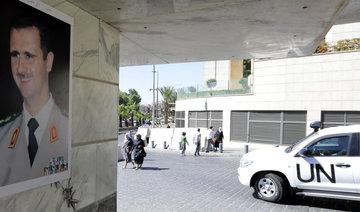

UN force says Israel fired near peacekeepers in south Lebanon
- UNIFIL reports two incidents of gunfire hitting 50 meters away from its patrols
- The force has been working with Lebanon’s army to support a ceasefire between Israel and Hezbollah
BEIRUT: The United Nations Interim Force in Lebanon said gunfire from an Israeli position hit close to its peacekeepers twice on Friday, reporting no casualties but decrying a “concerning trend.”
UNIFIL has repeatedly reported Israeli fire near or toward its personnel in recent months, and last week said an Israeli attack near one of its positions lightly wounded a peacekeeper.
Personnel patrolling in south Lebanon on Friday “reported 15 rounds of small arms fire that struck no more than 50 meters away from them,” a UNIFIL statement said.
Shortly afterwards, “peacekeepers in a second patrol in the same area reported approximately 100 rounds of machine-gun fire struck approximately 50 meters from them,” it added, reporting no damage or injuries.
“Peacekeepers assessed that the fire came from an Israel Defense Forces (IDF) position south of the Blue Line in both cases,” the statement said, referring to the de facto border, and “sent a ‘stop fire’ request through its liaison channels.”
It said UNIFIL had informed the Israeli army about the peacekeepers’ activities in advance.
“Incidents like these are happening on a too-regular basis, and becoming a concerning trend,” the statement said.
“We reiterate our call to the IDF to cease aggressive behavior and attacks on or near peacekeepers working for peace and stability along the Blue Line.”
UNIFIL has acted as a buffer between Israel and Lebanon for decades, and recently has been working with Lebanon’s army to support a year-old ceasefire between Israel and militant group Hezbollah.
The force on Friday noted that “attacks on or near peacekeepers are serious violations” of a 2006 UN Security Council resolution that formed the basis of the current ceasefire.
Under the November 2024 truce, Israel was to withdraw its forces from south Lebanon, but it has kept them at five areas it deems strategic and carries out regular strikes on Lebanon, usually saying it is targeting Hezbollah sites and operatives.
Under heavy US pressure and fears of expanded Israeli strikes, Lebanon has committed to disarming Hezbollah, starting in the south near the frontier.
Last August, the UN Security Council voted for the peacekeepers to leave Lebanon in 2027.
UNIFIL has repeatedly reported Israeli fire near or toward its personnel in recent months, and last week said an Israeli attack near one of its positions lightly wounded a peacekeeper.
Personnel patrolling in south Lebanon on Friday “reported 15 rounds of small arms fire that struck no more than 50 meters away from them,” a UNIFIL statement said.
Shortly afterwards, “peacekeepers in a second patrol in the same area reported approximately 100 rounds of machine-gun fire struck approximately 50 meters from them,” it added, reporting no damage or injuries.
“Peacekeepers assessed that the fire came from an Israel Defense Forces (IDF) position south of the Blue Line in both cases,” the statement said, referring to the de facto border, and “sent a ‘stop fire’ request through its liaison channels.”
It said UNIFIL had informed the Israeli army about the peacekeepers’ activities in advance.
“Incidents like these are happening on a too-regular basis, and becoming a concerning trend,” the statement said.
“We reiterate our call to the IDF to cease aggressive behavior and attacks on or near peacekeepers working for peace and stability along the Blue Line.”
UNIFIL has acted as a buffer between Israel and Lebanon for decades, and recently has been working with Lebanon’s army to support a year-old ceasefire between Israel and militant group Hezbollah.
The force on Friday noted that “attacks on or near peacekeepers are serious violations” of a 2006 UN Security Council resolution that formed the basis of the current ceasefire.
Under the November 2024 truce, Israel was to withdraw its forces from south Lebanon, but it has kept them at five areas it deems strategic and carries out regular strikes on Lebanon, usually saying it is targeting Hezbollah sites and operatives.
Under heavy US pressure and fears of expanded Israeli strikes, Lebanon has committed to disarming Hezbollah, starting in the south near the frontier.
Last August, the UN Security Council voted for the peacekeepers to leave Lebanon in 2027.
Latest updates


© 2026 SAUDI RESEARCH & PUBLISHING COMPANY, All Rights Reserved And subject to Terms of Use Agreement.