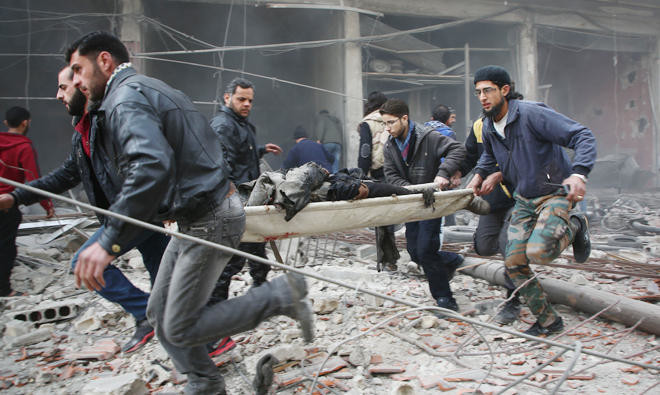
BEIRUT: The UN called on Tuesday for an immediate humanitarian cease-fire in Syria of at least a month, as heavy airstrikes were reported to have killed dozens of people in the last major rebel stronghold near Damascus.
Separately, UN war crimes experts said they were investigating multiple reports of bombs allegedly containing chlorine gas being used against civilians in the opposition-held towns of Saraqeb in the northwesterly province of Idlib and Douma in the Eastern Ghouta suburbs of Damascus.
The Syrian regime denies using chemical weapons.
The Syrian Observatory for Human Rights said Tuesday’s bombardment of Eastern Ghouta had killed at least 41 people. A local official, Khalil Aybour, put the toll at 53.
On Monday, airstrikes killed 30 people in Eastern Ghouta, the Observatory said.
“Today there is no safe area at all. This is a key point people should know: There is no safe space,” Siraj Mahmoud, the head of the Civil Defense rescue service in opposition-held rural Damascus, told Reuters.
“Right now, we have people under rubble, the targeting is ongoing, warplanes on residential neighborhoods.”
Insurgent shelling of regime-held Damascus killed three people, the Observatory and Syrian state media reported.
Airstrikes also killed at least six people in opposition-held Idlib including five in the village of Tarmala, the Observatory said.
UN officials in Syria called for hostilities to cease to enable humanitarian aid deliveries and the evacuation of the sick and wounded, listing seven areas of concern including northern Syria’s Kurdish-led Afrin region, being targeted by a Turkish offensive.
Syrian President Bashar Assad, helped by Iranian-backed militias and the Russian air force, is pursuing military campaigns against insurgents in the last major pockets of territory held by his opponents in western Syria.
Ghouta and Idlib
There were airstrikes on towns across the Eastern Ghouta, including Douma, where an entire building was brought down, a local witness said.
The UN representatives noted that Eastern Ghouta had not received inter-agency aid since November.
“Meanwhile, fighting and retaliatory shelling from all parties are impacting civilians in this region and Damascus, causing scores of deaths and injuries,” said their statement, released before the latest casualty tolls emerged on Tuesday.
Paulo Pinheiro, head of the International Commission of Inquiry on Syria, said the government siege of Eastern Ghouta featured “the international crimes of indiscriminate bombardment and deliberate starvation of the civilian population.”
Reports of airstrikes hitting at least three hospitals in the past 48 hours “make a mockery of so-called de-escalation zones,” Pinheiro said, referring to a Russian-led truce deal for opposition-held territory, which has failed to stop fighting there.
France’s Foreign Ministry said it was concerned by the reports of chlorine being used on civilians in Syria, but that it was too soon to confirm them.
French President Emmanuel Macron last May that “any use of chemical weapons would result in reprisals and an immediate riposte, at least where France is concerned.”
The conflict has been further complicated since January by a major offensive that neighboring Turkey launched against the Kurdish YPG militia in Afrin.


![]()
UN demands Syria cease-fire as airstrikes pound opposition areas
UN demands Syria cease-fire as airstrikes pound opposition areas


Latest updates


© 2026 SAUDI RESEARCH & PUBLISHING COMPANY, All Rights Reserved And subject to Terms of Use Agreement.