UK house prices fall for second month in January

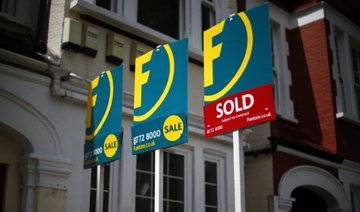
British annual house price growth has slowed since the vote to leave the EU. (Reuters)
Updated 07 February 2018
Follow

UK house prices fall for second month in January

LONDON: British house prices fell unexpectedly last month as inflation continued to squeeze household budgets, dragging annual house price growth down to one of its weakest rates in years, figures from major mortgage lender Halifax showed on Wednesday.
Average house prices fell 0.6 percent in January after a 0.8 percent decline in December, Halifax said, well below a consensus forecast of a 0.2 percent rise in a Reuters poll of economists and the first time prices have fallen for two months in a row since just after June 2016’s Brexit referendum.
British annual house price growth has slowed since the vote to leave the European Union, though the impact has been concentrated in London and neighboring areas, with most other parts of the country relatively little affected.
House prices in the three months to January were 2.2 percent higher than the same time a year earlier, down from 2.7 percent in December and the weakest increase since July, when prices rose at the slowest pace since April 2013.
Howard Archer, an economist at consultants EY Item Club, predicted house prices would rise by two percent this year, as high inflation and Brexit uncertainty kept a lid on prices.
“Housing market activity is expected to remain lackluster as the marked squeeze on consumer purchasing power only gradually eases, confidence is fragile and appreciable caution persists over engaging in major transactions,” he said.
British consumer price inflation hit its highest rate in more than five years in November, and the Bank of England raised borrowing costs for the first time in more than a decade.
November also saw finance minister Philip Hammond scrap a tax on house purchases for almost all first-time buyers. Halifax said it was too early to see any impact from the change.
Archer said a shortage of housing made outright year-on-year price falls unlikely.
The Halifax data contrast with figures published last week by rival lender Nationwide, which showed a surprise pick-up in growth to 3.2 percent in January, the biggest rise since March 2017.
Nonetheless, the figures would make the BoE’s Monetary Policy Committee reluctant to signal a rapid pace of further interest rate rises when it publishes its next rate decision on Thursday, Samuel Tombs of Pantheon Macroeconomics said.
“The MPC ... can’t ignore the evidence of a housing market slowdown now in front of them, so we doubt that they will signal to markets tomorrow that interest rates could rise as soon as May,” he said.


Kuwait to boost Islamic finance with sukuk regulation

Updated 05 February 2026
Follow

Kuwait to boost Islamic finance with sukuk regulation

  • The move supports sustainable financing and is part of Kuwait’s efforts to diversify its oil-dependent economy

RIYADH: Kuwait is planning to introduce legislation to regulate the issuance of sukuk, or Islamic bonds, both domestically and internationally, as part of efforts to support more sustainable financing for the oil-rich Gulf nation, Prime Minister Sheikh Ahmad Abdullah Al-Ahmad Al-Sabah said on Wednesday.

Speaking at the World Governments Summit in Dubai, Al-Sabah highlighted that Kuwait is exploring a variety of debt instruments to diversify its economy. The country has been implementing fiscal reforms aimed at stimulating growth and controlling its budget deficit amid persistently low oil prices. Hydrocarbons continue to dominate Kuwait’s revenue stream, accounting for nearly 90 percent of government income in 2024.

The Gulf Cooperation Council’s debt capital market is projected to exceed $1.25 trillion by 2026, driven by project funding and government initiatives, representing a 13.6 percent expansion, according to Fitch Ratings.

The region is expected to remain one of the largest sources of US dollar-denominated debt and sukuk issuance among emerging markets. Fitch also noted that cross-sector economic diversification, refinancing needs, and deficit funding are key factors behind this growth.

“We are about to approve the first legislation regulating issuance of government sukuk locally and internationally, in accordance with Islamic laws,” Al-Sabah said.

“This enables us to deal with financial challenges flexibly and responsibly, and to plan for medium and long-term finances.”

Kuwait returned to global debt markets last year with strong results, raising $11.25 billion through a three-part bond sale — the country’s first US dollar issuance since 2017 — drawing substantial investor demand. In March, a new public debt law raised the borrowing ceiling to 30 billion dinars ($98 billion) from 10 billion dinars, enabling longer-term borrowing.

The Gulf’s debt capital markets, which totaled $1.1 trillion at the end of the third quarter of 2025, have evolved from primarily sovereign funding tools into increasingly sophisticated instruments serving governments, banks, and corporates alike. As diversification efforts accelerate and refinancing cycles intensify, regional issuers have become regular participants in global debt markets, reinforcing the GCC’s role in emerging-market capital flows.

In 2025, GCC countries accounted for 35 percent of all emerging-market US dollar debt issuance, excluding China, with growth in US dollar sukuk issuance notably outpacing conventional bonds. The region’s total outstanding debt capital markets grew more than 14 percent year on year, reaching $1.1 trillion.