Gulf bourses rebound after global markets stabilize

Gulf stock markets rebounded modestly in early trade on Wednesday after global bourses stabilized following their tumble in recent days. (Reuters)
Updated 07 February 2018
Follow

Gulf bourses rebound after global markets stabilize

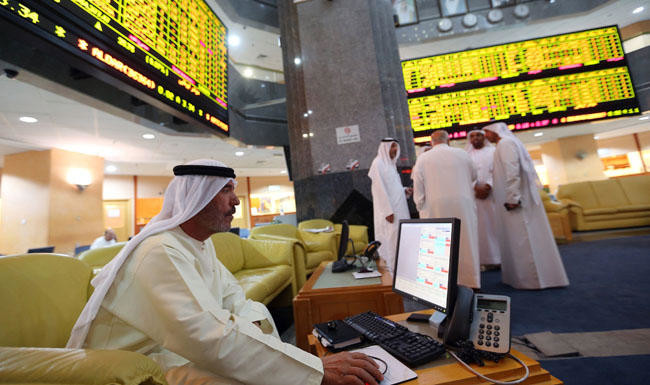
DUBAI: Gulf stock markets rebounded modestly in early trade on Wednesday after global bourses stabilized following their tumble in recent days.
The Saudi index was 0.9 percent higher after 45 minutes in a broad rally, with gaining stocks outnumbering losers by 164 to 11.
PetroRabigh, which surged in the past two days on very strong fourth-quarter earnings, added a further 3.8 percent. Food retailer Abdullah Al-Othaim Markets, which rose on Tuesday after saying quarterly profit grew 75 percent, climbed a further 3.9 percent.
But Al Yamamah Steel Industries sank 4.4 percent after saying quarterly net profit tumbled to 6.7 million riyals from 29 million riyals a year ago because of a slowdown in projects and stiff competition; SICO Bahrain had forecast a profit of 22.3 million riyals.
Dubai’s index gained 0.7 percent as blue chip Emaar Properties rebounded 0.9 percent. In Abu Dhabi, the index rose 0.4 percent as Ras Al Khaimah Ceramics jumped 3.6 percent in thin trade after reporting it swung into the black last year and hiked its dividend.
Qatar’s index climbed 1.5 percent with gainers outnumbering losers by 33 to three. Market sources said on Tuesday that Masraf Al Rayan and Amwal planned this quarter to list exchange-traded funds, which could give the market a boost.


Egypt inflation slows to 10.1% in January: CAPMAS  

Updated 16 sec ago
Follow

Egypt inflation slows to 10.1% in January: CAPMAS  

JEDDAH: Egypt’s annual inflation eased to 10.1 percent in January from 10.3 percent a month earlier, while consumer prices rose sharply on a monthly basis, highlighting persistent pressure on household costs. 

The consumer price index climbed to 268.1 points in January from 264.2 in December, the Central Agency for Public Mobilization and Statistics, also known as CAPMAS, said. Monthly inflation accelerated to 1.5 percent, compared with 0.1 percent in December. 

The government has stressed measures to contain inflation, with directives from President Abdel Fattah El-Sisi calling for coordination between the Central Bank of Egypt and the Ministry of Finance. 

Earlier, Prime Minister Mostafa Madbouli said these efforts aim to curb inflation pressures, support economic stability and encourage private sector growth. 

In its latest report, CAPMAS stated: “Among the most important indicators in price changes.... an increase in the prices of the grains and bread group by 0.1 percent, the meat and poultry group by 5.1 percent, the fish and seafood group by 1.7 percent, the dairy, cheese, and eggs group by 0.5 percent, the oils, and fats group by 0.2 percent.”  

Price movements in January contrasted with patterns seen in December 2025. Essential food and beverage categories recorded significant increases after some declines in the previous month. The meat and poultry group rose 5.1 percent in January following a 1.1 percent decline in December. 

Vegetables increased by 8.5 percent after falling 2 percent in December, while coffee, tea, and cocoa rose by 6.7 percent, up from 0.1 percent. Fish and seafood increased by 1.7 percent, dairy, cheese, and eggs by 0.5 percent, grains and bread by 0.1 percent, and tobacco and oils and fats rose by 0.7 percent and 0.2 percent, respectively. 

Housing-related costs continued to rise, with actual rents up 1.6 percent, imputed rents up 1.9 percent, and housing maintenance and repair up 0.8 percent. 

The report also showed hospital services increased by 3.4 percent, while outpatient clinic services rose by 1.0 percent, compared with December increases of 1.8 percent and 1.0 percent, respectively. 

Other consumer categories recorded moderate increases. Clothing and accessories rose by 1.4 percent, ready-made clothing by 1.1 percent, footwear by 0.4 percent, and cleaning, repair, and clothing rental by 1.0 percent. 

Personal care increased by 0.6 percent and transport services rose 0.3 percent, while household items and equipment rose between 0.2 percent and 0.7 percent. 

On the other hand, fruit prices decreased by 2.5 percent, and home appliances declined by 0.4 percent, continuing trends from December in some sectors.