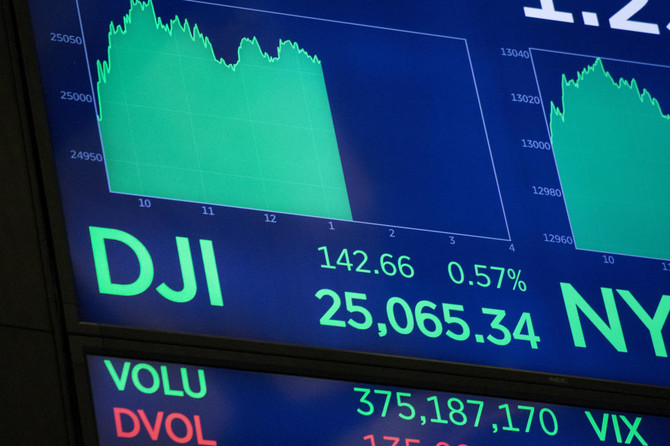
DUBAI: Gulf stock markets rose on Thursday, buoyed by rising oil prices and record closes on Wall Street, while strength in the UAE’s biggest bank boosted Abu Dhabi’s market in particular.
The Abu Dhabi index climbed 1.5 percent to its highest level since mid-August as First Abu Dhabi Bank surged 2.4 percent to 10.90 dirhams, bringing its gains in the last three days to 6.3 percent.
The stock rose on Wednesday above its 200-day average for the first time since September, triggering a minor double bottom formed by the lows since October. Of 10 analysts polled by Reuters, one has a “strong buy” on the stock, five have a “buy” and four have a “hold,” with a median target of 11.75 dirhams.
Dubai’s index edged up 0.1 percent to 3,464 points following four days of gains. Amlak Finance added 2.9 percent after saying it signed a memorandum of understanding with Egypt’s Marseilia Group to develop a property project in Cairo.
Dubai’s medium-term technical outlook turned positive this week as it began to rebound from the bottom of an uptrend channel dating back to early 2016. Technically, a rise in coming months to near the top of the channel would not be surprising, and would take the index above 3,700 points.
Saudi Arabia’s index rose 0.7 percent to its highest level since early October, passing resistance around 7,200 points, which was support in August and September. Any clean break — another daily close above that level on Sunday — would point up to at least the September peaks around 7,400 points.
Al Rajhi Bank added 1.6 percent after its 2 percent gain on Wednesday.
Egypt’s blue-chip index fell 0.4 percent. But Glaxo Egypt surged 7.0 percent after reporting a 26 percent year-on-year rise in third-quarter consolidated net profit.

Gulf markets gain on global trend
Saudi POS spending jumps 28% in final week of Jan: SAMA
RIYADH: Saudi Arabia’s point-of-sale spending climbed sharply in the final week of January, rising nearly 28 percent from the previous week as consumer outlays increased across almost all sectors.
POS transactions reached SR16 billion ($4.27 billion) in the week ending Jan. 31, up 27.8 percent week on week, according to the Saudi Central Bank. Transaction volumes rose 16.5 percent to 248.8 million, reflecting stronger retail and service activity.
Spending on jewelry saw the biggest uptick at 55.5 percent to SR613.69 million, followed by laundry services which saw a 44.4 percent increase to SR62.83 million.
Expenditure on personal care rose 29.1 percent, while outlays on books and stationery increased 5.1 percent. Hotel spending climbed 7.4 percent to SR377.1 million.
Further gains were recorded across other categories. Spending in pharmacies and medical supplies rose 33.4 percent to SR259.19 million, while medical services increased 13.7 percent to SR515.44 million.

Food and beverage spending surged 38.6 percent to SR2.6 billion, accounting for the largest share of total POS value. Restaurants and cafes followed with a 20.4 percent increase to SR1.81 billion. Apparel and clothing spending rose 35.4 percent to SR1.33 billion, representing the third-largest share during the week.
The Kingdom’s key urban centers mirrored the national surge. Riyadh, which accounted for the largest share of total POS spending, saw a 22 percent rise to SR5.44 billion from SR4.46 billion the previous week. The number of transactions in the capital reached 78.6 million, up 13.8 percent week on week.
In Jeddah, transaction values increased 23.7 percent to SR2.16 billion, while Dammam reported a 22.2 percent rise to SR783.06 million.

POS data, tracked weekly by SAMA, provides an indicator of consumer spending trends and the ongoing growth of digital payments in Saudi Arabia.
The data also highlights the expanding reach of POS infrastructure, extending beyond major retail hubs to smaller cities and service sectors, supporting broader digital inclusion initiatives.
The growth of digital payment technologies aligns with Saudi Arabia’s Vision 2030 objectives, promoting electronic transactions and contributing to the Kingdom’s broader digital economy.