CAIRO: Nothing says “Egypt” like the Great Pyramids of Giza. The monumental structures are the oldest of the Seven Wonders of the World, and are the only remaining wonder of the ancient world.
Visiting them ought to be a magical experience. In practice, it is anything but. It involves fending off aggressive vendors and scammers, and wading through litter.
With tourism improving for the first time since the 2011 revolution, Egypt has decided it must improve conditions around one of its main attractions and biggest money spinners.
A development project costing 400 million Egyptian pounds ($23 million) to modernize the infrastructure around the pyramids includes plans for a fleet of electric cars transporting visitors from the entrance of the archaeological complex to the pyramids every five minutes.
The planned transformation also involves closing off the Mena House entrance to the site, restricting entry to the Fayoum entrance, and connecting the pyramids to the Grand Egyptian Museum, which is scheduled to open later this year.
Mohammed Ismail, general supervisor for the development project, told Al-Masry Al-Yom newspaper that the electric vehicles will be driven on UNESCO-approved “yellow concrete suitable for the area.”
The current pyramid “experience” involves passing through a heavy security checkpoint, only to face a barrage of hawkers and conmen using the hardest of hard-sell techniques for overpriced souvenirs, tickets and camel rides.
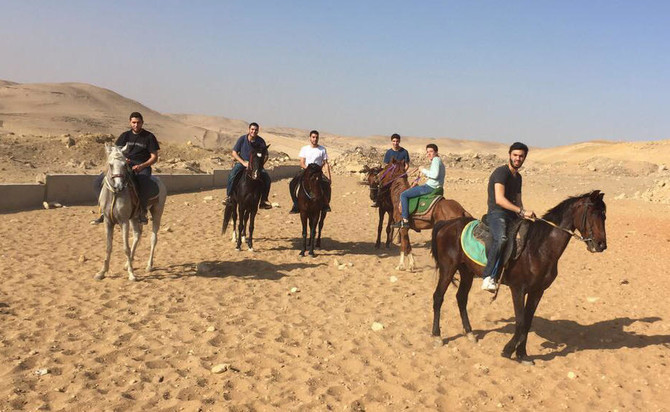
Jumping in front of vehicles and jostling tourists on foot, they loudly insist they are the sole purveyors of entrance tickets, and the only way to the pyramids is by horse — their horse.
Signs state that rides should cost no more than 5 pounds, but the scammers often demand hundreds.
“I was taking photos, and a man appeared out of nowhere and shoved a scarf into my bag,” said Mike, a 30-year-old tourist from England.
“I tried to give it back to him, but he claimed I’d already taken it and had to pay for it. The police just watched, and I only managed to get away by forcing the scarf back into his hand and rushing off. He actually looked offended!”
Another tourist said: “We drove past some very heavy security, and all of a sudden our car gets charged by three men shouting at us and banging on the car. They pointed at us to pull over to the side, but our driver managed to get past them and speed off. It was quite scary really.”
Even after fending off the scammers outside the complex, there is little chance of visitors enjoying the pyramids in relative peace because there are more vendors inside.
Police officers, who are supposed to safeguard the complex and provide a reassuring presence for tourists, stand idly by.
One Egyptian who helped two tourists escape from persistent hawkers was attacked by one of them for “stealing away customers.” When he complained to the police, they accused him of soliciting tourists without a license.
The sight that greets visitors is nothing like the typical travel brochure vista of the pyramids rising majestically from vast expanses of pristine desert.
Instead, approaching the venerable ancient monuments means wading through a sea of modern detritus: Cigarette packets, drinks and snack wrappers. No wonder Ismail describes it as an “open zoo.”
Tourist numbers in 2017 were 55 percent up on the previous year, and hopes are high that they will be even better this year.
On Feb. 20, flights from Russia are set to resume for the first time since the downing in October 2015 of a Russian carrier that was flying passengers from Sharm El-Sheikh on the Red Sea to St. Petersburg.
The 400-million-pound redevelopment budget does not include funding for the electric car shuttles. “We are looking for a financier,” said Ismail.
But the fate of nuisance vendors and camel-ride scammers is sealed. They will be moved to an entirely separate area dedicated to horse-riding.


![]()
![]()
![]()
![]()

Pyramids clean-up plans to send scammers packing


Pyramids clean-up plans to send scammers packing


Latest updates


© 2026 SAUDI RESEARCH & PUBLISHING COMPANY, All Rights Reserved And subject to Terms of Use Agreement.