Kashmir is a nuclear flashpoint, warns Pakistani expert

1 / 5
(Photos courtesy: the President Office - Pakistan)
2 / 5
(Photos courtesy: the President Office - Pakistan)
3 / 5
(Photos courtesy: the President Office - Pakistan)
4 / 5
(Photos courtesy: the President Office - Pakistan)
5 / 5
(Photos courtesy: the President Office - Pakistan)
Updated 07 February 2018
Follow

Kashmir is a nuclear flashpoint, warns Pakistani expert

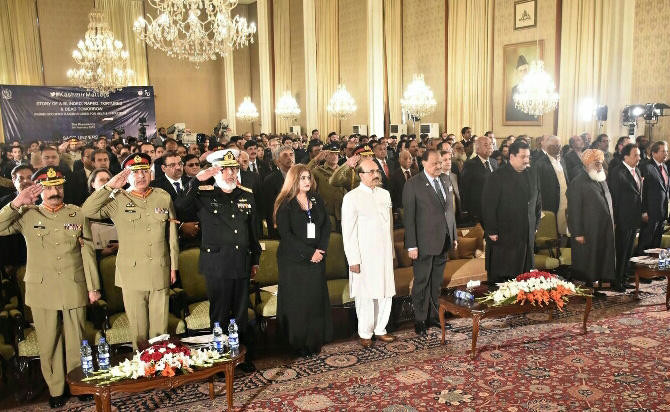
ISLAMABAD: “Indian atrocities” were condemned and Kashmir described as “the biggest prison of humanity on earth” when a major ceremony was held at the Presidency to commemorate Kashmir Solidarity Day on Monday.
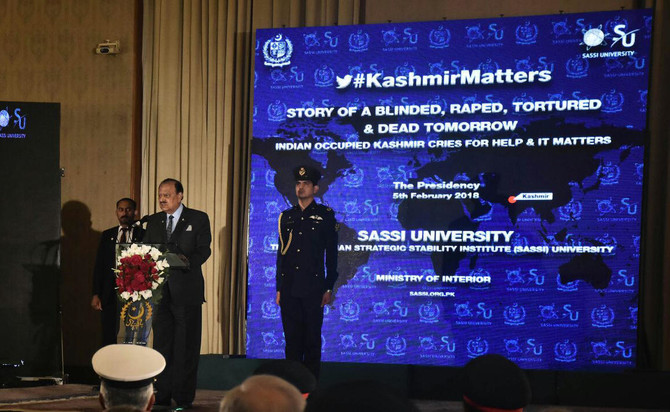
Addressing the audience, Pakistan President Mamnoon Hussain paid tribute and promised unflinching support to the people of Kashmir.
“The freedom struggle of the brave and valiant people of Kashmir is a unique movement in the world. They have faced persecution for the last 70 years. Despite this severe repression, they have been heroically facing subjugation,” he said.
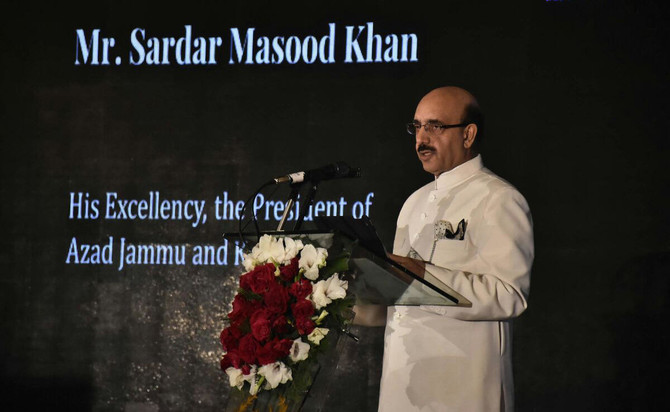
President of Azad Jammu and Kashmir Sardar Masood Khan also attended the event and condemned “Indian atrocities.” He said political and human rights activists were killed in Indian-administered Kashmir since “they raise their voices against Indian brutalities and seek a plebiscite.” He added that India was in gross violation of a UN resolution and claimed it was not possible for anyone to stop the people of Kashmir from getting their birth right.
Several ministers, parliamentarians, government functionaries, Kashmiri leaders and other high-profile public figures were also present at the gathering.
Other participants described Kashmir as “the biggest prison of humanity on earth” and criticized the UN in a video documentary for its inability to implement the UN resolution calling for a free and impartial plebiscite for the people of Kashmir.
Kashmir Solidarity Day is annually observed on Feb. 5 as a national holiday in Pakistan to support the struggle of the people of Indian-administered Kashmir and remember those who have lost their lives in the conflict.
A number of speakers lashed out at New Delhi, claiming that it was trying to reduce “the disputed Muslim-majority state to a Muslim-minority state through rape, torture, extrajudicial killings, and use of pellets.”
Talking to Arab News, Defense Minister Khurram Dastgir Khan said there had been a more than 600 percent increase in casualities along the disputed border that separates the two South Asian nuclear rivals between 2016 and 2017.
“Kashmir matters because peace in South Asia matters,” said Dastgir.
Since 2014, border skirmishes along the Line of Control and working boundary between Pakistan and India have greatly increased.
Pakistan blamed India for more than 1,800 cease-fire violations in 2017, though a 2003 cease-fire accord signed by both countries theoretically remains in effect. According to official statistics, more than 300 violations have been committed by India since the beginning of this year, leading to the deaths of many innocent civilians.
The ceremony at the Presidency was organized by South Asian Strategic Stability Institute (SASSI), an independent think-tank dedicated to promoting peace and stability in South Asia.
SASSI launched today #KashmirMatters campaign, during Monday’s ceremony.
“Escalation dynamics can’t be controlled by Pakistan or India which can lead to a nuclear conflict – the skirmishes remain low-intensity but have the potential of escalating to a point of no return,” Dr. Maria Sultan, chairperson and president of SASSI and its university, told Arab News.
“Kashmir is a nuclear flashpoint” and can spell disaster for the region if not resolved, she added.


Pakistan awaits mandate clarity before committing troops to Gaza stabilization force, FO says

Updated 9 sec ago
Follow

Pakistan awaits mandate clarity before committing troops to Gaza stabilization force, FO says

  • Foreign office says Islamabad cannot commit to contributing troops unless it obtains clarity on the force’s mandate
  • Says Pakistan can be part of peacekeeping force but not of any disarming or de-militarization mandates

ISLAMABAD: Foreign office spokesperson Tahir Andrabi said on Thursday that Pakistan has identified its “red lines” on contributing to the International Stabilization Force (ISF) in Gaza, adding that Islamabad would be unable to take a decision on the matter without clarity about the force’s mandate. 

Andrabi’s comments come as Prime Minister Shehbaz Sharif gears up to attend the inaugural Board of Peace meeting to be chaired by US President Donald Trump in Washington today, Thursday. 

Trump’s 20-point peace plan for Gaza calls for ‌a multi-nation force to oversee a ‌transition period for reconstruction and economic recovery in the Palestinian territory. Pakistan has previously said it is willing to contribute troops for the peace force but would not be part of any move to disarm Hamas. 

“On the international security assistance force, we understand that a decision is awaited on the contours of the mandate of the Board of Peace, on the mandate of the International Stabilization Force,” Andrabi said during a weekly briefing to reporters. 

“And till such time, we would obviously not be in a position to take any decision on this matter. We have identified our red lines quite explicitly.”

Andrabi quoted a previous statement of Deputy Prime Minister Ishaq Dar by saying: “Pakistan can be part of the peacekeeping mandate, but we would obviously not be part of any disarming, de-militarization mandates.”

He said discussion on the international force might take place in Washington today.

The foreign office spokesperson said Pakistan has joined the Board of Peace with a particular focus of aiding in the reconstruction of Gaza and for the long-term settlement of issues faced by Palestinians.

Andrabi said Israel’s recent move to register lands in the West Bank will also come up in the Board of Peace meeting today. 

“That is how Israel is violating international law, UN resolutions on wider occupied Palestinian territories, not just Gaza,” he said.

“So, I think the board of peace meeting affords an opportunity to discuss this important development.”

SAUDI MEDIATION FOR PAKISTANI DETAINEES
To a question about the release of three Pakistani detainees by Afghanistan this week on Saudi Arabia’s mediation, Andrabi welcomed the role played by the Kingdom and “other brotherly Muslim countries.”

 Afghanistan government spokesperson Zabihullah Mujahid announced on Tuesday that it had released three Pakistani soldiers captured during border clashes between the two countries in October after mediation from Saudi Arabia. Mujahid said the detainees were handed over to a visiting Saudi delegation in Kabul.

“Pakistan values the positive role of our brotherly countries, our important OIC Islamic countries, in basically messaging Taliban leadership, reminding them of their obligations under international law, to ensure that their territory is not used for terrorism in Pakistan,” the spokesperson said.

“I think such an exchange also took place between Riyadh and Kabul.”

However, he said Saudi Arabia was not part of any “structured mediation talks” between Pakistan and Afghanistan.

“I am not aware of that role and I would strongly urge you not to speculate into it,” he said. 

To a question about Pakistan’s response if India violates the Indus Waters Treaty, Andrabi said Islamabad will not compromise on its water rights.

“We will not let India weaponize water. We will not compromise on even a single drop of water that this treaty allows us to have a share of, and we will not compromise on the water rights of the people of Pakistan,” he added.