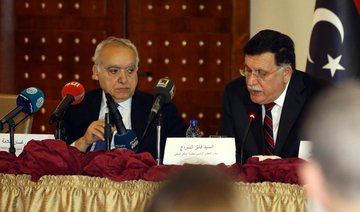
BENGHAZI, Libya: Libya’s UN-backed government in Tripoli has condemned attacks against hundreds of displaced black Libyans known as Tawergha who were still stranded in a camp on Monday after militiamen prevented them from returning home.
In a statement late Sunday, it said it is still working to ensure that the hundreds of families taking refuge in a camp near the town of Bani Walid can return to their home city, also known as Tawergha.
Witnesses reported that the Tawergha, who were due to return on Feb. 1 under an agreement with the neighboring city of Misrata, were barred from entry by militias who fired in the air and even shot up some cars.
“Yesterday evening, an armed group attacked the camp and drove the families back while shooting in the air, robbing cars and an ambulance,” said Naser Alwafi, a Tawergha resident and eyewitness. “When some of Tawergha youth tried to stop them, the militias targeted them directly, injuring many and damaging some of the cars.”
Misrata militiamen blame the Tawergha for siding with Libya’s longtime dictator Muammar Qaddafi during the 2011 uprising that overthrew and killed him. The Tawergha have been living in camps and makeshift housing across Libya since then, facing threats and extortion.
Libya was plunged into chaos after the uprising, and today is split between two governments, each of which relies on myriad militias.
In December, the Tripoli government said Tawergha families would be able to return to their hometown in February following a reconciliation deal. The UN has called for the deal to be implemented.
Tawergha was used as a staging ground for attacks on Misrata during the uprising. Anti-Qaddafi militias, mainly from Misrata, later drove out its residents, believing they had aided Qaddafi’s forces. The town has been largely deserted since then.
Human Rights Watch estimates that about 40,000 have been displaced from the town.
On Wednesday, the municipal council of Misrata called on the Tripoli government to postpone its decision to allow Tawergha residents to return, saying escalations by unnamed parties had disrupted security arrangements. The government said it was looking into the issue and urged parties to the agreement to coordinate with the relevant authorities to ensure the safe return of Tawergha’s residents.

Libya condemns militia attacks against Tawergha minority
Turkiye’s Kurdish party says Syria deal leaves Ankara ‘no excuses’ on peace process
ANKARA: Turkiye’s pro-Kurdish DEM Party said on Monday that the Turkish government had no more “excuses” to delay a peace process with the Kurdistan Workers Party (PKK) now that a landmark integration deal was achieved in neighboring Syria.
On Sunday in Syria, the Kurdish-led Syrian Democratic Forces (SDF) agreed to come under the control of authorities in Damascus — a move that Ankara had long sought as integral to its own peace effort with the PKK. “For more than a year, the government has presented the SDF’s integration with Damascus as the biggest obstacle to the process,” Tuncer Bakirhan, co-leader of the DEM Party, told Reuters, in some of the party’s first public comments on the deal in Syria.
“The government will no longer have any excuses left. Now it is the government’s turn to take concrete steps.” Bakirhan cautioned President Tayyip Erdogan’s government against concluding that the rolling back Kurdish territorial gains in Syria negated the need for a peace process in Turkiye. “If the government calculates that ‘we have weakened the Kurds in Syria, so there is no longer a need for a process in Turkiye,’ it would be making a historic mistake,” he said in the interview.
Turkish officials said earlier on Monday that the Syrian integration deal, if implemented, could
advance the more than year-long process with the PKK, which is based in northern Iraq. Erdogan urged
swift integration of Kurdish fighters into Syria’s armed forces. Turkiye, the strongest foreign backer of Damascus, has since 2016 repeatedly sent forces into northern Syria to curb the gains of the SDF — which after the 2011–2024 civil war had controlled more than a quarter of Syria while fighting Islamic State with strong US backing.
The United States has built close ties with Damascus over the last year and was closely involved in mediation between it and the SDF toward the deal.
Bakirhan said progress required recognition of Kurdish rights on both sides of the border.
“What needs to be done is clear: Kurdish rights must be recognized in both Turkiye and Syria, democratic regimes must be established, and freedoms must be guaranteed,” he said.
On Sunday in Syria, the Kurdish-led Syrian Democratic Forces (SDF) agreed to come under the control of authorities in Damascus — a move that Ankara had long sought as integral to its own peace effort with the PKK. “For more than a year, the government has presented the SDF’s integration with Damascus as the biggest obstacle to the process,” Tuncer Bakirhan, co-leader of the DEM Party, told Reuters, in some of the party’s first public comments on the deal in Syria.
“The government will no longer have any excuses left. Now it is the government’s turn to take concrete steps.” Bakirhan cautioned President Tayyip Erdogan’s government against concluding that the rolling back Kurdish territorial gains in Syria negated the need for a peace process in Turkiye. “If the government calculates that ‘we have weakened the Kurds in Syria, so there is no longer a need for a process in Turkiye,’ it would be making a historic mistake,” he said in the interview.
Turkish officials said earlier on Monday that the Syrian integration deal, if implemented, could
advance the more than year-long process with the PKK, which is based in northern Iraq. Erdogan urged
swift integration of Kurdish fighters into Syria’s armed forces. Turkiye, the strongest foreign backer of Damascus, has since 2016 repeatedly sent forces into northern Syria to curb the gains of the SDF — which after the 2011–2024 civil war had controlled more than a quarter of Syria while fighting Islamic State with strong US backing.
The United States has built close ties with Damascus over the last year and was closely involved in mediation between it and the SDF toward the deal.
Bakirhan said progress required recognition of Kurdish rights on both sides of the border.
“What needs to be done is clear: Kurdish rights must be recognized in both Turkiye and Syria, democratic regimes must be established, and freedoms must be guaranteed,” he said.
© 2026 SAUDI RESEARCH & PUBLISHING COMPANY, All Rights Reserved And subject to Terms of Use Agreement.