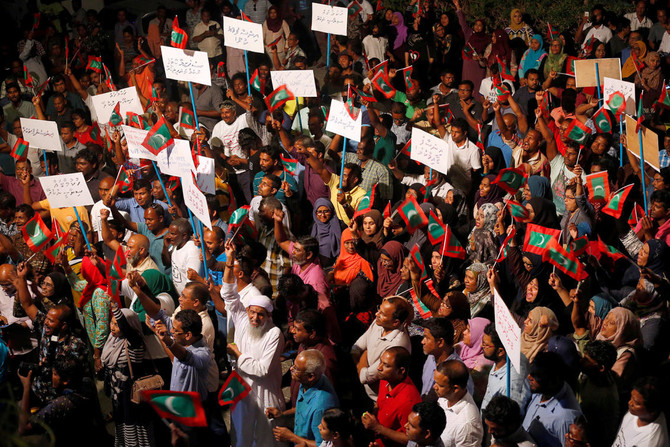
MALE, Maldives: The Maldives government has declared a 15-day state of emergency amid a deepening political crisis between the president and the judiciary over its order to release a group of imprisoned opposition leaders.
Legal Affairs Minister Azima Shakoor announced the state of emergency on state television Monday evening.
A surprise ruling last week by the Supreme Court directing the release of the opposition leaders has led to a tense standoff between President Yameen Abdul Gayoom and the Supreme Court, with protests spilling into the streets of the capital, Male, and soldiers in riot gear deployed to the parliament building to stop lawmakers from meeting.
A former president is among those ordered freed by the court after trials criticized for flawed due process.
Shakoor said earlier Monday that the government doesn’t believe that the court order can be enforced.
Maldives became a multiparty democracy 10 years ago after decades of autocratic rule, but lost many of the democratic gains after Yameen was elected in 2013.
The political crisis in the Maldives has deepened as the president of the island nation said the Supreme Court had overstepped its authority in ordering the release of a group of imprisoned opposition leaders.
The surprise judicial ruling last week has led to an increasingly tense standoff between President Yameen Abdul Gayoom and the Supreme Court, with protests spilling into the streets of the capital, Male, and soldiers in riot gear deployed to the parliament building to stop lawmakers from meeting.
Yameen, in a letter to the court released by his office, said the order had encroached on the powers of the state and was an “infringement of national security and public interest.” He urged the court to “review the concerns” of the government.

Maldives government declares state of emergency
Kosovo voters cast ballots in a second attempt this year to elect a government and avoid more crisis
- The prime minister’s party is again the favorite in the race, but it is unclear whether it will manage to muster a majority this time in the 120-member parliament
PRISTINA: Voters in Kosovo cast ballots on Sunday in an early parliamentary election in hopes of breaking a political deadlock that has gripped the small Balkan nation for much of this year.
The snap vote was scheduled after Prime Minister Albin Kurti’s governing Vetevendosje, or Self-Determination, party failed to form a government despite winning the most votes in a Feb. 9 election.
The deadlock marked the first time Kosovo could not form a government since it declared independence from Serbia in 2008 following a 1998-99 war that ended in a NATO intervention.
The prime minister’s party is again the favorite in the race, but it is unclear whether it will manage to muster a majority this time in the 120-member parliament, after other mainstream parties refused an alliance.
According to Kosovo’s election laws, 20 parliamentary seats are automatically assigned to ethnic Serb representatives and other minority parties.
Another inconclusive vote would further deepen the crisis. Kosovo has already not approved a budget for next year, sparking fears of possible negative effects on the already poor economy in the country of 2 million people.
Lawmakers are set to elect a new president in March as current President Vjosa Osmani’s mandate expires in early April. If this fails too, another snap election must be held.
The main opposition parties are the Democratic League of Kosovo and the Democratic Party of Kosovo. They have accused Kurti of authoritarianism and of alienating Kosovo’s US and European Union allies since he came to power in 2021.
A former political prisoner during Serbia’s rule in Kosovo, the 50-year-old Kurti has taken a tough stand in talks mediated by the European Union on normalizing relations with Belgrade. In response, the EU and the United States imposed punitive measures.
Kurti has promised to buy military equipment to boost security.
No reliable pre-election polls have been published. Kurti’s party at the previous election won around 42 percent of the votes while the two main rival parties had together around 40 percent.
Analysts say that even the slightest changes in numbers on Sunday could prove decisive for the future distribution of power but that nothing is certain.
Tensions with restive ethnic Serbs in the north exploded in clashes in 2023 when scores of NATO-led peacekeepers were injured. In a positive step, ethnic Serb mayors this month took power peacefully there after a municipal vote.
Kurti has also agreed to accept third-country migrants deported from the United States as part of tough anti-immigration measures by the administration of President Donald Trump. One migrant has arrived so far, authorities have told The Associated Press.
Kosovo is one of the six Western Balkan countries striving to eventually join the EU, but both Kosovo and Serbia have been told they must first normalize relations.