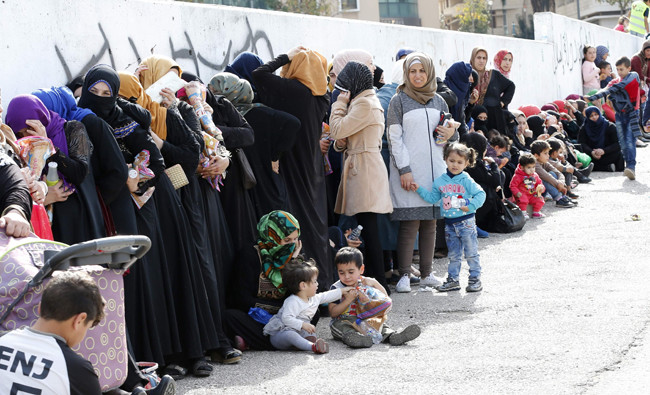
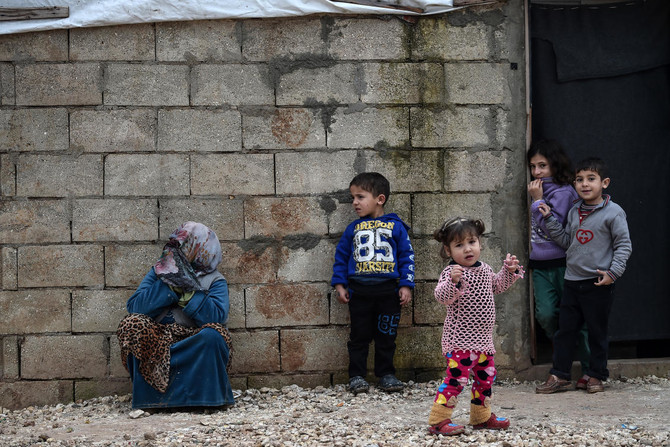
BEIRUT: International aid groups have warned countries hosting Syrian refugees in the Middle East and the West against forcing them to return or discussing measures to that effect.
A report by several leading humanitarian organizations — including the Norwegian Refugee Council and CARE International — spoke of an alarming trend advocating for deportations.
“Hundreds of thousands of refugees are at risk of being pushed to return to Syria in 2018, despite ongoing violence, bombing and shelling that are endangering the lives of civilians,” it said.
The report, entitled “Dangerous Ground,” observed that measures to send refugees back to their homes in Syria were increasingly prominent on the agenda of host countries.
“As the military situation changed in Syria, and against a backdrop of increased anti-refugee rhetoric and policies across the world, governments began in 2017 to openly contemplate the return of refugees to the country,” it said.
The number of refugees who returned to Syria — which has been racked by a conflict that killed at least 340,000 people since 2011 — rose to 721,000 in 2017, from 560,000 the previous year.
But the report warned that three times as many Syrians were displaced last year and that a further 1.5 million people were expected to be forced from their homes in 2018.
“Now, return would neither be safe nor voluntary for the vast majority who fled the war and the violence,” NRC Secretary-General Jan Egeland said.
“Currently, even in certain so-called de-escalation areas, we’ve seen bloodshed, targeting of hospitals and schools, and death,” he said of regions that were selected last year for truces meant to pave the way for an end to the war.
The report expressed concern over measures being discussed in Europe, including in Denmark and Germany, that could lead to forced returns.
Only three percent of vulnerable Syrian refugees so far have been resettled in wealthy countries. Most remain in countries bordering Syria, including Lebanon, Jordan, and Turkey, but rhetoric on refugee return has also picked up there.
“In Syria’s neighboring countries, the push to return refugees has manifested itself in closed borders, deportations and forced or involuntary returns,” the report said.
Helle Thorning-Schmidt, the head of the Save the Children aid group that also co-authored the report, warned that many children risked being sent straight into harm’s way.
“No child should have to return home before it is safe. Right now, many parts of Syria are unsafe for children. Bombs are still falling and basic services like schools and hospitals lie in ruins,” she said.
Action Against Hunger and Danish Refugee Council also contributed to the report.


![]()
![]()
Aid groups warn against forced refugee returns
Aid groups warn against forced refugee returns
Latest updates


© 2026 SAUDI RESEARCH & PUBLISHING COMPANY, All Rights Reserved And subject to Terms of Use Agreement.