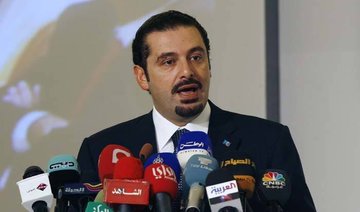
BEIRUT: Lebanese Prime Minister Saad Hariri said on Thursday that Lebanon would not force refugees to return to Syria but called for more international help in dealing with the refugee crisis.
More than a million Syrians fled into neighboring Lebanon after war broke out in their country in 2011 and now account for about a quarter of its population.
As the Syrian regime has gained control over more territory, and as fighting has ended in more parts of Syria, some Lebanese politicians have called for Syrian refugees to return.
“My government’s position is very clear. Nobody’s going to force anyone to go back if they don’t want to go back,” Hariri said.
In a speech at a donor conference in Beirut calling for $2.68 billion in humanitarian aid for the crisis this year, Hariri warned that refugees would try to move to other countries if there was not enough support for them in Lebanon.
“We need more from the international community because we are doing a public service for the international community. Otherwise, these people, if we do not do more, if you do not do more, they will seek refuge somewhere else,” he said.
Separately, at least 20 civilians were killed Thursday in Syrian regime’s airstrikes on opposition-held territory in the country’s north, a war monitor said.
Elsewhere three children were reported killed in artillery strikes on opposition-held Eastern Ghouta, while state news agency SANA said seven people died in apparent retaliatory shelling of nearby regime-held Damascus.
The aerial bombardments in the north pounded several areas in the provinces of Aleppo and Idlib, where regime troops are waging a Russian-backed assault against opposition fighters and radicals.
“Regime raids hit two villages in the south of Aleppo province, killing 15 civilians,” said Rami Abdel Rahman, head of Syrian Observatory for Human Rights.
In the neighboring province of Idlib, regime airstrikes killed five civilians in the town of Saraqeb, said the observatory, a Britain-based war monitor.
That broad region is held by Hayat Tahrir Al-Sham (HTS), which is dominated by Al-Qaeda’s one-time affiliate in Syria.
Regime troops launched a ferocious offensive in late December to retake parts of Idlib and secure a key road leading from Aleppo south to the capital. Regime forces have made key gains, recapturing the Abu Duhur military airport and dozens of nearby villages.
Since it erupted in 2011, Syria’s conflict has morphed from a protest movement into a brutal and complex war that has left 340,000 people dead.
In an attempt to bring an end to the fighting, backers of opposing sides last year agreed to four “de-escalation” zones in the country.
Idlib makes up part of one zone. The other three are in Syria’s south, the central province of Homs, and the area of Eastern Ghouta, an opposition enclave near Damascus.


![]()

Hariri: Lebanon will not force Syrian refugees to return
Hariri: Lebanon will not force Syrian refugees to return

Latest updates


Recommended



© 2026 SAUDI RESEARCH & PUBLISHING COMPANY, All Rights Reserved And subject to Terms of Use Agreement.