BEIRUT: There is no crisis in Lebanon’s relations with Saudi Arabia, Lebanese Prime Minister Saad Hariri said on Friday while attending a meeting of the International Support Group for Lebanon in Paris.
“To the contrary, we see that our relationship with the Kingdom is distinctive, and we are keen to maintain these relations with Saudi Arabia, all Arab countries, and all countries of the world,” Hariri said.
At the meeting, the international community reaffirmed its “support for Lebanon, its sovereignty, stability, and security, as well as improving its economic situation.”
The meeting was chaired by the UN and France, and attended by Hariri, the foreign ministers of the US, China, Russia, Germany, Britain, and the EU, and representatives of the Arab League, the UN High Commissioner for Refugees (UNHCR), the World Bank, and the office of the UN special coordinator for Lebanon.
The meeting was held after Lebanon underwent a political crisis following Hariri’s unexpected resignation, in which he accused Iran and Hezbollah of taking control of Lebanon, and then his suspension of his resignation after all parties in the Lebanese government committed to the “self-distancing policy.”
Regarding protecting Lebanon from sliding back into Iran-Saudi conflicts, Hariri stressed that “self-distancing is imposed on everyone.”
Hariri said the fragile stability in his country “appeared like a small miracle” given the wars in Syria, Iraq and Yemen. “The desire of all in Lebanon is to save our democracy,” he said.
On the fear of the permanent settlement of Palestinians in Lebanon after the US declared Jerusalem the capital of Israel, Hariri said that “resettlement is unacceptable, and the Lebanese constitution is clear and explicit about this matter.”
French President Emmanuel Macron stressed that “external powers should not intervene in Lebanese affairs, and the self-distancing policy must be implemented in full.”
“Lebanon’s sovereignty and territorial integrity must be respected by all, and Lebanon must restore institutions’ work and launch the reform process,” he said, “There is a security challenge in south Lebanon, and measures must continue there as well as the implementation of resolution 1701.”
He said that “Lebanon’s stability is essential for the whole region, and it is of vital importance for Lebanon not to have its armed groups intervene in crises.”
French Foreign Minister Jean-Yves Le Drian said: “France’s relations with Saudi Arabia are built on great trust and transparency regarding the decisions, intentions, and initiatives of both countries, and therefore this meeting was held with the knowledge of all parties and actors, including Saudi Arabia.”
Asked about the possibility of playing a role with Iran to help Lebanon overcome its crisis, Le Drian said: “The self-distancing policy is being implemented inside and outside Lebanon.”
Addressing his government, Hariri said: “My government must now devote itself to maintaining the best relations with Arab states and the international community on the basis of respecting the Security Council’s resolutions, especially 1701, which has been contributing to ensuring stability and security in our southern border for 11 years.”
“My government must also face the challenges associated with hosting Syrian refugees in Lebanon, resume reforms, and hold the parliamentary elections in May 2018.”
He stressed that “stability in Lebanon is maintained by sacrifices, dialogue, and settlement.”
Amina J. Mohammed, deputy secretary-general of the UN, said that “work will begin as soon as Hariri returns to Lebanon”, pointing out that “we are going through difficult days, and we need more hope for the region.”
Hariri also met with US Secretary of State Rex Tillerson.
The group recalled the necessity of implementing the 2012 Baabda Declaration, especially “disassociating from any regional and international conflicts and wars, controlling the Lebanese-Syrian border, and preventing the establishment of a buffer zone in Lebanon as well as the use of Lebanon as a route for smuggling weapons and militants.”
The group stressed the need to “protect Lebanon from the crises that are destabilizing the Middle East” and called on “all regional states and organizations to work for the political, social, economic, and financial stability and security of Lebanon, in full respect of its sovereignty and integrity.”
The group also expressed its “satisfaction for Hariri’s return to Beirut because he is a key partner for safeguarding the unity and the stability of Lebanon.” It welcomed his decision, made in agreement with Lebanese President Michel Aoun, to continue his term at the head of the government, and the decision announced by the Council of Ministers on Dec. 5 to disassociate from any regional conflicts and wars and from internal affairs of Arab countries.
The group stressed that “it will pay close attention to the implementation of the council’s decision by all Lebanese parties in the spirit of national concord and compromise, as spelled out in previous declarations, in particular the 2012 Baabda Declaration.”
The group reiterated its call for “the need to fully implement and respect all UN Security Council resolutions, especially 1701.” It commended “the role of the UN Interim Force in Lebanon (UNIFIL) in maintaining peace along the Blue Line and its cooperation with the Lebanese Army to extend and consolidate the authority of the Lebanese state over all Lebanese territories.”
The group highlighted that “the Lebanese Army is the only legitimate armed force in Lebanon, as enshrined in the Lebanese constitution and in the Taif Agreement.” It called on all Lebanese parties to resume talks on the national defense plan.
The group commended the efforts made by the Lebanese people and authorities to host Syrian refugees, recalling “the importance, when conditions allow, of a safe, dignified and non-coercive UN-facilitated return of refugees, in accordance with international law and humanitarian principles, including the principle of non-refoulement.”


![]()
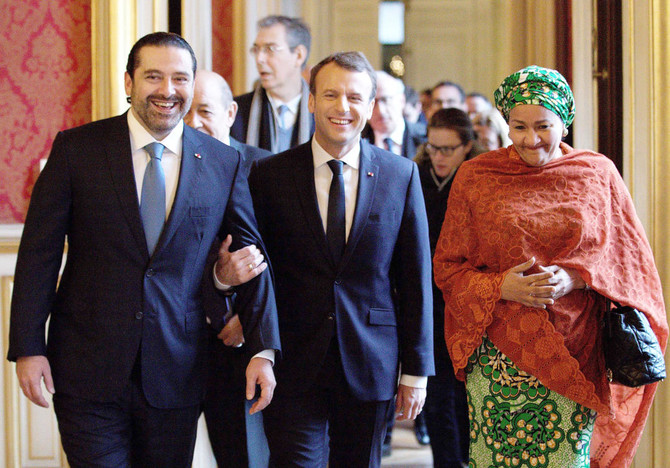
Hariri: We are keen to maintain good ties with all
Hariri: We are keen to maintain good ties with all


Latest updates


© 2026 SAUDI RESEARCH & PUBLISHING COMPANY, All Rights Reserved And subject to Terms of Use Agreement.