LONDON: We have heard many stories about boats loaded with Syrians fleeing the violence in their country in search of an unknown future in European countries. The trusted people smugglers did not tell them that, for many, they would not live to see their destinations and would instead drown at sea, scattered off the shores of Europe.
According to the International Organization for Migration (IOM), since 2014, more than 8,000 people died crossing the Mediterranean on their way to Europe. According to the data, more than 1,252 of them were unidentified men, women and children who were buried without tombstones.
Now, British artist Arabella Dorman, who is known as the “war artist,” is refusing to let their memories fade. Instead, she chose to immortalize their memory through her incredible artwork, which shakes onlookers to their very core.
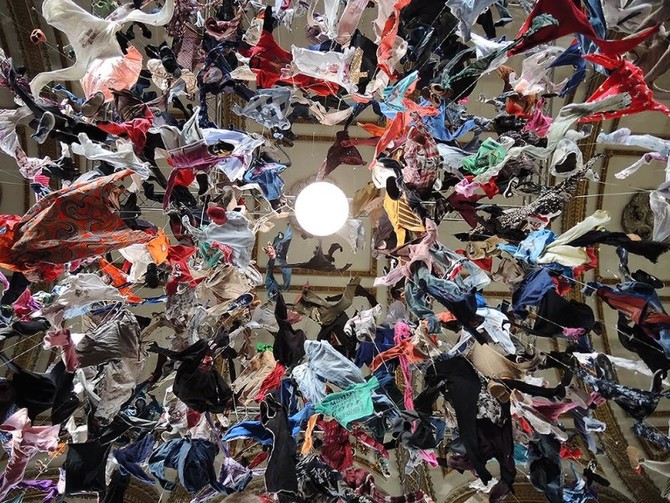
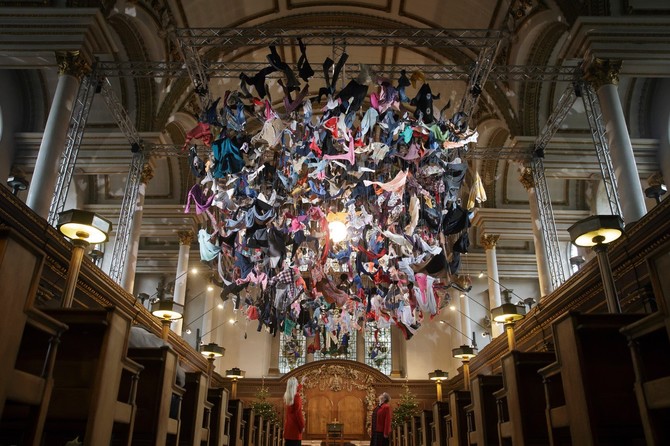
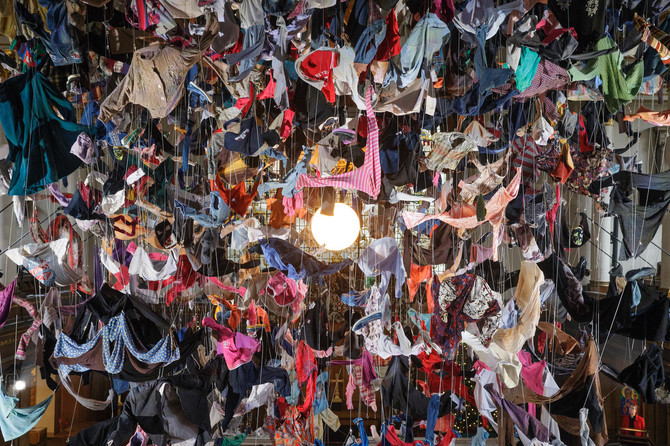
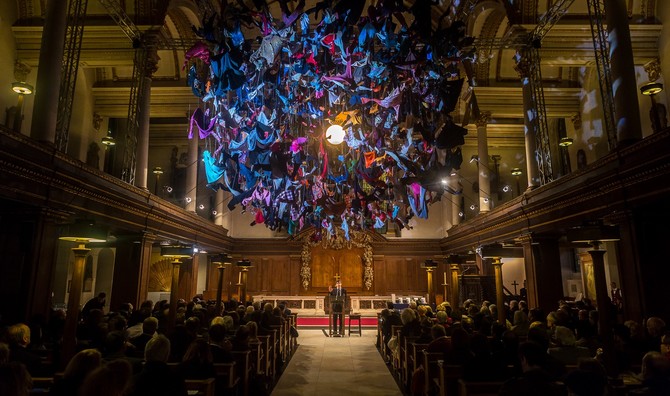
Dorman’s artwork, entitled “Suspended,” hangs from the ceiling of St. James’ Church in London. She expressed her feelings using pieces of clothing that belonged to Syrian refugees which had washed ashore.
In an interview with Asharq Al-Awsat newspaper, the artist said that she had visited many war-torn countries — such as Iraq, Afghanistan, and Palestine — and had met with people forgotten by humanity in a world clouded by mistrust and hatred.
“I have long been distressed by the tragedies I saw in those countries, in which I stayed for long periods of time to observe the suffering of innocent people, but my visit to Lesbos, Greece, during September and October 2014 has left me with a feeling I’ve never experienced before despite the tragedies I had seen in the past,” she said.
She added: “As I stood on the beach, which was covered with empty clothes, I felt an urge to rise up against this injustice. As a mother of two children, it pained me to see the empty clothes of little ones. No words can describe the pain that overwhelmed me.
“As an artist, I channel my emotions into paintings, but after I saw the wet clothes on the beach, which are the only remnants of these people, I decided to undertake a stronger project and turn these pieces of clothing into an artwork that reflects humanity in the world.”
The artwork is installed in the shape of a circle on the ceiling of St. James’ Church with a light source shining in the center. The light shines brightly then gradually dims until it goes out.
“The circular shape represents Earth and the changing light in the center represents hope and how it changes inside us humans,” Dorman explained. “When the light completely goes out, the darkness of the artwork reflects the dark, unfair human tragedy.”
When the artist first embarked on turning her idea into an actual work of art, she sought the help of the Starfish Foundation, a charity that helps refugees, as well as a remarkable number of volunteers. Dorman received around 1,400 pieces of clothing, from which she had chosen 800 and sent them to large laundries before she hired a company in the British Midlands to treat them so as to ensure they do not go up in flames in order to safely display them in public areas.
“Suspended” was hung in the churchyard in London on Dec. 11, and will remain there until Feb. 8. Dorman hopes that it can later be installed at Canterbury Cathedral in England, which will require the help and efforts of volunteers.
Twenty volunteers have helped Dorman install her work in St. James’ Church. She pointed out that the empty clothes are moving for many people, especially a baby’s shirt that says “my first birthday.”
“This shirt makes me shudder, especially as the baby was not aware that this was his first and last birthday,” she said.
St. James’ Church was chosen for displaying the artwork in December 2017 for three reasons. Rev. Lucy Winkett of St. James’ said: “Christmas can very easily be bankrupt of meaning, so as a church, we’re saying there’s no better time to talk about this big issue.”
The second reason is the need to shed light on the Syrian refugee crisis, while the third is the artwork’s contribution to raising donations for the Starfish Foundation to help refugees.
Dorman has been labelled a “war artist” because she worked with the British forces in southern Iraq in 2006, in Afghanistan between 2009 and 2014, in the islands of Greece in 2005 and in refugee camps in Calais and Dunkirk in 2015 and 2016.
She was listed as one of the BBC’s Top 100 Women in 2014 and as one of Salt Magazine’s 100 Most Inspiring Women in 2015.
* This article has been translated from Arabic and originally appeared in Asharq Al-Awsat on Jan. 24, 2018.


![]()
![]()
![]()
![]()
UK artist highlights refugee plight by using drowned Syrians’ clothes to raise charity
UK artist highlights refugee plight by using drowned Syrians’ clothes to raise charity

Latest updates


Recommended


© 2026 SAUDI RESEARCH & PUBLISHING COMPANY, All Rights Reserved And subject to Terms of Use Agreement.