IMF's Christine Lagarde calls for ‘urgent action’ to create jobs in Arab world

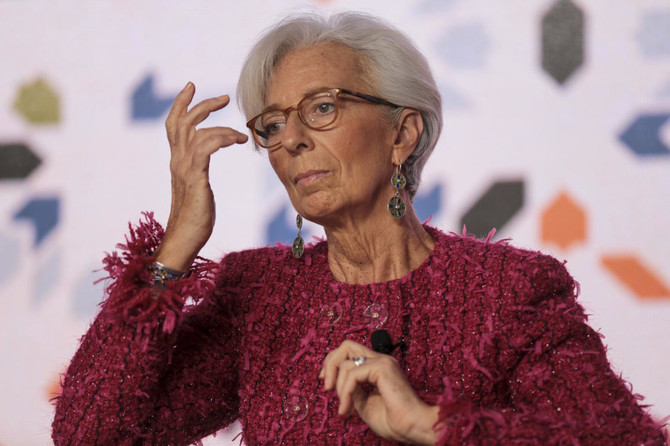
Christine Lagarde, Managing Director of International Monetary Fund IMF attends the opening session of the Opportunities For All economic conference in Marrakech, Morocco, Tuesday, Jan. 30, 2018. (AP)
Updated 30 January 2018
Follow

IMF's Christine Lagarde calls for ‘urgent action’ to create jobs in Arab world

LONDON: Arab countries need to do more to create private sector jobs and bolster inclusive growth amid growing youth unemployment and regional dissatisfaction, said Christine Lagarde, managing director of the International Monetary Fund (IMF), said on Tuesday.
Speaking at an IMF conference in Marrakesh, Morocco, she said 27 million young people would join the workforce in Arab countries in the next five years in a region that has the highest rate of youth unemployment in the world at 25 percent.
Although Arab states are progressing with reforms, they must move away from being “state employers” and focus on improving social safety nets, Lagarde said.
During the two-day conference on inclusive growth, Lagarde said the public dissatisfaction that is “bubbling up” in several countries is a reminder that even more ‘urgent action’ is needed.
In Tunisia, violent demonstrations broke out again this month as anger mounts over IMF-backed measures that include subsidy cuts and tax increases.
Chris Doyle, director of the Council for Arab-British Understanding (CABU), told Arab News: “Frustrations across the Arab world are growing.”
Doyle said: “The region must urgently deploy more resources to tackle youth unemployment and these resources must be deployed far more effectively.”
The director said Middle Eastern governments must take action to end its “many conflicts and crises” to unlock the region’s potential.
Doyle urged the region to look at redesigning its education system to ensure it provides the right skills for a twenty first century jobs market.
“The region needs to look at skilling up for the digital economy,” he said. “However, be under no illusion, it’s a massive challenge.”
The Cabu expert said that Egypt represents a particularly pressing challenge due to its central location and large and growing population.
“[Joblessness] will have an immediate impact on the country and it’s not rosy,” he warned.
“We may well witness more protests and discontent. Governments really should be really aware that [protests] represent genuine economic weaknesses and reflect the levels of corruption in the region.”
Wes Schwalje, COO of GCC research firm Tahseen Consulting, agreed that regional education systems are struggling to produce national workforces with the skills that meet “the needs of knowledge-based economic development and the Fourth Industrial Revolution.”
Schwalje told Arab News: ” A youthful, growing labor market can be beneficial to economic development if it is accompanied by job creation. Without job creation, the counterfactual is youth becoming unemployed, discouraged, or entering the informal economy.
“Discontent among youth is particularly significant since there is a strong link between youth bulges experiencing economic hardship and political violence. If the public sector is unable to create sufficient jobs for Arab youth, the only other option is private sector job creation.”
High levels of public sector employment in the Arab World have been criticized as “perpetuating low productivity, lack of economic diversification, and high public sector wage bills, Schwalje said.
The COO added: “Market reforms will need to reorient Arab youth toward private sector jobs… A number of Arab countries are piloting ambitious labor market reforms, such as unemployment benefits, minimum wages, fees on foreign workers, and increased mobility of foreign workers, but their success is far from certain.”


UNCTAD, Social Development Bank launch fellowship to power Saudi entrepreneurs

Updated 23 December 2025
Follow

UNCTAD, Social Development Bank launch fellowship to power Saudi entrepreneurs

RIYADH: The Social Development Bank has signed a memorandum of understanding with UN Trade and Development to launch the “Empretec Saudi Fellowship,” a new initiative aimed at equipping high-potential Saudi entrepreneurs with advanced training and tools to scale their ventures.

The agreement was signed on the sidelines of the second edition of the DeveGo 2025 forum, held on Dec. 21–22 at the King Abdulaziz International Conference Center in Riyadh. The event brought together entrepreneurs, policymakers, and representatives from regional and international organizations, alongside public and private sector leaders.

Featuring more than 150 exhibitors, 85 speakers, and 45 workshops, the forum focused on sharing local and global best practices and strengthening the Kingdom’s entrepreneurial ecosystem.

The Empretec Saudi Fellowship is part of UNCTAD’s flagship capacity-building program to promote entrepreneurship and support micro, small, and medium-sized enterprises and startups. Active in more than 40 countries, the program seeks to develop personal entrepreneurial behaviors through intensive training, access to international experts, and technical tools that help transform promising ideas into scalable, high-impact businesses.

Rebeca Grynspan, UNCTAD secretary-general, said Saudi Arabia offers fertile ground for entrepreneurial growth.

“Saudi Arabia has a wonderful platform to bring everybody up, and the entrepreneurs here are so eager. They have ideas, creativity, and energy,” she told Arab News. “If they come through our program with the Social Development Bank, which does a wonderful job, they will be more successful — because that’s what we want.”

In his opening remarks, Saudi Minister of Human Resources and Social Development Ahmed Al-Rajhi, who also chairs the SDB board, highlighted the rapid evolution of the Kingdom’s startup landscape.

“The Kingdom is witnessing a qualitative transformation in the entrepreneurship and freelance ecosystem, enabling young men and women to enter new promising sectors such as artificial intelligence, renewable energy, advanced technologies, and venture capital,” he said. “This provides broader opportunities to contribute to innovation, expansion, and global competitiveness.”

During a tour of the exhibition alongside Al-Rajhi, Grynspan met a wide range of small and medium-sized businesses and handicraft makers, praising the depth of local talent. She noted that participants spanned the full spectrum of enterprises — from early-stage ventures to more established and sophisticated companies — reflecting a rich diversity of experience.

Al-Rajhi said the Social Development Bank invests more than SR8 billion annually to support enterprises and entrepreneurs, helping raise employment in bank-financed businesses from about 12,000 in 2021 to more than 140,000 in 2025.

Beyond financing, the bank runs several non-financial programs, including the Jada 30 business communities, which have incubated more than 4,300 enterprises across 13 cities, and the Dulani Business Center, which has delivered over 67,000 consultations benefiting more than 150,000 male and female entrepreneurs.

Speaking on the broader economic outlook, Grynspan added: “This is a wonderful place to come. Now is an economy that is thriving, is a population that is hopeful. And you have these young, talented people that are only waiting for an opportunity to make it happen for everybody.”

During the forum, the bank also signed multiple cooperation agreements spanning key sectors such as finance, education, energy, healthcare, heritage, the nonprofit sector, and freelance work. The partnerships align with SDB’s strategy to build an integrated system of financial and non-financial empowerment tailored to the needs of entrepreneurs, startups, and micro-enterprises.