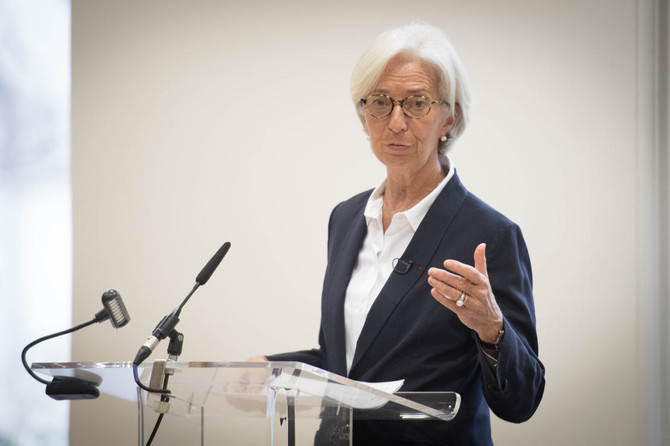
PARIS: International Monetary Fund Chief Christine Lagarde has urged France and other countries to push through reforms “while the sun is shining” on the global economy.
In an interview with France’s Le Journal du Dimanche published Sunday, Lagarde said the strength of the global economic recovery had taken the IMF by surprise.
“In 2017, for the first time in a long time, we revised our growth forecasts upwards whereas previously we used to lower them,” she said.
Global growth of 3.6 percent was both “stronger and more widely shared” in 2017, she said, noting that developed economies were now growing again under their own steam and no longer merely being pulled along by demand in emerging markets.
Lagarde said the favorable climate lent itself to implementing reforms.
“When the sun is shining you should take advantage to fix the roof,” she said, using one of her favorite maxims.
This year’s global growth is on a par with the average of the two decades leading up to the global financial crisis.
The IMF has forecast a further slight improvement in 2018, to 3.7 percent.
In Lagarde’s native France, seen for years as one of Europe’s weak links, the recovery kicked in in earnest this year.
From 1.1 percent in 2016, growth is expected to rise to 1.9 percent in 2017 — still short of the 2.4 percent forecast for the euro zone as a whole but better than the 1.6 percent initially forecast in the eurozone’s second-largest economy.
Centrist President Emmanuel Macron aims to consolidate the momentum and bring down stubbornly high unemployment with an ambitious program of labor, tax and welfare reforms.
Lagarde said the changes were key to boosting France’s credibility at a time when Macron is pushing for reforms at the European level, including closer integration among eurozone members.
The managing director of the IMF was France’s finance minister in 2008, when the euro looked to be in serious jeopardy.
Nearly 10 years later, the currency is out of the woods.
But, Lagarde warned, “the mission has not been accomplished — and maybe never will — because Europe is not united on moving toward greater integration while maintaining national sovereignty.”

Make reforms while sun shines on world economy: Lagarde
Saudi banks post 2.5% loan growth in Q3 as corporate credit leads: Alvarez & Marsal
RIYADH: Saudi Arabia’s 10 largest listed banks recorded a 2.5 percent increase in net loans and advances in the third quarter from the previous three months, underscoring sustained lending momentum in the Kingdom, a new analysis showed.
The growth was driven by corporate lending, which rose 3 percent during the period and accounted for roughly 59 percent of total loans, according to Alvarez & Marsal’s latest KSA Banking Pulse report.
This steady lending momentum aligns with the wider trend observed in the Gulf Cooperation Council region, where corporate lending continues to gain traction as economies diversify away from hydrocarbons.
In November, S&P Global Ratings said banks across the GCC are expected to maintain stable credit fundamentals in 2026, even as the region faces potential geopolitical and economic shocks.
The rating agency added that the sector’s outlook is supported by broadly steady profitability, solid capitalization, and resilient asset quality.
Commenting on the findings, Sam Gidoomal, managing director and head of Middle East Financial Services at Alvarez & Marsal, said: “Saudi banks continued to demonstrate operational resilience during the third quarter of 2025, supported by stable lending activity, disciplined cost management, and improving asset quality.”
Retail lending in the Kingdom increased by 1.7 percent quarter on quarter during the period, according to the report.
Deposit growth moderated to 2.2 percent, down from 2.7 percent in the second quarter.
“The deceleration in deposits was largely attributable to SNB, which recorded a 2.9 percent quarter on quarter decline, driven by a sharp 7.9 percent quarter on quarter contraction in time deposits,” the report stated.
Government-related entity deposits saw a marginal decline in the third quarter, with their share falling to 31.2 percent of total deposits.
Operating income among Saudi banks increased by 1.8 percent in the third quarter, moderating slightly from the 2 percent rise recorded over the previous three months.
Net interest income was broadly flat, edging up 0.1 percent quarter on quarter, while fee and commission income rose 3.8 percent during the same period.
Aggregate net income increased by 2.8 percent in the third quarter, compared with 3.4 percent growth in the previous three months.
“Despite margin compression, the sector’s strong capital position and consistent efficiency gains position banks well as they prepare for an evolving interest-rate environment in 2026,” added Gidoomal.
Net interest margins contracted by 7 basis points to 2.73 percent, reflecting continued pressure from rising funding costs, the report said.
Banks also demonstrated stronger cost discipline, with operating expenses declining 0.9 percent quarter on quarter, marking a third consecutive improvement in efficiency. The aggregate cost-to-income ratio fell 80 basis points to 28.7 percent in the third quarter.
Return on equity edged higher by 6 basis points to 15.5 percent, while return on assets remained steady at 2.1 percent, underscoring sustained sector resilience.
Asset quality strengthened further, with the non-performing loan ratio declining to 0.94 percent and the coverage ratio rising to 158.1 percent.
“Saudi banks are maintaining solid financial foundations despite periods of global market volatility,” said Quentin Mulet-Marquis, managing director, Financial Services at Alvarez & Marsal.
He added: “Strong earnings, low NPL rates, and comfortable capital buffers underpin investor confidence, while healthy valuation multiples and competitive dynamics continue to support growing appetite for mergers and acquisitions activity in the sector.”
The Saudi banks analyzed in the Alvarez & Marsal report are Saudi National Bank, Al Rajhi Bank, and Riyad Bank, as well as Saudi British Bank, and Banque Saudi Fransi.
Other banks covered include Arab National Bank, Alinma Bank, and Bank Albilad, alongside Saudi Investment Bank, and Bank Aljazira.
Earlier in December, a separate report by S&P Global said Saudi Arabia’s private credit market is set to expand rapidly as the Kingdom seeks to bridge funding gaps linked to its Vision 2030 transformation agenda.
The report noted that the Kingdom’s public and private sector debt — including bank lending, bond and sukuk issuance, and private capital financing — grew at a compound annual rate of 12 percent between 2021 and 2024.