IMF chief Christine Lagarde finds common cause with Donald Trump on protecting IP rights

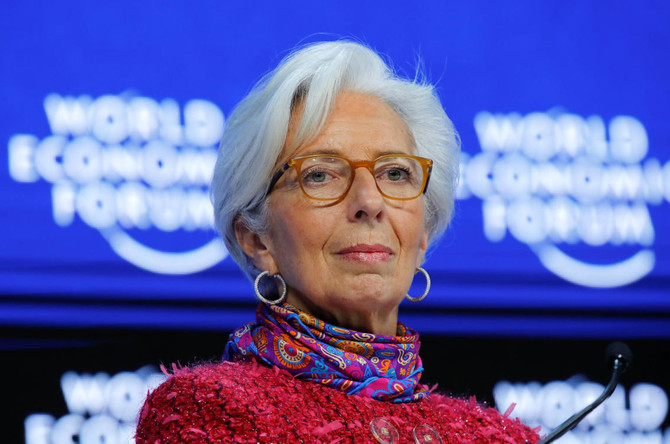
IMF chief Christine Legarde found common ground with US president Donald Trump on encouraging fair trade and protecting intellectual property rights. (AP)
Updated 27 January 2018
Follow

IMF chief Christine Lagarde finds common cause with Donald Trump on protecting IP rights

LONDON: International Monetary Fund (IMF) Managing Director Christine Lagarde found at least some common cause with US President Donald Trump on Friday in supporting the global fight against intellectual property (IP) theft.
Speaking on a panel at the World Economic Forum in Davos, Lagarde echoed a similar sentiment delivered by Trump earlier in the day, stating that he would not “tolerate” IP theft.
Lagarde also stressed that it was important to tackle “unfair” trade practices.
“We need to have more, better trade and fair trade, but for this we need international cooperation,” she said. “We need a reset, we need to look at IP rights, but it needs to be looked at in a cooperative way. The World Trade Organization is a forum where this should happen.”
The IMF expects global economic growth of about 3.9 percent this year and next year. “We are in a sweet spot and we should celebrate,” said Lagarde.
She said this was the result of good policies, but there were risks, including excessive inequalities and lack of international cooperation.
The IMF chief stressed that a lack of international cooperation could lead to “significant” geopolitical risks. She added that “lagging productivity” could be boosted with more investment into R&D to facilitate innovation.
“We need more trade not less,” she said. “And the fight against corruption is vital to give more hope and encourage our economies.”
Speaking on the same panel, Mark Carney, governor of the Bank of England, told the WEF audience that more investment relative to savings was leading to monetary “normalization.”“For central banks, there is a regime shift toward normalization,” he said.
Carney added: “UK banks have five times more capital than before the 2008 crisis and the Bank of England is confident it can withstand the shock of the hardest of hard Brexits.”


‘The future is renewables,’ Indian energy minister tells World Economic Forum

Updated 22 January 2026
Follow

‘The future is renewables,’ Indian energy minister tells World Economic Forum

  • ‘In India, I can very confidently say, affordability (of renewables) is better than fossil fuel energy,’ says Pralhad Venkatesh Joshi during panel discussion
  • Renewables are an increasingly important part of the energy mix and the technology is evolving rapidly, another expert says at session titled ‘Unstoppable March of Renewables?’

BEIRUT: “The future is renewables,” India’s minister of new and renewable energy told the World Economic Forum in Davos on Wednesday.
“In India, I can very confidently say, affordability (of renewables) is better than fossil fuel energy,” Pralhad Venkatesh Joshi said during a panel discussion titled “Unstoppable March of Renewables?”
The cost of solar power has has fallen steeply in recent years compared with fossil fuels, Joshi said, adding: “The unstoppable march of renewables is perfectly right, and the future is renewables.”
Indian authorities have launched a major initiative to install rooftop solar panels on 10 million homes, he said. As a result, people are not only saving money on their electricity bills, “they are also selling (electricity) and earning money.”
He said that this represents a “success story” in India in terms of affordability and “that is what we planned.”
He acknowledged that more work needs to be done to improve reliability and consistency of supplies, and plans were being made to address this, including improved storage.
The other panelists in the discussion, which was moderated by Godfrey Mutizwa, the chief editor of CNBC Africa, included Marco Arcelli, CEO of ACWA Power; Catherine MacGregor, CEO of electricity company ENGIE Group; and Pan Jian, co-chair of lithium-ion battery manufacturer Contemporary Amperex Technology.
Asked by the moderator whether she believes “renewables are unstoppable,” MacGregor said: “Yes. I think some of the numbers that we are now facing are just proof points in terms of their magnitude.
“In 2024, I think it was 600 gigawatts that were installed across the globe … in Europe, close to 50 percent of the energy was produced from renewables in 2024. That has tripled since 2004.”
Renewables are an increasingly important and prominent part of the energy mix, she added, and the technology is evolving rapidly.
“It’s not small projects; it’s the magnitude of projects that strikes me the most, the scale-up that we are able to deliver,” MacGregor said.
“We are just starting construction in the UAE, for example. In terms of solar size it’s 1.5 gigawatts, just pure solar technology. So when I see in the Middle East a round-the-clock project with just solar and battery, it’s coming within reach.
“The technology advance, the cost, the competitiveness, the size, the R&D, the technology behind it and the pace is very impressive, which makes me, indeed, really say (renewables) is real. It plays a key role in, obviously, the energy demand that we see growing in most of the countries.
“You know, we talk a lot about energy transition, but for a lot of regions now it is more about energy additions. And renewables are indeed the fastest to come to market, and also in terms of scale are really impressive.”
Mutizwa asked Pan: “Are we there yet, in terms of beginning to declare mission accomplished? Are renewables here to stay?”
“I think we are on the road but (its is) very promising,” Pan replied. There is “great potential for future growth,” he added, and “the technology is ready, despite the fact that there are still a lot of challenges to overcome … it is all engineering questions. And from our perspective, we have been putting in a lot of resources and we are confident all these engineering challenges will be tackled along the way.”
Responding to the same question, Arcelli said: “Yes, I think we are beyond there on power, but on other sectors we are way behind … I would argue today that the technology you install by default is renewables.
“Is it a universal truth nowadays that renewables are the cheapest?” asked Mutizwa.
“It’s the cheapest everywhere,” Arcelli said.