

From Riyadh to orbit: Saudi health tech firm pioneers AI medical care

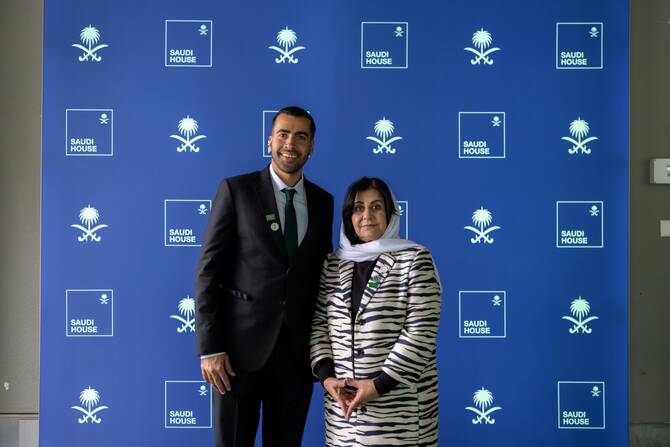
Selwa Al-Hazzaa, an ophthalmologist with 35 years of experience, and Naif Al-Obaidallah, her son and co-founder from a tech and investment background, announced at the World Economic Forum in Davos a partnership with Cornell University to study the eye microbiome in space. (Supplied/SDM)
Short Url
Updated 22 January 2026
Follow

From Riyadh to orbit: Saudi health tech firm pioneers AI medical care

  • Al-Obaidallah emphasized the early challenges of building a healthtech startup, but praised the ever-improving climate in Saudi Arabia

DAVOS: A Saudi health technology startup is breaking new ground in ophthalmology and artificial intelligence by studying eye diseases both on Earth and in space, start-up co-founders told Arab News on Tuesday.

Selwa Al-Hazzaa, an ophthalmologist with 35 years of experience, and Naif Al-Obaidallah, her son and co-founder from a tech and investment background, announced at the World Economic Forum in Davos a partnership with Cornell University to study the eye microbiome in space.

“Being an ophthalmologist for the last 35 years, there are many diseases, unfortunately, that there is no treatment for,” Al-Hazzaa said.

“We got this idea: why don’t we take samples of the eye, the microbiome, take them to space, and see how they mutate. Whatever solution we find in space will help astronauts — and it can also help patients here on Earth,” she added.

The project, entirely Saudi-led with support from the King Abdulaziz City for Science and Technology and the Saudi Space Agency, leverages simulation labs to test findings before deployment in orbit.

“We looked at many entities and found that Cornell University are very, very on top when it comes to space technology and the microbiome,” Al-Hazzaa added.

For the pair, this latest collaboration builds on years of innovation in AI healthcare solutions.

SDM’s SAARIA system automates retinal image analysis, enabling non-specialists to detect eye diseases. Other AI-driven tools it is pioneering streamline diagnostics for ophthalmology and mammography, among others.

“It’s going to augment physicians, not replace them,” Al-Hazzaa said. “We can now give doctors the patients who need surgery on a silver platter.”

Al-Obaidallah emphasized the early challenges of building a healthtech startup, but praised the ever-improving climate in Saudi Arabia.

“Being a startup in healthcare, it’s very hard to integrate AI due to regulations, patient data rules, and ethical frameworks,” he said. “We faced challenges, but every solution we create helps shape the industry for everyone.”

He continued: “If you go back a few years, there were very few startups. Now, thousands of companies are incubated across ministries, and Saudi Arabia ranks first in investment and unicorn creation in the region.”

Al-Hazzaa noted that the founders’ expertise, spanning medicine, cloud technology, security, and investment, has been pivotal.

“What brought us together was passion. We look at it as a service first, business second,” she said.

Their solutions are already reaching tens of thousands of underprivileged patients in Saudi Arabia.

“We started with diabetes because it’s a global pandemic,” Al-Hazzaa said. “Globally, only 55 percent of diabetics are examined; in the Gulf, only 24 percent. Using SAARIA, we’ve saved the sight of 40,000 patients — free of charge.”

Beyond diagnostics, SDM is moving into predictive healthcare, with plans to forecast conditions such as hypertension, stroke, Alzheimer’s, and 20 other diseases based on retinal scans.

The startup recently secured a grant from the Research Development Innovation Authority to expand this work.

The partnership with Cornell, combined with Saudi support for women in tech, is a source of pride for the pair.

“Despite all the obstacles, people in the beginning thought I was crazy,” Al-Hazzaa said.

“Today, as a Saudi woman in tech, I can say we’ve surpassed the G20 and Silicon Valley in female involvement, with 36 percent of our team women.”

Al-Obaidallah added that SDM’s success demonstrated the strength of the Kingdom’s digital transformation.

“We’re able to take technology, AI, and healthcare and make it accessible for everyone. Healthcare is not a privilege; it’s a right,” he said.


‘Stability can’t be bought’: Saudi ministers extol benefits of long-term reform in a fragmented world

Updated 56 min 54 sec ago
Follow

‘Stability can’t be bought’: Saudi ministers extol benefits of long-term reform in a fragmented world

  • They outline during discussion at the World Economic Forum in Davos the ways in which the Kingdom is capitalizing on stability as a competitive advantage
  • They highlight in particular the use of predictable policymaking, disciplined public finances, and long-term planning under Saudi Vision 2030

DAVOS: Stability is the crucial ingredient for long-term economic growth, especially in an increasingly fragmented global economy, Saudi ministers said on Thursday at the World Economic Forum in Davos.

It is not something that can be purchased or improvised, said Faisal Alibrahim, the minister of economy and planning, it must be developed patiently.

“You have to build it, accumulate it over time, for it to be the right kind of stability,” he said. “We treat it as a discipline,” he added.

Speaking during a panel discussion on the Saudi economy, Alibrahim and Finance Minister Mohammed Al-Jadaan outlined the ways in which the Kingdom has sought to capitalize on stability as a competitive advantage.

They highlighted in particular the use of predictable policymaking, disciplined public finances, and long-term planning under the Kingdom’s Vision 2030 plan for national development and diversification.

Al-Jadaan said governments and businesses alike are operating in a world where uncertainty has become the norm, which places a greater burden on policymakers to reduce ambiguity wherever possible.

“Businesses can price tariffs, they can price taxes,” he said. “What they find very difficult to price is ambiguity. We are trying to ensure that we build that resilience within our economy and give the private sector that predictability that they need.”

This focus on predictability, he added, has been central to Saudi Arabia’s economic transformation, by helping the private sector to plan for the long term while the government undertakes deep structural reform.

Alibrahim noted that trust has become a big factor in global trade and investment, particularly as geopolitical tensions and economic fragmentation intensify.

In a fragmenting world, one of the rarest things now is the idea that a “commitment made today will be honored tomorrow,” he said. Yet trust shapes how the world trades and how markets remain active, because it means participants can predict what will happen, he added. Stability therefore becomes a “rare currency, and even a competitive edge.”

He also said that reform on paper was not enough; it must be coupled with streamlined regulation and continuous engagement, so that businesses can develop long-term thinking and navigate uncertainty with more confidence.

Al-Jadaan framed Saudi Vision 2030 as a multiphase journey that began with structural reforms, followed by an execution-heavy phase, and is now entering a third stage focused on the maximization of impact.

He said the Kingdom was in a phase of “learning, reprioritizing and staying the course,” would make bold decisions, and had the “courage to continue through difficulties.” A key anchor of all this, he added, was discipline in relation to public finance.

“You cannot compromise public finance for the sake of growth,” Al-Jadaan said. “If you spend without restraint, you lose your anchor while the economy is still diversifying.”

This discipline underpins what he described as Saudi Arabia’s “deficit by design” — in other words, borrowing strategically to fund capital expenditure that supports long-term growth, rather than consumption.

“If you borrow to spend on growth-enhancing investment, you are safe,” he said. “If you borrow to consume today, you are leaving the burden to your children.”

Alibrahim said the focus in the next phase of Vision 2030 will be on the optimal deployment of capital, ensuring the momentum continues while costs are tightly managed.

Looking ahead, both ministers emphasized the importance of long-term planning, which can be a challenge for some countries constrained by short election cycles.

“If you cannot take a long-term view in a turbulent world, it becomes very difficult,” Al-Jadaan said.

“Success stories like Singapore, South Korea and China were built on decades-long plans, pursued through good times and bad.”

The ministers’ discussion points were echoed by international participants. Noubar Afeyan, founder and CEO of life sciences venture capital firm Flagship Pioneering, said that by utilizing technology, including artificial intelligence, alongside a strategic vision in the form of Vision 2030, the Kingdom had been able to turn vulnerabilities into strengths, becoming not only self-sufficient but a potential exporter of innovation and intellectual property.

“Uncertainty opens up opportunities for countries that might otherwise be overlooked,” he added.

“Saudi Arabia, with Vision 2030, is positioning itself to not only address its own challenges but also become a net exporter of innovation and expertise.”

Ajay Banga, the president of the World Bank, said Vision 2030 had helped create “physical and human infrastructure” that allows Saudi Arabia to capitalize on its demographic dividend.

Jennifer Johnson, CEO of investment management firm Franklin Templeton, said Saudi policymakers stood out for their openness and curiosity.

“I have spoken to Saudi ministers and they ask what they need to do — that doesn’t happen often,” she said.