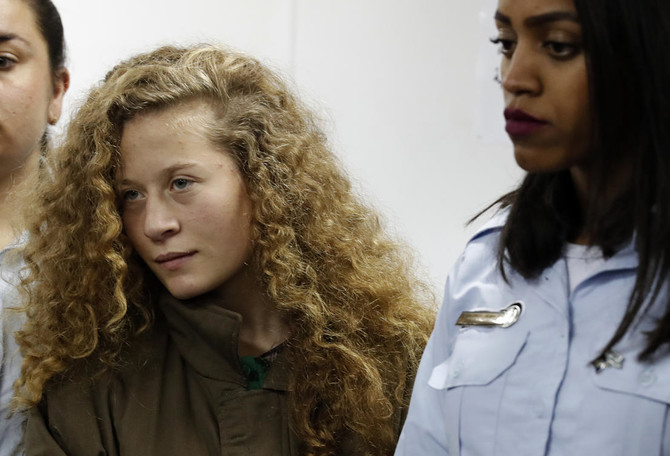
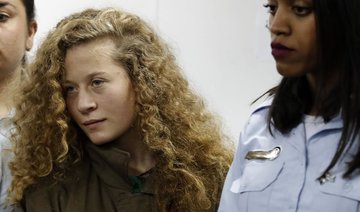
JERUSALEM: The start of a military trial for a Palestinian teenager charged after a viral video showed her hitting two Israeli soldiers has been delayed until February 6, her lawyer said Tuesday.
The trial of Ahed Tamimi, 16, had been due to begin on Wednesday. Her mother Nariman will also go on trial on February 6, their lawyer Gaby Lasky told AFP.
The Israeli military confirmed the date had been changed to February 6, adding it was postponed at Lasky’s request.
Both Ahed Tamimi and her mother have been ordered to be held in custody throughout their trial.
Ahed Tamimi’s cousin Nour Tamimi, 20, has also been charged in connection with the case, but was freed on bail on January 5. Her next court appearance has been set for February 12, Lasky said.
The UN Office of the High Commissioner for Human Rights has criticized Israeli authorities’ actions in the case, while the European Union has expressed concern over Israel’s detention of minors, including Ahed Tamimi.
Ahed Tamimi has been hailed as a hero by Palestinians who see her as bravely standing up to Israel’s occupation of the West Bank.
Israelis accuse her family of using her as a pawn in staged provocations.
She has been charged with 12 counts including assault and could face a lengthy jail term if convicted.
The charges relate to events in the video and five other incidents. They include stone-throwing, incitement and making threats.
Ahed Tamimi’s family says the December 15 incident that led to the arrests occurred in the yard of their home in Nabi Saleh, near Ramallah in the West Bank.
Israel’s military said the soldiers were in the area to prevent Palestinians from throwing stones at Israeli motorists.
A video shows the cousins approaching two soldiers and telling them to leave before shoving, kicking and slapping them.
Ahed Tamimi is the most aggressive of the two in the video.
The heavily armed soldiers do not respond to what appears to be an attempt to provoke rather than seriously harm them.
They then move backwards after Nariman Tamimi becomes involved.
The scuffle took place amid clashes and protests against US President Donald Trump’s controversial recognition of Jerusalem as Israel’s capital.
Relatives say that a member of the Tamimi family was wounded in the head by a rubber bullet fired during those protests.
Eighteen Palestinians have been killed since Trump’s declaration on December 6, most of them in clashes with Israeli forces. One Israeli has been shot dead since then.
Ahed Tamimi has been involved in a series of previous incidents, with older pictures of her confronting soldiers widely published.
She has become something of an icon for Palestinians who have flooded social media with praise and support.

Trial delayed for Palestinian teen in viral ‘slap video’
Washington presses Syria to shift from Chinese telecom systems
- Syria is exploring the possibility of procuring Chinese technology
- It was unclear whether the United States pledged financial or logistical support to Syria to do so
DAMASCUS: The United States has warned Syria against relying on Chinese technology in its telecommunications sector, arguing it conflicts with US interests and threatens US national security, according to three sources familiar with the matter.
The message was conveyed during an unreported meeting between a US State Department team and Syrian Communications Minister Abdulsalam Haykal in San Francisco on Tuesday. Washington has been coordinating closely with Damascus since 2024, when Syria’s now President Ahmed Al-Sharaa ousted longtime leader Bashar Assad, who had a strategic partnership with China.
Syria is exploring the possibility of procuring Chinese technology to support its telecommunications towers and the infrastructure of local Internet service providers, according to a Syrian businessman involved in the procurement talks.
“The US side asked for clarity on the ministry’s plans regarding Chinese telecom equipment,” said another source briefed on the talks.
But Syrian officials said infrastructure development projects were time-critical and that Damascus was seeking greater vendor diversity, the source added.
SYRIAN OFFICIALS CITE US EXPORT CONTROLS AS TELECOMS BARRIER
Syria is open to partnering with US firms but the matter was urgent and export controls and “over-compliance” remained an issue, according to person familiar with the meeting in San Francisco.
A US diplomat familiar with the discussions told Reuters that the US State Department “clearly urged Syrians to use American technology or technology from allied countries in the telecoms sector.”
It was unclear whether the United States pledged financial or logistical support to Syria to do so.
Responding to Reuters questions, a US State Department spokesperson said: “We urge countries to prioritize national security and privacy over lower-priced equipment and services in all critical infrastructure procurement. If it seems too good to be true, it probably is.”
The spokesperson added that Chinese intelligence and security services “can legally compel Chinese citizens and companies to share sensitive data or grant unauthorized access to their customers’ systems” and promises by Chinese companies to protect customers’ privacy were “entirely inconsistent with China’s own laws and well-established practices.”
China has repeatedly rejected allegations of it using technology for spying purposes.
The Syrian Ministry of telecommunications told Reuters any decisions related to equipment and infrastructure are made “in accordance with national technical and security standards, ensuring data protection and service continuity.”
The ministry said it is also prioritizing the diversification of partnerships and technology sources to serve the national interest.
Syria’s telecom infrastructure has relied heavily on Chinese technology due to US sanctions imposed on successive Assad governments over the civil war that grew from a crackdown on anti-government protests in 2011.
Huawei technology accounts for more than 50 percent of the infrastructure of Syriatel and MTN, the country’s only telecom operators, according to a senior source at one of the companies and documents reviewed by Reuters. Huawei did not immediately respond to a request for comment.
Syria is seeking to develop its private telecommunications sector, devastated by 14 years of war, by attracting foreign investment.
In early February, Saudi Arabia’s largest telecom operator, STC, announced it would invest $800 million to “strengthen telecommunications infrastructure and connect Syria regionally and internationally through a fiber-optic network extending over 4,500 kilometers.”
The ministry of telecommunications says that US restrictions “hinder the availability of many American technologies and services in the Syrian market,” emphasizing that it welcomes expanding cooperation with US companies when these restrictions are lifted.
Syria has inadequate telecommunications infrastructure, with network coverage weak outside city centers and connection speeds in many areas barely exceeding a few kilobits per second.