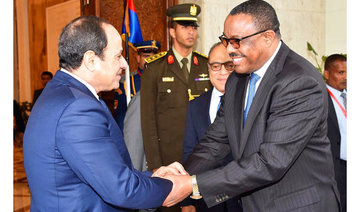
ADDIS ABABA: The leaders of Ethiopia, Egypt and Sudan met in Addis Ababa Monday to discuss contentious issues related to the dam that Ethiopia is building on the Nile River.
Ethiopian Prime Minister Hailemariam Desalegn, Egyptian President Abdel-Fattah el-Sisi and Sudanese President Omar Al-Bashir met on the sidelines of the African Union summit. The meeting comes after the Ethiopian and Egyptian leaders met less than two weeks ago in Cairo.
“The leaders have instructed their foreign ministers and other relevant ministries to deliberate on outstanding issues and report to the head of states within one month,” said the Ethiopian Foreign Ministry, adding the three leaders have agreed to meet again in a year. The leaders agreed to create a three-nation infrastructure fund to encourage cooperation.
Egypt fears the $4.8 billion dam could reduce its share of the Nile River waters while Ethiopia asserts it needs the dam for its development. Ethiopia is seeking to assure Cairo the dam on the border with Sudan will not significantly harm it. It appears the main issue is how quickly the reservoir behind the dam will be filled and if the filling will cause Egypt to get less Nile water.
The dam is designed to generate 6,400 megawatts, which is expected to more than double Ethiopia’s current production of 4,000 megawatts, is now 63 percent completed and this East African nation hopes to become an energy hub in Africa upon its completion.
While Ethiopia has said the dam is a “matter of life or death” for its people, Egypt has said water is a “matter of life or death” for its people.

Ethiopia, Egypt and Sudan leaders discuss Nile dam impasse
Police target Ukrainians and Russian in ransomware probe
BERLIN: Police have carried out raids against two members of a ransomware group known as “Black Basta” in Ukraine, and issued an arrest warrant for its Russian head, German prosecutors said Thursday.
The group is accused of using malware to encrypt systems and then demanding money to restore them.
Between March 2022 and February 2025, its members extorted hundreds of millions of euros from around 600 companies and public institutions around the world, the prosecutors said in a statement.
The victims were mainly “companies in Western industrialized nations” but also included hospitals and other public institutions.
As part of a coordinated operation between Germany, the Netherlands, Switzerland, Ukraine and Britain, police searched the homes of two Ukrainian suspects and seized evidence, the prosecutors said.
Investigators have also identified and issued an arrest warrant for a Russian citizen accused of being the founder and head of the group, they said.
German police named the suspect as Oleg Evgenievich Nefedov, 35.
Nefedov “decided on targets, recruited employees, assigned them tasks, participated in ransom negotiations, managed the proceeds and used them to pay the members of the group,” the police said.
The searches in Ivano-Frankivsk and Lviv were directed against suspected members of the group accused of so-called hash cracking, a method of guessing passwords.
Ukrainian officials also searched the home of another member of the group near Kharkiv in August, whose job was allegedly to help ensure the malware was not detected by antivirus programs.
Black Basta extorted some 20 million euros ($23 million) from around 100 companies and institutions in Germany alone, the prosecutors said.
The group is accused of using malware to encrypt systems and then demanding money to restore them.
Between March 2022 and February 2025, its members extorted hundreds of millions of euros from around 600 companies and public institutions around the world, the prosecutors said in a statement.
The victims were mainly “companies in Western industrialized nations” but also included hospitals and other public institutions.
As part of a coordinated operation between Germany, the Netherlands, Switzerland, Ukraine and Britain, police searched the homes of two Ukrainian suspects and seized evidence, the prosecutors said.
Investigators have also identified and issued an arrest warrant for a Russian citizen accused of being the founder and head of the group, they said.
German police named the suspect as Oleg Evgenievich Nefedov, 35.
Nefedov “decided on targets, recruited employees, assigned them tasks, participated in ransom negotiations, managed the proceeds and used them to pay the members of the group,” the police said.
The searches in Ivano-Frankivsk and Lviv were directed against suspected members of the group accused of so-called hash cracking, a method of guessing passwords.
Ukrainian officials also searched the home of another member of the group near Kharkiv in August, whose job was allegedly to help ensure the malware was not detected by antivirus programs.
Black Basta extorted some 20 million euros ($23 million) from around 100 companies and institutions in Germany alone, the prosecutors said.
© 2026 SAUDI RESEARCH & PUBLISHING COMPANY, All Rights Reserved And subject to Terms of Use Agreement.