CAIRO: Egypt’s president on Thursday expressed his “extreme concern” to Ethiopia’s visiting prime minister over the lack of progress in talks on the impact of a massive upstream dam that Egypt fears could cut into its vital share of the Nile.
President Abdel Fattah El-Sisi has warned that Egypt’s share of the Nile, which provides nearly all its freshwater, is a red line. But he has also sought to reassure Ethiopia and Sudan that Egypt has no intention of going to war.
El-Sisi was grim-faced during most of a news conference he jointly addressed with Prime Minister Hailemariam Desalegn after the two held talks in Cairo.
El-Sisi said he appreciated Ethiopia’s repeated assurances that the dam, which is about 60 percent complete, would not have a negative impact on Egypt, but he said studies must still be completed and that all sides should abide by their findings.
Egypt is a mostly desert country that depends on the Nile for almost all of its water needs. Its 95 million people grow by at least a million every year, further straining its water resources and posing a perpetual challenge to its economic development.
“I expressed our extreme concern over the continuation of the state of stagnation besetting the tripartite technical track,” which is aimed at examining the impact of the dam on Egypt and Sudan, El-Sisi said.
He said cooperation among the Nile basin countries must not be a “zero-sum game.”
Relations have deteriorated between Egypt and Sudan, with Cairo accusing Khartoum of siding with Ethiopia in the dispute over the dam and reviving a long-standing border dispute.
Of special concern to Egypt is the speed at which a planned reservoir is filled behind the dam and the method of its annual replenishment. Egypt fears that a quick fill would drastically reduce the Nile’s flow, with potentially severe effects on its agriculture and other sectors.
Ethiopia says the $5 billion dam is essential, noting that the vast majority of its population lacks electricity. The dam will generate over 6,400 megawatts, a massive boost to the country’s current production of 4,000 Megawatts.
Egypt recently proposed that World Bank experts be brought in as neutral arbitrators. El-Sisi said Sudan and Ethiopia are still studying the proposal, but that Desalegn wanted a different team of experts.


![]()
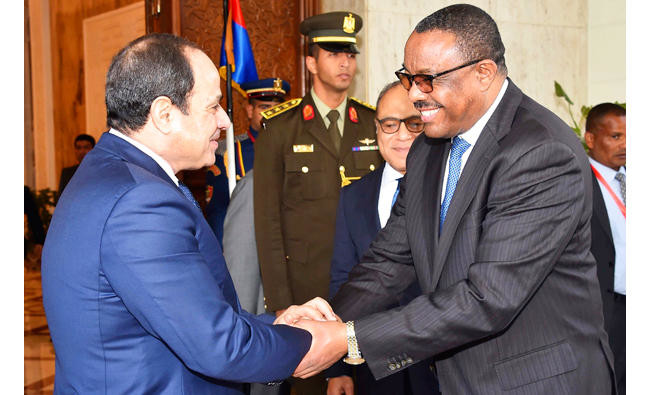
El-Sisi shows ‘extreme concern’ over Nile dam to Ethiopian PM
El-Sisi shows ‘extreme concern’ over Nile dam to Ethiopian PM
Latest updates


© 2026 SAUDI RESEARCH & PUBLISHING COMPANY, All Rights Reserved And subject to Terms of Use Agreement.