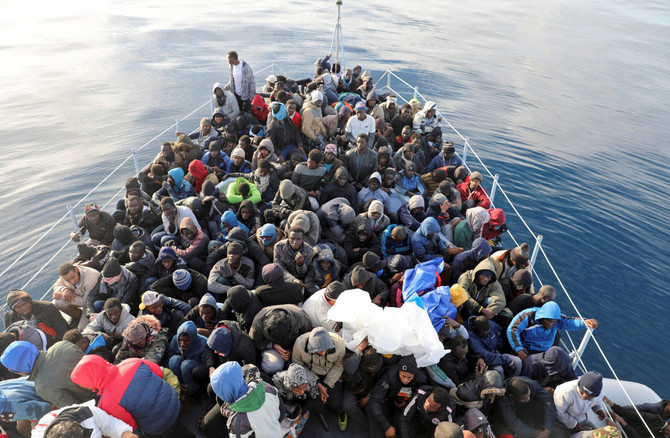
ROME: The Italian coast guard says it has helped coordinate the rescue of some 800 migrants on the Mediterranean Sea.
The coast guard said they were spotted in five boats, including two rubber dinghies, on Saturday.
It said seven children who had water in their lungs were taken by helicopter to the nearest hospital that could treat them, located in Sfax, Tunisia. The coast guard also said two bodies were recovered.
Hundreds of thousands of migrants have been rescued at sea in recent years and taken to ports in southern Italy. Some are seeking refuge from armed conflicts, while many others, particularly from sub-Saharan Africa, are economic migrants likely to be found ineligible for asylum in Europe.
Human traffickers launch overcrowded, unseaworthy boats from Libya and other countries with Mediterranean coastlines.

Italy: 800 migrants rescued, 2 bodies found in Mediterranean
Germany’s leader calls on US and Europe to ‘repair trans-Atlantic trust’
- German Chancellor said Europe and US should conclude that 'we are stronger together'
- Merz acknowledges rift in trans-Atlantic relations over the past year as he opens Munich Security Conference
MUNICH: German Chancellor Friedrich Merz called on Friday for the United States and Europe to “repair and revive trans-Atlantic trust together,” arguing that even the US isn’t powerful enough to go it alone in an increasingly tough world.
Merz called for a “new trans-Atlantic partnership,” acknowledging that “a divide, a deep rift” has opened up across the Atlantic as he opened the Munich Security Conference, an annual gathering of top global security figures including many European leaders and US Secretary of State Marco Rubio.
At last year’s conference, held a few weeks into US President Donald Trump’s second term, Vice President JD Vance stunned European leaders by lecturing them about the state of democracy and freedom of speech on the continent — a moment that set the tone for the last year.
A series of statements and moves from the Trump administration targeting allies followed, including Trump’s threat last month to impose new tariffs on several European countries in a bid to secure US control of Greenland, a semiautonomous territory of NATO ally Denmark. The president later dropped that threat.
‘Stronger together’
“The culture war of the MAGA movement in the US is not ours,” Merz said. “The freedom of the word ends here when this word is turned against human dignity and the constitution. And we don’t believe in tariffs and protectionism, but in free trade.”
He added that Europe would stand by climate agreements and the World Health Organization “because we are convinced that we will only solve global tasks together.”
But Merz said Europe and the US should conclude that “we are stronger together” in today’s world. He argued that the post-World War II world order “as imperfect as it was at its best times, no longer exists” today.
“In the era of great-power rivalry, even the United States will not be powerful enough to go it alone,” he said. “Dear friends, being a part of NATO is not only Europe’s competitive advantage. It’s also the United States’ competitive advantage, so let’s repair and revive trans-Atlantic trust together.”
The Europeans, Merz said, are doing their part.
A ‘shift in mindset’ in Europe
Since last year’s Munich conference, NATO allies have agreed under pressure from Trump to a large increase in their defense spending target.
NATO Secretary-General Mark Rutte said there has been a “shift in mindset,” with “Europe really stepping up, Europe taking more of a leadership role within NATO, Europe also taking more care of its own defense.”
With Rubio heading the US delegation this year, European leaders can hope for a less contentious approach more focused on traditional global security concerns.
Speaking as he introduced Merz, conference chairman Wolfgang Ischinger asked: “does the Trump administration truly believe that it needs allies and partners and if so ... is Washington actually prepared to treat allies as partners?”
Before departing for Germany on Thursday, Rubio had some reassuring words as he described Europe as important for Americans.
“We’re very tightly linked together with Europe,” he told reporters. “Most people in this country can trace both, either their cultural or their personal heritage, back to Europe. So, we just have to talk about that.”
But Rubio made clear it wouldn’t be business as it used to be, saying: “We live in a new era in geopolitics, and it’s going to require all of us to reexamine what that looks like.”
Mike Waltz, the US ambassador to the United Nations, told the conference that the US had been sustaining the financial burden of multilateralism for too long and Europeans need to do more.
“There is a cost to the status quo and the status quo was not sustainable any more,” Waltz said.
Merz said that Europe’s “excessive dependency” on the US was its own fault, but it is leaving that behind. “We won’t do this by writing off NATO — we will do it by building a strong, self-supporting European pillar in the alliance, in our own interest,” he said.
He acknowledged that Europe and the US will likely have to bridge more disagreements in the future than in the past, but “if we do this with new strength, respect and self-respect, that is to the advantage of both sides.”
Rubio arrived in Munich on Friday. He met Merz and Chinese Foreign Minister Wang Yi separately on the sidelines of the conference, and also had a meeting scheduled with Danish Prime Minister Mette Frederiksen and Greenlandic Prime Minister Jens-Frederik Nielsen. He is due to address the conference on Saturday morning.
Merz called for a “new trans-Atlantic partnership,” acknowledging that “a divide, a deep rift” has opened up across the Atlantic as he opened the Munich Security Conference, an annual gathering of top global security figures including many European leaders and US Secretary of State Marco Rubio.
At last year’s conference, held a few weeks into US President Donald Trump’s second term, Vice President JD Vance stunned European leaders by lecturing them about the state of democracy and freedom of speech on the continent — a moment that set the tone for the last year.
A series of statements and moves from the Trump administration targeting allies followed, including Trump’s threat last month to impose new tariffs on several European countries in a bid to secure US control of Greenland, a semiautonomous territory of NATO ally Denmark. The president later dropped that threat.
‘Stronger together’
“The culture war of the MAGA movement in the US is not ours,” Merz said. “The freedom of the word ends here when this word is turned against human dignity and the constitution. And we don’t believe in tariffs and protectionism, but in free trade.”
He added that Europe would stand by climate agreements and the World Health Organization “because we are convinced that we will only solve global tasks together.”
But Merz said Europe and the US should conclude that “we are stronger together” in today’s world. He argued that the post-World War II world order “as imperfect as it was at its best times, no longer exists” today.
“In the era of great-power rivalry, even the United States will not be powerful enough to go it alone,” he said. “Dear friends, being a part of NATO is not only Europe’s competitive advantage. It’s also the United States’ competitive advantage, so let’s repair and revive trans-Atlantic trust together.”
The Europeans, Merz said, are doing their part.
A ‘shift in mindset’ in Europe
Since last year’s Munich conference, NATO allies have agreed under pressure from Trump to a large increase in their defense spending target.
NATO Secretary-General Mark Rutte said there has been a “shift in mindset,” with “Europe really stepping up, Europe taking more of a leadership role within NATO, Europe also taking more care of its own defense.”
With Rubio heading the US delegation this year, European leaders can hope for a less contentious approach more focused on traditional global security concerns.
Speaking as he introduced Merz, conference chairman Wolfgang Ischinger asked: “does the Trump administration truly believe that it needs allies and partners and if so ... is Washington actually prepared to treat allies as partners?”
Before departing for Germany on Thursday, Rubio had some reassuring words as he described Europe as important for Americans.
“We’re very tightly linked together with Europe,” he told reporters. “Most people in this country can trace both, either their cultural or their personal heritage, back to Europe. So, we just have to talk about that.”
But Rubio made clear it wouldn’t be business as it used to be, saying: “We live in a new era in geopolitics, and it’s going to require all of us to reexamine what that looks like.”
Mike Waltz, the US ambassador to the United Nations, told the conference that the US had been sustaining the financial burden of multilateralism for too long and Europeans need to do more.
“There is a cost to the status quo and the status quo was not sustainable any more,” Waltz said.
Merz said that Europe’s “excessive dependency” on the US was its own fault, but it is leaving that behind. “We won’t do this by writing off NATO — we will do it by building a strong, self-supporting European pillar in the alliance, in our own interest,” he said.
He acknowledged that Europe and the US will likely have to bridge more disagreements in the future than in the past, but “if we do this with new strength, respect and self-respect, that is to the advantage of both sides.”
Rubio arrived in Munich on Friday. He met Merz and Chinese Foreign Minister Wang Yi separately on the sidelines of the conference, and also had a meeting scheduled with Danish Prime Minister Mette Frederiksen and Greenlandic Prime Minister Jens-Frederik Nielsen. He is due to address the conference on Saturday morning.
© 2026 SAUDI RESEARCH & PUBLISHING COMPANY, All Rights Reserved And subject to Terms of Use Agreement.