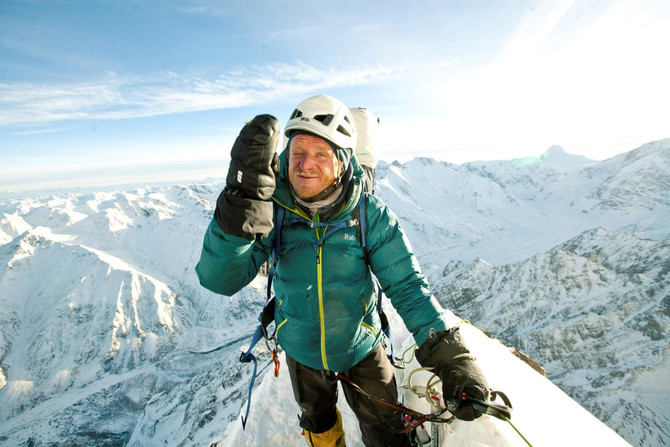
ISLAMABAD: Elite Polish climbers were on Saturday ascending Pakistan’s treacherous “Killer Mountain” in the dark to save a French woman mountaineer and a fellow Pole, officials said, hoping the daring effort could see them reach the French climber on Sunday.
Military helicopters buzzing over the 8,126 meter (26,660 feet) Nanga Parbat mountain spotted Elisabeth Revol of France at about 6,700m mark during daylight hours, a Pakistani official said, but were unable to communicate with Tomasz Mackiewicz from Poland, who is believed to be in a crevasse.
After abandoning their ascent at about 7,400m on Pakistan’s second highest mountain, Revol on Friday helped Mackiewicz, who is suffering from frostbite and snow blindness, come down to 7,280 meters and set him up in a tent to spend the night, before descending and calling for help on a satellite phone.
The race against time effort will continue into the night after Pakistan’s military picked up several Polish climbers attempting the first winter ascent of nearby K2, the world’s second-highest mountain, and flew them to Nanga Parbat on Saturday to lead the rescue.
Brig. Shahid Sardar, a representative of military-owned Askari Aviation, told Reuters that Revol was spotted near Nanga Parbat’s Base Camp 2, while the Polish rescue team had been dropped off at Base Camp 1.
“We are hoping they will reach the French lady by tomorrow, but there is no contact with the Polish climber. It is a very complex rescue operation,” Sardar said.
“We should know by mid-day tomorrow.”
Masha Gordon, who is coordinating a crowdfunding campaign to finance the helicopter rescue, said Polish climbers — including elite mountaineers Adam Bielicki and Denis Urubko — were dropped off at Base Camp 1 at 4,800m and had begun their ascent.
“They have a tracker on them and have last been seen at 5,225m. They will continue climbing up through the night,” Gordon posted on the GoFundMe rescue page, which showed 74,000 euros ($92,000) had been raised by Saturday.
The campaign is aiming to raise 100,000 euros, while the Polish government said it would provide financial guarantees and support for the operation.
Revol knows Mackiewicz’s location high up on Nanga Parbat, where in winter perceived temperatures can reach minus 60 degrees Celsius.
“Elisabeth took a decision to start a descent down from 6,700m toward them provided she can find fixed ropes,” Gordon added. “She has no battery power left. We believe in the strength of her spirit.”
Pakistan’s military said two Pakistan Army helicopters carrying four rescuers were undertaking the mission.
Pakistan rivals Nepal for the number of peaks over 7,000 meters (23,000 feet) and is considered climbers’ paradise, but fatalities are also common.
Nanga Parbat obtained its “Killer Mountain” moniker due to the high number of lives it has claimed over the years. In June a Spanish man and an Argentinian perished in an avalanche while trying to scale its peak.
The first successful winter ascent of the mountain was made as recently as February 2016. Mackiewicz has made six previous attempts to scale Nanga Parbat in winter.

Polish climbers ascend Pakistan’s “Killer Mountain” to rescue French woman, Pole
Gaza student evacuated to UK with her family after government climbdown
- Manar Al-Houbi was initially denied permission to bring her husband and children after changes to UK rules on foreign scholarship recipients
- Several students still stranded in Gaza as relocation deadline looms, after refusing to abandon family members
LONDON: A student from Gaza granted permission to live and study in the UK has been evacuated from the Palestinian territory, with her family, by the British government.
Manar Al-Houbi won a full scholarship to study for a doctorate at the University of Glasgow. It also allowed her to bring her husband and children with her, and they applied for the required visas. But shortly before her studies were due to start, UK authorities told her the rules for international students and their dependents had changed and her family could no longer accompany her.
Shortly after her story was reported in October, however, the government backed down as said it would consider evacuation of international students’ dependents on a “case-by-case basis.”
Al-Houbi and her family are now in Jordan, on their way to the UK, The Guardian newspaper reported on Friday. The British scheme for the evacuation of students from Gaza is due to expire on Dec. 31. People who have attempted to use it have described it as being riddled with issues, as a result of which some students with scholarships have been left stranded in the Palestinian territory.
Several told the Guardian they had decided not to travel to the UK because they had felt pressured into leaving loved ones behind, including children.
Wahhaj Mohammed, 32, said he was told by the Foreign, Commonwealth and Development Office to travel to the UK alone, and his wife and children would be allowed to join him later. Two months after he arrived in Glasgow, his family are still in Gaza with no time frame for them to follow him.
“The uncertainty affects every aspect of my life here,” he told The Guardian. “It’s difficult to settle, to feel present or to engage academically when the people you love most remain living under constant threat.”
The Guardian said UK officials were “hopeful” his family would be evacuated in 2026 but could offer no guarantee about when this might happen.
Another student, Amany Shaher, said she refused to leave her family behind in Gaza and as a result was denied permission to travel to the UK this week. She does not know whether she will be permitted to defer her scholarship to study at the University of Bristol.
The 34-year-old, who has three children, said: “How can I even consider leaving my children behind in Gaza? Nowhere else in the world would a mother be expected to part so easily from her children. It’s dehumanizing. We have a right to stick together as a family and not be forced to separate — that should not be too much to ask.
“None of us know if the UK’s student evacuation scheme will be extended or not. We haven’t been given any clear guidance or timelines and have no idea what 2026 will bring.”
Mohammed Aldalou also refused to leave behind his family, including his 5-year-old autistic and non-verbal son, to take up a scholarship for postgraduate studies at the London School of Economics.
He said the Foreign Office had suggested to him he travel separately from them, as they did with Mohammed.
“They should ask themselves what they would do if they were in my shoes,” he said. “It’s heartbreaking that after everything we’ve been through, we’re being asked to make this impossible decision.”
Sources told The Guardian it was unlikely the Foreign Office would extend the scheme to allow students to travel from Gaza to the UK later, but that a meeting took place last week with the Department for Education to discuss whether students could begin their studies online.