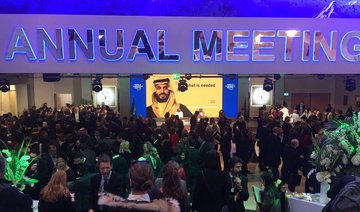
DAVOS: President Donald Trump lived up to his reputation as a business-focused politician with a special address to the World Economic Forum (WEF) annual meeting in Davos that concentrated on his achievements in economic and financial policy — especially the big tax cuts he has brought in.
He told a packed gathering of business leaders and policymakers that his policies had led to strong economic growth and to stock markets “smashing all records.”
“There has never been a better time to invest in the USA. America is open for business, and now is the perfect time to bring business, jobs and investment to the US,” he told them.
“We have created $7 trillion dollars worth of wealth on the stock markets, and created 2.4 million new jobs in the US,” he said.
The president said that he had “revived the American dream after years of stagnation,” and that his policies had led to the lowest unemployment rates for African, Hispanic and female Americans. He said his tax cuts had increased household incomes “by thousands of dollars” in the US.
In a question session after his address with Klaus Schwab, executive chairman and founder of the WEF, Trump revealed that he had dinner in Davos with 15 business leaders who had “become friends” after he explained his economic policies to them. Some had promised to bring “billions of dollars” back to the US as investment.
He singled out Apple as a company that was going to repatriate $350 billion of funds held in overseas, more tax-efficient jurisdictions. “They (the dinner invites) are putting in money. I didn’t know them before but now they are friends.”
He said that tax reform had been a “dream” of American presidents for nearly 40 years, since President Reagan last undertook a major overhaul of the system.
Much of his address concentrated on the performance of the American economy and stock markets since he became president a year ago. He said that this was because he had reduced regulatory and bureaucratic obstacles to doing business.
“Regulation is stealth taxation. We have teams of unelected bureaucracy who are crushing business,” he said.
Trump said that he had pledged to scrap two regulations for every one he introduced, but in fact had managed to eliminate 22 for each new law.
He also said that his administration had lifted self-imposed restrictions on the energy industry, because “no country should be held hostage over energy.”
Some analysts had forecast a hostile reception and even an organized walkout when the president began speaking, but the delegates mostly listened in silence and gave polite applause at the end.
There were signs of hostility on only two occasions. Some attendees murmured aloud when Schwab, introducing Trump, said that he had been the victim of “misconception and biased interpretation.”
The media contingent in the Davos audience also voiced their disapproval when Trump said that he had always had a good press as a businessman but that since he had become president the media had become “nasty, mean, vicious and fake.”

Donald Trump tells Davos: ‘Now is the perfect time to invest in America’
First EU–Saudi roundtable on critical raw materials reflects shared policy commitment
RIYADH: The EU–Saudi Arabia Business and Investment Dialogue on Advancing Critical Raw Materials Value Chains, held in Riyadh as part of the Future Minerals Forum, brought together senior policymakers, industry leaders, and investors to advance strategic cooperation across critical raw materials value chains.
Organized under a Team Europe approach by the EU–GCC Cooperation on Green Transition Project, in coordination with the EU Delegation to Saudi Arabia, the European Chamber of Commerce in the Kingdom and in close cooperation with FMF, the dialogue provided a high-level platform to explore European actions under the EU Critical Raw Materials Act and ResourceEU alongside the Kingdom’s aspirations for minerals, industrial, and investment priorities.
This is in line with Saudi Vision 2030 and broader regional ambitions across the GCC, MENA, and Africa.
ResourceEU is the EU’s new strategic action plan, launched in late 2025, to secure a reliable supply of critical raw materials like lithium, rare earths, and cobalt, reducing dependency on single suppliers, such as China, by boosting domestic extraction, processing, recycling, stockpiling, and strategic partnerships with resource-rich nations.
The first ever EU–Saudi roundtable on critical raw materials was opened by the bloc’s Ambassador to the Kingdom, Christophe Farnaud, together with Saudi Deputy Minister for Mining Development Turki Al-Babtain, turning policy alignment into concrete cooperation.
Farnaud underlined the central role of international cooperation in the implementation of the EU’s critical raw materials policy framework.
“As the European Union advances the implementation of its Critical Raw Materials policy, international cooperation is indispensable to building secure, diversified, and sustainable value chains. Saudi Arabia is a key partner in this effort. This dialogue reflects our shared commitment to translate policy alignment into concrete business and investment cooperation that supports the green and digital transitions,” said the ambassador.
Discussions focused on strengthening resilient, diversified, and responsible CRM supply chains that are essential to the green and digital transitions.
Participants explored concrete opportunities for EU–Saudi cooperation across the full value chain, including exploration, mining, and processing and refining, as well as recycling, downstream manufacturing, and the mobilization of private investment and sustainable finance, underpinned by high environmental, social, and governance standards.
From the Saudi side, the dialogue was framed as a key contribution to the Kingdom’s industrial transformation and long-term economic diversification agenda under Vision 2030, with a strong focus on responsible resource development and global market integration.
“Developing globally competitive mineral hubs and sustainable value chains is a central pillar of Saudi Vision 2030 and the Kingdom’s industrial transformation. Our engagement with the European Union through this dialogue to strengthen upstream and downstream integration, attract high-quality investment, and advance responsible mining and processing. Enhanced cooperation with the EU, capitalizing on the demand dynamics of the EU Critical Raw Materials Act, will be key to delivering long-term value for both sides,” said Al-Babtain.
Valere Moutarlier, deputy director-general for European industry decarbonization, and directorate-general for the internal market, industry, entrepreneurship and SMEs at European Commission, said the EU Critical Raw Materials Act and ResourceEU provided a clear framework to strengthen Europe’s resilience while deepening its cooperation with international partners.
“Cooperation with Saudi Arabia is essential to advancing secure, sustainable, and diversified critical raw materials value chains. Dialogues such as this play a key role in translating policy ambitions into concrete industrial and investment cooperation,” she added.