LONDON: Four of the highest paid male BBC journalists have agreed to pay cuts, the broadcaster said on Friday, following revelations that its top male news reporters and presenters were earning significantly more than women doing similar jobs.
Radio broadcasters Jeremy Vine and John Humphrys, news anchor Huw Edwards and North America editor Jon Sopel had all agreed either formally or in principle to salary cuts, the BBC said on its website.
The broadcaster was forced to disclose last year that two thirds of the highest earners on air were men.
Funded by a license fee levied on TV viewers, the BBC is closely scrutinized and held to exacting standards by the public and rival media. The pay disclosures, which it had resisted, highlighted a broader debate about gender inequality.
Director-General Tony Hall pledged to close the gender pay gap by 2020, but the organization has been criticized by its own journalists and by lawmakers for not acting fast enough.
Its China editor Carrie Gracie, who was paid significantly less than her male counterparts, resigned her role last month to fight against what she called the “secretive and illegal BBC pay culture.”
North America editor Sopel, one of the four who had agreed to a salary cut, earned between £200,000 and £249,999 ($285,100-$356,373) in 2016/17, the disclosures showed.
Gracie said she was paid £135,000 a year as China editor.
The highest paid of the four was Jeremy Vine, who earned between £700,000 and £749,999 for radio and TV work. Today radio program presenter Humphrys earned between £600,000 and £649,999, while news anchor Edwards was paid between £550,000 and £599,999.
The BBC said the level of the cuts was not yet known.
Tony Hall and Carrie Gracie will be questioned by a committee of lawmakers on Wednesday about BBC pay.


Four senior BBC male journalists agree pay cuts after inequality row
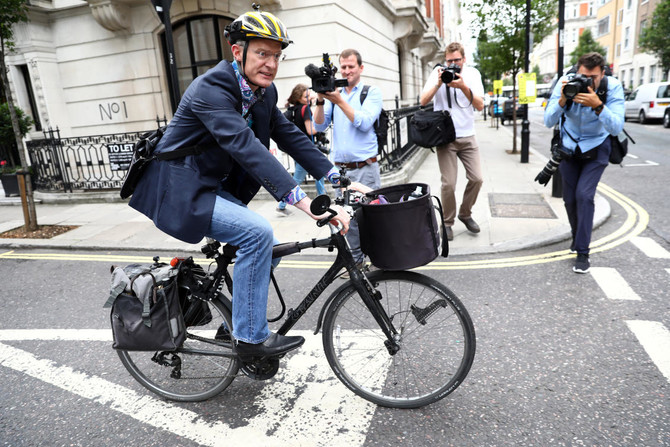
Four senior BBC male journalists agree pay cuts after inequality row


BBC slammed for ‘shameful’ cut to ‘free Palestine’ comment at BAFTA Awards
- Broadcaster removes from broadcast part of filmmaker Akinola Davies Jr.’s acceptance speech at the British Academy Film Awards
- Amnesty UK praises filmmaker for speaking up for those ‘facing and fleeing from persecution and mass atrocities’
LONDON: The BBC was accused on Monday of a “shameful” decision after it cut part of an acceptance speech at the previous night’s British Academy Film Awards in which a filmmaker uttered the phrase “free Palestine.”
British-Nigerian director and co-writer Akinola Davies Jr. and his brother, co-writer Wale Davies were collecting the award for outstanding debut by a British writer, director or producer for their film “My Father’s Shadow” when the former made the comment.
The BBC chose not to include the final part of his speech when it broadcast the BAFTAs ceremony later in the evening. However, the corporation did broadcast an inadvertent racist slur shouted by a person with Tourette syndrome while Black actors Michael B. Jordan and Delroy Lindo were presenting an award.
Akinola thanked industry figures and family for their support as he accepted the award, before dedicating it to “all those whose parents migrated to obtain a better life for their children.”
In the final part of his speech, cut by the BBC, he said: “To the economic migrant, the conflict migrant, those under occupation, dictatorship, persecution and those experiencing genocide, you matter and your stories matter more than ever.
“Your dreams are an act of resistance. To those watching at home, archive your loved ones, archive your stories yesterday, today and forever. For Nigeria, for London, Congo, Sudan, free Palestine. Thank you.”
The BBC, which broadcast the ceremony with a two-hour time delay, said the cut was made for timing reasons.
A spokesperson told Deadline: “The live event is three hours, and it has to be reduced to two hours for its on-air slot. The same happened to other speeches made during the night, and all edits were made to ensure the program was delivered to time. All winners’ speeches will be available to watch via BAFTA’s YouTube Channel.”
Human rights campaign group Amnesty UK described the decision by the BBC to cut part of the speech as “shameful.”
It added: “Thank you Akinola Davies Jr. for using your platform to speak out for the rights of migrants and people facing and fleeing from persecution and mass atrocities, from the Congo to Sudan to Palestine.”
In June last year, the BBC was at the center of a row after it broadcast a Glastonbury Festival performance by the duo Bob Vylan, during which the lead singer chanted “death to the IDF” in protest against the Israeli Defense Forces’ assault on Gaza.


