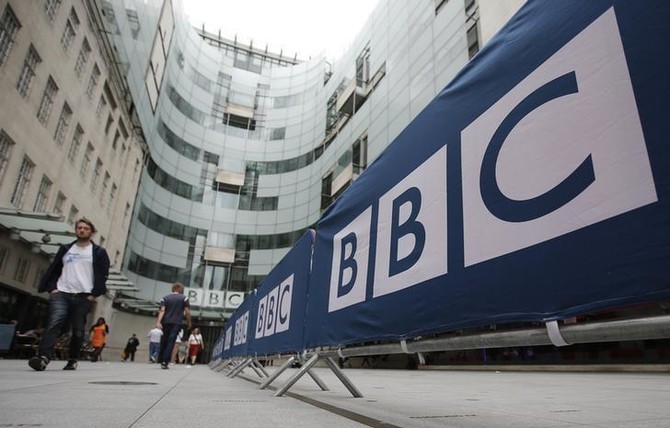
BBC to allow top-earning stars to engage critics on social media

The BBC must make the disclosure under the terms of its 11-year royal charter negotiated with David Cameron’s government. (Reuters)
Updated 19 July 2017
Follow

BBC to allow top-earning stars to engage critics on social media

LONDON: British broadcaster BBC will allow its top stars to defend themselves on social media after details of their salaries are revealed on Wednesday.
The list of top TV and radio presenters, who earn more than £150,000 (SR732,630) a year, is expected to include Gary Lineker, Graham Norton and Fiona Bruce.
BBC’s talents — such as Match of the Day presenter Gary Lineker, who has more than 5 million Twitter followers — are frequent users of social media and often engage readers and critics in bitter exchanges.
Last year David Cameron ordered the BBC to disclose what it paid on-air talent earning more than £450,000 a year. But the figure was slashed to £150,000 under Theresa May in a move that meant other well-known faces – such as Laura Kuenssberg and John Humphrys – would also be on the list.
BBC has told all employees on the list that their salary was to be revealed and has offered support and advice on dealing with the fallout.
Culture Secretary Karen Bradley said publishing the salaries of stars earning more than £150,000 would bring the BBC “in line with the civil service” on transparency.
It would help ensure that BBC “produces value for money for the license fee” and that more transparency could lead to savings that could be “invested in even more great programs,” she told the House of Commons in September last year.
Wednesday’s publication of the list – alongside its annual report – will be followed by a vigorous defense of the BBC’s top-level pay from senior corporation figures, led by director general Tony Hall.

“I completely understand that to lots and lots of people these are very large sums but we are a broadcaster, a global broadcaster, in a very competitive market,” Hall said in an interview.
“No-one would want us to be paying sums where it’s not at a discount to the market. People expect us to have great broadcasters, great presenters, great stars but pay them less than they would get in the market.”
Saudi Arabia strengthens global ranking in 2026 Soft Power Index

Updated 20 January 2026
Follow

Saudi Arabia strengthens global ranking in 2026 Soft Power Index

  • UAE maintains 10th place, Qatar climbs 2 spots

DUBAI: Saudi Arabia climbed three positions to 17th place in this year’s Soft Power Index, released on Tuesday by marketing consultancy Brand Finance.

Other Gulf nations also performed well, with the UAE maintaining its 10th-place ranking and Qatar and Bahrain each climbing two spots to No. 20 and No. 49, respectively, marking a rebound for the region after a softer showing in 2025.

The report indicates that the performance reflects sustained investment in proactive diplomacy, economic diversification and expanded initiatives across culture, tourism and sports.

It also comes at a time when several Western powers are recording declines in their rankings, highlighting the growing influence of Gulf states.

“The UAE remains a clear regional leader, while Saudi Arabia and Qatar have strengthened their global positions through focused economic diplomacy and international engagement,” said Savio D’Souza, managing director for the Middle East and Africa, Brand Finance.

Saudi Arabia and the UAE either maintained or improved their rankings across all key pillars, including familiarity, reputation and influence.

The Kingdom recorded notable gains, with increases of 25 points in the People & Values pillar and 12 points in the Culture & Heritage pillar.

“Although perceptions across some markets remain mixed, renewed upward movement in the rankings suggests that targeted, long-term soft power strategies are beginning to pay off,” D’Souza said.

Globally, the US retained its top position despite recording the steepest overall decline in its score, followed by China in second place. Japan rose to third place, overtaking the UK, which ranked fourth, while Germany placed fifth.

Brand Finance defines “soft power” as a “nation’s ability to influence the preferences and behaviors of various actors in the international arena (states, corporations, communities, publics, etc.) through attraction and persuasion rather than coercion.” 

Each nation is assessed across 55 individual metrics, producing an overall score out of 100 and a ranking from first to 193rd.