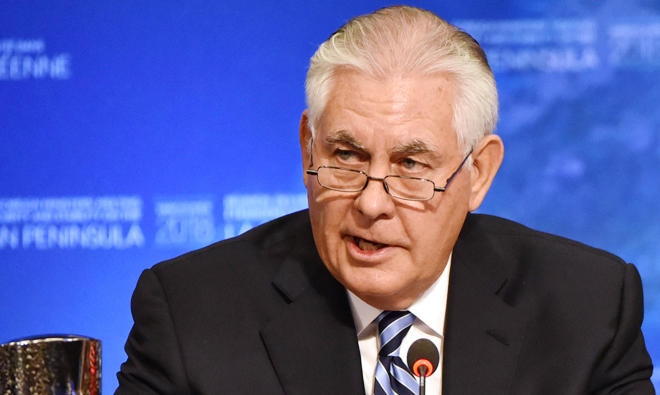
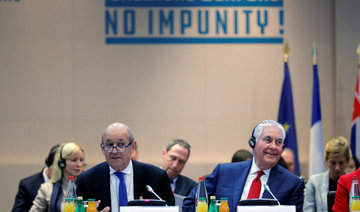
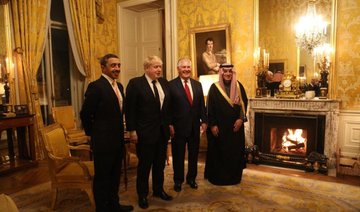
PARIS/ DUBAI: US Secretary of State Rex Tillerson met on Tuesday with the foreign ministers of Britain, Saudi Arabia and the UAE to discuss “a political solution” to the conflict in Yemen, sources said.
The meeting was organized by top British diplomat Boris Johnson at the British Embassy in Paris.
Tillerson and Johnson took part earlier Tuesday in the launch of an international initiative against chemical weapons, in particular in Syria.
“The conflicts in Syria and Yemen have created two of the worst humanitarian crises of our time,” Johnson said ahead of the meetings.
“There can be no military solution to either conflict, only peaceful and carefully negotiated political solutions will truly end the suffering.”
“We talked about the agreed critical goals in Yemen which are, first and foremost, to sustain the measures that have been taken over the course of the past weeks to expand” humanitarian access, a senior US State Department official said after the embassy meeting.
“That’s what provides all of us the space” to pursue “further goals” of a political resolution to the conflict and a strategy to counter Iranian influence in Yemen, he added.
Riyadh on Monday announced $1.5 billion in humanitarian aid and an operation to facilitate relief.
Saudi Arabia and the US accuse Iran of smuggling weapons to the Houthi militia.
“The Iranian proliferation has to come to an end. If it doesn’t come to an end, there need to be consequences,” the US official said, without specifying the form of retribution.
Clashes in Yemen
Clashes in the Yemeni rebel heartland of Saada province have killed 40 Houthi fighters, Saudi media said on Wednesday.
The Houthis were killed in clashes over the past 24 hours with a pro-government alliance, which controls several pockets of the province, Al-Ekhbariya television reported.

Tillerson meets with British, Saudi, UAE ministers on Yemen
Germany says UN rights rapporteur for Palestinian territories should quit
- Albanese has said that her comments are being falsely portrayed
- “I have never, ever, ever said ‘Israel is the common enemy of humanity’,” Albanese said
BERLIN: German Foreign Minister Johann Wadephul on Thursday called for the resignation of the UN special rapporteur for the Palestinian territories, Francesca Albanese, over comments she made allegedly targeting Israel at a conference.
“I respect the UN system of independent rapporteurs. However, Ms Albanese has made numerous inappropriate remarks in the past. I condemn her recent statements about Israel. She is untenable in her position,” Wadephul wrote on X.
Albanese has said that her comments are being falsely portrayed. She denounced what she called “completely false accusations” and “manipulation” of her words in an interview with broadcaster France 24 on Wednesday.
Speaking via videoconference at a forum in Doha on Saturday organized by the Al Jazeera network, Albanese referred to a “common enemy of humanity” after criticizing “most of the world” and much of Western media for enabling the “genocide” in Gaza.
“And this is a challenge — the fact that instead of stopping Israel, most of the world has armed, given Israel political excuses, political sheltering, economic and financial support,” she said.
Albanese said that “international law has been stabbed in the heart” but added that there is an opportunity since “we now see that we as a humanity have a common enemy.”
Wadephul’s French counterpart Jean-Noel Barrot on Wednesday made the same call for Albanese to resign over the comments.
“France unreservedly condemns the outrageous and reprehensible remarks made by Ms Francesca Albanese, which are directed not at the Israeli government, whose policies may be criticized, but at Israel as a people and as a nation, which is absolutely unacceptable,” Barrot told French lawmakers.
Albanese posted video of her comments to X on Monday, writing in the post that “the common enemy of humanity is THE SYSTEM that has enabled the genocide in Palestine, including the financial capital that funds it, the algorithms that obscure it and the weapons that enable it.”
In her interview with France 24, which was recorded before Barrot’s statement, she contended that her comments were being misrepresented.
“I have never, ever, ever said ‘Israel is the common enemy of humanity’,” Albanese told the broadcaster.