WASHINGTON: Attorney General Jeff Sessions was questioned for hours in the special counsel’s Russia investigation, the Justice Department said, as prosecutors moved closer to a possible interview with President Donald Trump about whether he took steps to obstruct an FBI probe into contacts between Russia and his 2016 campaign.
The interview with Sessions last week makes him the highest-ranking Trump administration official, and first Cabinet member, known to have submitted to questioning. It came as special counsel Robert Mueller investigates whether Trump’s actions in office, including the firing of FBI Director James Comey, constitute improper efforts to stymie the FBI investigation.
With many of Trump’s closest aides having now been questioned, the president and his lawyers are preparing for the prospect of an interview that would likely focus on some of the same obstruction questions. Expected topics for any sit-down with Mueller, who has expressed interest in speaking with Trump, would include not only Comey’s firing but also interactions the fired FBI director has said unnerved him, including a request from the president that he end an investigation into a top White House official.
In the Oval Office on Tuesday, Trump said he was “not at all concerned” about what Sessions may have told the Mueller team.
The recent questioning of the country’s chief law enforcement officer shows the investigators’ determined interest in the obstruction question that has been at the heart of the investigation for months through interviews of many current and former White House officials.
Sessions himself is a potentially important witness given his role as a key Trump surrogate on the campaign trail and his direct involvement in the May 9 firing of Comey, which he advocated. The White House initially said the termination was done on the recommendation of the Justice Department and cited as justification a memo from Deputy Attorney General Rod Rosenstein that faulted Comey for his handling of the Hillary Clinton email server investigation.
But Trump said later that he was thinking of “this Russia thing” when he fired Comey, and he had decided to make the move even before the Justice Department’s recommendations.
Sessions was one of Trump’s earliest and most loyal allies, the first senator to endorse him during the presidential campaign and then a key national security adviser. He was present for an April 2016 Trump foreign policy speech at the Mayflower Hotel in Washington, where he spoke with the Russian ambassador to the US. He also attended a meeting a month earlier with campaign aides including George Papadopoulos, a foreign policy adviser who pleaded guilty last year to lying to the FBI.
Sessions may well have been asked during his Mueller interview about any interactions he had with Papadopoulos, as well as about his own encounters during the campaign with the Russian ambassador.
He might also be able to supply information about White House efforts to discourage him from recusing himself from the Russia investigation, which he did last March after acknowledging two previously undisclosed encounters with the ambassador. And he may also have been asked about an episode from last February in which Comey says Trump cleared the room of Sessions and other officials before encouraging him to end an investigation into fired National Security Adviser Michael Flynn.
Mueller has been investigating the events leading up to Flynn’s dismissal from the White House in February.
Comey says he documented that conversation in a memo, one of a series of contemporaneous notes he kept of conversations with the president that troubled him. The New York Times, which first reported the interview with Sessions, said that investigators spoke to Comey last year about his memos.
Over the past several months, Mueller’s investigators have spoken with other people close to the president, including White House counsel Don McGahn, former chief of staff Reince Priebus and Trump’s son-in-law, Jared Kushner, in the probe of campaign contacts with Russia and possible obstruction.
Mueller has conveyed interest in speaking with the president, and White House attorney Ty Cobb has said that is “under active discussion” with Trump’s individual lawyers. He said last week on a CBS News’ political podcast, “The Takeout,” that he expected the investigation to be wrapped up within weeks.
“There’s no reason for it not to conclude soon,” Cobb said. “Soon to me would be in the next four to six weeks.”
Though Trump and Sessions during the campaign shared an ambitious law-and-order agenda, and even though the attorney general has continued to push the president’s priorities, his recusal decision has strained their bond. Since then, Trump has lashed out repeatedly on Twitter at Sessions and the Justice Department, and the two men now rarely speak directly. Trump saw the recusal as weak and disloyal, believing his attorney general should be doing more to protect him
People familiar with the matter have told The Associated Press that McGahn had contacted Sessions to urge him to retain control of the investigation. McGahn was acting at the behest of the president, according to one of those people, who spoke only on condition of anonymity to discuss the investigation.
Rosenstein appointed Mueller to take over the Russia investigation a week after Comey was fired. He oversees the work of Mueller’s investigators, but he told the AP in an interview last June that he, too, would recuse himself if his actions ever became relevant to the probe. He was questioned by Mueller’s team months ago, according to people familiar with the matter.
Sessions’ attorney, Chuck Cooper, declined to comment.
Four people have so far been charged in the Mueller investigation, including Flynn and former Trump campaign chairman Paul Manafort. Flynn and Papadopoulos have pleaded guilty to lying to the FBI.


![]()
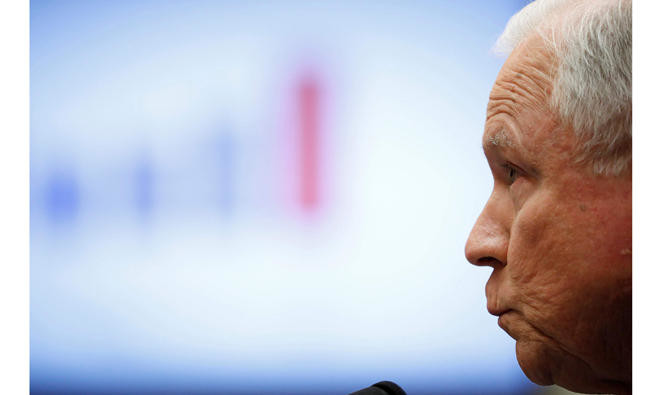
Sessions questioned in Russia probe, Trump may be up soon
Sessions questioned in Russia probe, Trump may be up soon

Latest updates



Recommended


© 2026 SAUDI RESEARCH & PUBLISHING COMPANY, All Rights Reserved And subject to Terms of Use Agreement.