At Davos, Modi puts free trade first

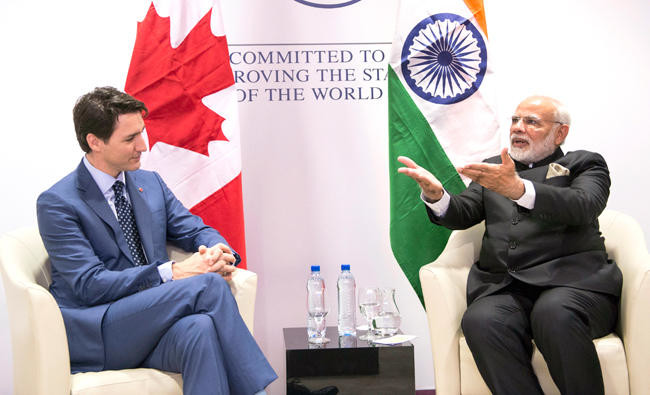
Indian Prime Minister Narendra Modi ranked protectionism among the three biggest challenges to global stability, along with climate change and terrorism. His Canadian counterpart Justin Trudeau also linked protectionism with the other challenges the WEF perceives: Technological disruption, gender inequalities and climate change. (AP)
Updated 24 January 2018
Follow

At Davos, Modi puts free trade first

DAVOS: Indian Prime Minister Narendra Modi kicked off the opening of the World Economic Forum (WEF) in Davos with a rallying cry for free trade and a warning against the threat posed by climate change.
In the first address at Davos by an Indian leader for two decades, he talked of the need for “creating a shared future in a fractured world” — with a warning that technological changes “can create fault lines that can inflict a very painful wound,” — ticking the box marked “fourth industrial revolution,” the core of the WEF cannon.
But he also sprang to the defense of global free trade and laissez-faire economics with a reference to the “forces of protectionism” in a thinly veiled hit at US President Donald Trump, who is expected to expound his “America First” message on Friday.
“The solution to this worrisome situation against globalization is not isolation. Its solution is in understanding and accepting change,” he said. Modi ranked protectionism among the three biggest challenges to global stability, along with climate change and terrorism.
Indeed, the specter of Trump — due on Friday — loomed everywhere on the first day. Prime Minister Justin Trudeau of Canada — one of the WEF’s favorites for a number of reasons, not least his physical and philosophical contrast to the American — took the opportunity of his special address to announce that Canada and 10 trade partners had signed an agreement to advance the Trans-Pacific Partnership, the trade treaty Trump renounced as one of his first acts in office.
Like Modi, he too linked protectionism with the other challenges the WEF perceives: Technological disruption, gender inequalities and climate change.
Norwegian Prime Minister Erna Solberg struck a note familiar with Saudi Arabian attendees at the WEF, when she called for a new global crackdown on global corruption.
“We need to see who is taking money, who is bribing others, and show that this is unacceptable in all our societies,” she said, proposing a #MeToo campaign against corruption, which she said was fueling terrorism and making it harder for emerging countries to develop their economies.
Middle East issues were on display at the meeting too, with behind-closed-doors sessions on the strategic condition of the region and geopolitics. Executives from Middle East corporations were involved in an apparently endless series of bilateral briefings.
Participants at the 48th annual meeting of the WEF had struggled through huge snow drifts and transport problems to get to the event.
At one stage, even the helicopters could not land — an event unprecedented for most WEF veterans.
But they did not let those wintry problems dim their enthusiasm for the basic message that Davos likes to hear: Liberal globalism in all its forms.


Reforms target sustained growth in Saudi real estate sector, says Al-Hogail

Updated 26 January 2026
Follow

Reforms target sustained growth in Saudi real estate sector, says Al-Hogail

RIYADH: The Real Estate Future Forum opened its doors for its first day at the Four Seasons Riyadh, with prominent global and local figures coming together to engage with one of the Kingdom’s most prospering sectors.

With new regulations, laws, and investments underway, 2026 is expected to be a year of momentous progress for the real estate sector in the Kingdom.

The forum opened with a video highlighting the sector’s progress in the Kingdom, during which an emphasis was placed on the forum’s ability to create global reach, representation, as well as agreements worth a cumulative $50 billion

With the Kingdom now opening up real estate ownership to foreigners, this year’s Real Estate Future Forum is placing a great deal of importance on this new milestone and its desired outcomes and impact on the market. 

Aside from this year’s forum’s unique discussions surrounding those developments, it will also be the first of its kind to launch the Real Estate Excellence Award and announce its finalist during the three-day summit.

Minister of Municipalities and Housing and Chairman of the Real Estate General Authority Majed Al-Hogail took to stage to address the diverse audience on the real estate market’s achievements thus far and its milestones to come.

Of those important milestones, he underscored “real estate balance” as a key pillar of the sector’s decisions to implement regulatory tools “with the aim of constant growth which can maintain the vitality of this sector.” He pointed to examples of those regulatory measures, such as the White Land Tax.

On 2025’s progress, the minister highlighted the jump in Saudi family home ownership, which went from 47 percent in 2016 to 66 percent in 2025, keeping the Kingdom’s Vision 2030 goal of 70 percent by the end of the decade on track.

He said the opening of the real estate market to foreigners is an indicator of the sector’s maturity under the leadership of Crown Prince Mohammed bin Salman. He said his ministry plans to build over 300,000 housing units in Riyadh over the next three years.

Speaking to Arab News,  Al-Hogail elaborated on these achievements, stating: “Today, demand, especially local demand, has grown significantly. The mortgage market has reached record levels, exceeding SR900 billion ($240 billion) in mortgage financing, we are now seeing SRC (Saudi Real Estate Refinance Co.) injecting both local and foreign liquidity on a large scale, reaching more than SR54 billion”

Al-Hogail described Makkah and Madinah as unique and special points in the Kingdom’s real estate market as he spoke of the sector’s attractiveness.

 “Today, the Kingdom of Saudi Arabia has become, in international investment indices, one that takes a good share of the Middle East, and based on this, many real estate investment portfolios have begun to come in,” he said. 

Al-Ahsa Gov. Prince Saud bin Talal bin Badr Al-Saud told Arab News the Kingdom’s ability to balance both heritage sites with real estate is one of its strengths.

He said: “Actually the real estate market supports the whole infrastructure … the whole ecosystem goes back together in the foundation of the real estate; if we have the right infrastructure we can leverage more on tourism plus we can leverage more on the quality of life … we’re looking at 2030, this is the vision … to have the right infrastructure the time for more investors to come in real estate, entertainment, plus tourism and culture.”