COPENHAGEN: Catalonia’s ousted leader Carles Puigdemont asked Tuesday to return to Spain “without any risk” of being detained for his role in the independence drive despite Madrid warning he would not be let in “even in the boot of a car.”
Speaking from Copenhagen on his first trip from Belgium where he now lives in self-exile, he said: “My intention in the coming days is to contribute to restoring democracy in order to respect election results.”
Fresh from a victory in December elections that saw separatist parties win an absolute majority led by his Together for Catalonia grouping, Puigdemont has been formally designated by the Catalan parliamentary speaker — another separatist — as the candidate to lead the region again.
But he has to figure out how he can be officially voted in at a parliamentary session due by the end of the month.
Parliamentary legal experts say he must be physically present at the session and Madrid has warned it will move to block any attempt by him to govern remotely, but if he returns to Spain he faces prison on charges of rebellion, sedition and misuse of public funds.
“What better sign would there be to restore democracy than being able to come back without any risk to attend the parliamentary debate?” Puigdemont asked of the session that will see lawmakers vote for or against him.
He called on “everyone to make this possible, starting with the Spanish authorities.”
But his request is likely to fall on deaf ears, with Spain’s Interior Minister Juan Ignacio Zoido announcing hours earlier that authorities were “taking steps along the border and inside the country, everywhere, to see that that does not happen.
“We are doing it in such a way that he cannot enter (the Catalan parliament) even in the boot of a car,” Zoido told Spanish television.
Puigdemont went to Belgium at the end of October after the Catalan parliament declared independence.
This was short-lived, however, as Prime Minister Mariano Rajoy moved to stop the secession crisis in a region deeply divided over independence.
He imposed direct rule on the semi-autonomous region, sacked its government, dissolved its parliament and called snap elections.
Several days later, separatist leaders were charged for their attempt to break from Spain via a banned independence referendum, but by then Puigdemont and several of his former ministers were already in Belgium.
The plebiscite, which went ahead in October despite a court ban, prompted a brutal police crackdown.
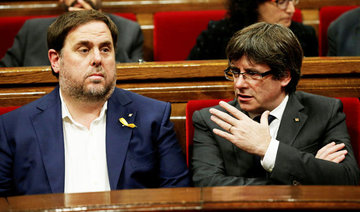
Other leaders who remained in Spain such as former Catalan vice president Oriol Junqueras were jailed pending an investigation.
On Wednesday, Puigdemont is due to meet with the Catalan parliamentary speaker in Brussels to discuss how he can be voted in.
Separatists are looking into having him attend virtually via videolink, although Puigdemont has not ruled out returning to Catalonia.
Puigdemont was invited to Denmark by Magni Arge, an MP for the Faroese separatist party Tjodveld (Republicans) who served as an observer for the Catalan referendum.
During a seminar on the Catalan crisis at the University of Copenhagen on Monday, Puigdemont hailed Denmark’s policy toward its former colonies Greenland and the Faroe Islands.
They have since 1950 gradually been granted more sovereignty in their bids for full independence.
“It’s not easy I know, but you’re proof that it’s possible,” Puigdemont said.
Greenland MP and former prime minister Aleqa Hammond was among the participants.
However, representatives of the parties that make up Denmark’s center-right government coalition declined to attend, as did those from the country’s two biggest parties, the Social Democrats and the anti-immigration Danish People’s Party.


![]()
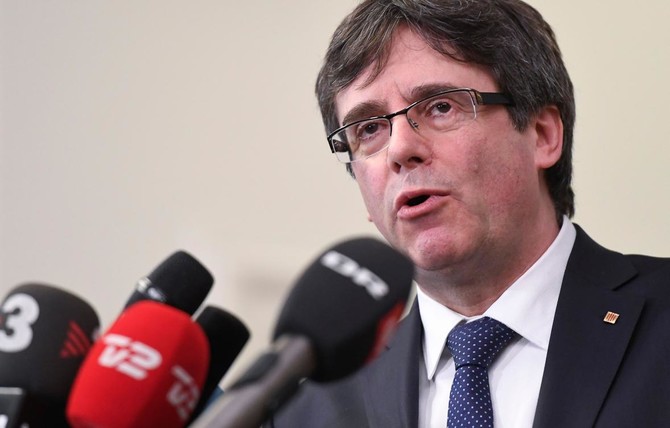
Sacked Catalan leader asks to return to Spain ‘risk-free’
Sacked Catalan leader asks to return to Spain ‘risk-free’

Latest updates


© 2026 SAUDI RESEARCH & PUBLISHING COMPANY, All Rights Reserved And subject to Terms of Use Agreement.