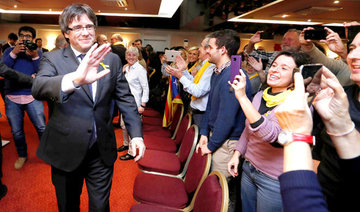
AJACCIO: Nationalist gains at the ballot box in Corsica may have earned the French island comparisons with Catalonia, but even its hardcore separatists admit that breaking away is a distant dream.
The ruling alliance of separatists and pro-autonomy candidates took 45 percent of the vote in last weekend’s first round of regional elections, advances they look set to cement in Sunday’s final round.
The score represents a 10-point rise in the Pe a Corsica (“For Corsica”) alliance’s showing when they came to power at the local level two years ago on the island where Napoleon was born.
Like Spain’s Catalonia, the stunningly beautiful island wedged between France and Italy has its own language, a proud identity and a history of testy relations with the central government.
But while the Catalan separatists led by Carles Puigdemont went as far as a full-blown independence declaration, Corsican nationalists are sticking to more modest goals.
Energised by last weekend’s gains to push for more autonomy, they have already revived three demands long rejected by Paris.
They want equal recognition for the Corsican language and an amnesty for convicts they consider to be political prisoners.
And they want the state to recognize a special Corsican residency status — partly an effort to fight property speculation fueled by foreigners snapping up holiday homes.
These are sensitive issues on an island where a four-decade bombing campaign by the National Liberation Front of Corsica (FLNC) — mainly targeting state infrastructure — was called off only in 2014.
The worst nationalist attack saw France’s top official on the island, Claude Erignac, assassinated in 1998.
Calm returned when the FLNC laid down its weapons — which, according to political analyst Jerome Fourquet, has helped to “normalize nationalism.”
The nationalists have become “a responsible, presentable political force,” Fourquet wrote in a report for the Jean Jaures Foundation.
As part of this more moderate approach, nationalists assure that an immediate independence bid is not on the table.
Even separatist leader Jean-Guy Talamoni — nicknamed by some “the Corsican Puigdemont” — suggests the island would split from France in 10 or 15 years at the earliest, if a majority supported it.
Yet opinion polls show that most of Corsica’s 330,000 residents, many of whom live off seasonal tourism and rely heavily on state subsidies, want to stay part of France.
Even in the northern village of Belgodere, where nationalists scored 90.22 percent last Sunday, the result was largely a reflection of local problems.
“I’m not voting out of political allegiance, or for autonomy or independence,” said Jean-Paul Pernet, the village’s only doctor, who backed the nationalists.
He voted, he said, “For people who will bring concrete plans” to rural areas that feel isolated and neglected by authorities. The nationalists’ opponents have repeatedly raised the prospect of Corsica being “the next Catalonia.”
But Andre Fazi, a politics lecturer at Corsica University, dismissed a Catalonia-style independence bid as a “fantasy.”
For Thierry Dominici, a Corsica specialist at the University of Bordeaux, the main barrier to independence is the island’s heavy economic dependence on the mainland.
That is not the case for Catalonia, where chief among many separatists’ complaints is that their wealthy region, representing a fifth of Spain’s economic output, does not get enough back for what it pays into national coffers.
Corsica, by contrast, represents just 0.4 percent of the French economy, suffering from higher unemployment and poverty rates than the mainland.
“An economically viable Corsica — I don’t think we’ll see it in my lifetime,” Dominici said.
“Even in terms of constitutional law, it’s a completely different situation,” he added.
While Catalonia already enjoys widespread autonomy in policy areas such as health, education and policing, “France is the most centralized unitary state in Europe,” Dominici said.
Even hard-line Corsican separatists like the small U Rinnovu party have limited themselves to pushing for an independence referendum in 2032.

Will Corsica be the new Catalonia?
Venezuela to debate historic amnesty bill for political prisoners
- Venezuela could pass a landmark bill on Thursday granting amnesty to political prisoners, marking an early milestone in the transition from the rule of toppled leader Nicolas Maduro
CARACAS:Venezuela could pass a landmark bill on Thursday granting amnesty to political prisoners, marking an early milestone in the transition from the rule of toppled leader Nicolas Maduro.
The legislation, which covers charges used to lock up dissidents under Maduro and his predecessor Hugo Chavez, aims to turn the page on nearly three decades of state repression.
It was spearheaded by interim president Delcy Rodriguez, who replaced Maduro after he was captured by US forces in Caracas last month and flown to New York to face trial.
Rodriguez took Maduro’s place with the consent of US President Donald Trump, provided she does Washington’s bidding on access to Venezuelan oil and expanding democratic freedoms.
She has already started releasing political prisoners ahead of the pending amnesty. More than 400 people have been released so far, according to rights group Foro Penal, but many more are still behind bars.
Rodriguez also ordered the closure of the notorious Helicoide prison in Caracas, which has been denounced as a torture center by the opposition and activists.
Lawmakers voted last week in favor of the amnesty bill in the first of two debates.
The second debate on Thursday coincides with Youth Day in Venezuela, which is traditionally marked by protests.
Students from the Central University of Venezuela, one of the country’s largest schools and home to criticism of Chavismo, called for a rally on campus.
Venezuela’s ruling party also announced a march in the capital Caracas.
’We deserve peace’
Venezuela’s attorney general said Wednesday that the amnesty — which is meant to clear the rap sheets of hundreds of people jailed for challenging the Maduro regime — must apply to both opposition and government figures.
He urged the United States to release Maduro and his wife, both in detention in New York.
“We deserve peace, and everything should be debated through dialogue,” Attorney General Tarek William Saab told AFP in an interview.
Delcy Rodriguez’s brother Jorge Rodriguez, who presides over the National Assembly, said last week that the law’s approval would trigger the release of all political prisoners.
“Once this law is approved, they will all be released the very same day,” he told prisoners’ families outside the notorious Zona 7 detention center in Caracas.
’We are all afraid’
Venezuelan opposition leader Juan Pablo Guanipa was one of the detainees granted early release.
But he was re-arrested less than 12 hours later and put under house arrest.
Authorities accused him of violating his parole after calling for elections during a visit to Helicoide prison, where he joined a demonstration with the families of political prisoners.
Guanipa is a close ally of Nobel Peace Prize laureate and opposition leader Maria Corina Machado, who was in hiding for over a year before she fled the country to travel to Oslo to receive the award.
“We are all afraid, but we have to keep fighting so we can speak and live in peace,” Guanipa’s son told reporters outside his home in Maracaibo.
The legislation, which covers charges used to lock up dissidents under Maduro and his predecessor Hugo Chavez, aims to turn the page on nearly three decades of state repression.
It was spearheaded by interim president Delcy Rodriguez, who replaced Maduro after he was captured by US forces in Caracas last month and flown to New York to face trial.
Rodriguez took Maduro’s place with the consent of US President Donald Trump, provided she does Washington’s bidding on access to Venezuelan oil and expanding democratic freedoms.
She has already started releasing political prisoners ahead of the pending amnesty. More than 400 people have been released so far, according to rights group Foro Penal, but many more are still behind bars.
Rodriguez also ordered the closure of the notorious Helicoide prison in Caracas, which has been denounced as a torture center by the opposition and activists.
Lawmakers voted last week in favor of the amnesty bill in the first of two debates.
The second debate on Thursday coincides with Youth Day in Venezuela, which is traditionally marked by protests.
Students from the Central University of Venezuela, one of the country’s largest schools and home to criticism of Chavismo, called for a rally on campus.
Venezuela’s ruling party also announced a march in the capital Caracas.
’We deserve peace’
Venezuela’s attorney general said Wednesday that the amnesty — which is meant to clear the rap sheets of hundreds of people jailed for challenging the Maduro regime — must apply to both opposition and government figures.
He urged the United States to release Maduro and his wife, both in detention in New York.
“We deserve peace, and everything should be debated through dialogue,” Attorney General Tarek William Saab told AFP in an interview.
Delcy Rodriguez’s brother Jorge Rodriguez, who presides over the National Assembly, said last week that the law’s approval would trigger the release of all political prisoners.
“Once this law is approved, they will all be released the very same day,” he told prisoners’ families outside the notorious Zona 7 detention center in Caracas.
’We are all afraid’
Venezuelan opposition leader Juan Pablo Guanipa was one of the detainees granted early release.
But he was re-arrested less than 12 hours later and put under house arrest.
Authorities accused him of violating his parole after calling for elections during a visit to Helicoide prison, where he joined a demonstration with the families of political prisoners.
Guanipa is a close ally of Nobel Peace Prize laureate and opposition leader Maria Corina Machado, who was in hiding for over a year before she fled the country to travel to Oslo to receive the award.
“We are all afraid, but we have to keep fighting so we can speak and live in peace,” Guanipa’s son told reporters outside his home in Maracaibo.
© 2026 SAUDI RESEARCH & PUBLISHING COMPANY, All Rights Reserved And subject to Terms of Use Agreement.