


War-weary Sudanese celebrate as Ramadan returns to Khartoum

1 / 2
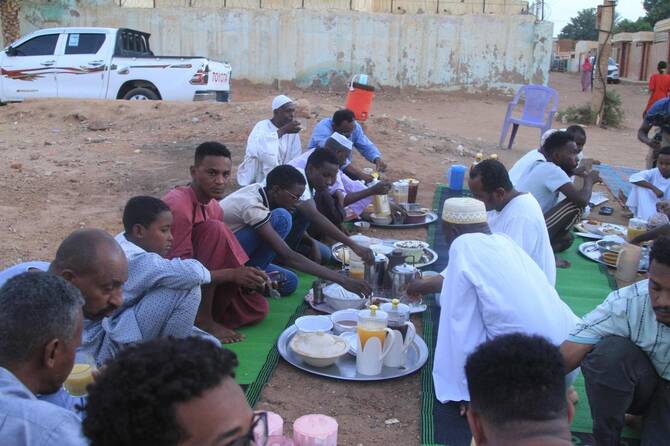
Sudanese people gather for to have their fast-breaking Iftar meal on the first day of Muslim holy fasting month of Ramadan, at a street in Al-Hattana neighborhood in Omdurman, the twin city of Khartoum on Feb. 18, 2026. (AFP)
2 / 2
Sudanese people gather for to have their fast-breaking Iftar meal on the first day of Muslim holy fasting month of Ramadan, at a street in Al-Hattana neighborhood in Omdurman, the twin city of Khartoum on Feb. 18, 2026. (AFP)
Short Url
Updated 19 February 2026
Follow

War-weary Sudanese celebrate as Ramadan returns to Khartoum

  • “Last Ramadan, there were no more than two families. Today, we are 13 families breaking the fast together, and that’s in just one street,” said Abdelkader Omar
  • Soaring prices have hit people’s pockets as they reduce their purchases of fruit and vegetables

KHARTOUM: A familiar scene returned to Khartoum as men gathered in the streets of the war-scarred Sudanese capital to break their fast on the first day of the Muslim holy month of Ramadan.
It was here that fighting first erupted in April 2023 between the army and the paramilitary Rapid Support Forces.
The conflict then swept across the country, killing tens of thousands of people and displacing millions.
For close to two years, the Sudanese capital — composed of the three cities of Khartoum, Omdurman and Bahri — was ravaged by war until the army recaptured it last March.
Entire neighborhoods had been besieged, some left in ruins, as rival fighters shot at each other across the Nile River.
“Last Ramadan, there were no more than two families. Today, we are 13 families breaking the fast together, and that’s in just one street,” said Abdelkader Omar.
The trader had returned home to Omdurman months after being forced to flee the city.
Like many others, he had brought a dish to share with his neighbors, sitting outside on a mat.
Only men were gathered here, with women remaining at home for iftar, the fast-breaking meal.
“Goods are available, but prices compared to wages makes things difficult,” said Omar.
Sudan has known only triple-digit annual inflation for years. Figures for 2024 stood at 151 percent, down from a 2021 peak of 358 percent.
The currency has also collapsed, going from 570 Sudanese pounds to the US dollar before the war to 3,500 in 2026 on the black market.
Soaring prices have hit people’s pockets as they reduce their purchases of fruit and vegetables at Khartoum’s central market.
“People complain about prices, say they’re outrageous. You can find everything, but the cost keeps rising,” said Mohamed, a market vendor.
Meanwhile, Omar said he was just happy to be home after so long.
“We found the place safe and people back in their houses,” he said.

- ‘No one is missing’ -

Elsewhere in Omdurman, Hassan Bachir laid the table as neighbors rolled out a mat, all waiting for the sun to set.
Bachir, 53, returned last June after fleeing the country.
“Today I went to the Omdurman market to buy what I needed, and given what I’d seen during the war, I didn’t expect it to look like this again,” he said.
He too has been hit hard by the price hikes but stressed that “Sudanese people help each other out” in many ways, including through community kitchens.
Around him sat other men, each with their own dish.
Glasses of helo-murr, a bittersweet drink made from corn flour, lined the table.
Journalist Othman al?Jundi, who had stayed in Omdurman during the war, said the city was “completely different” this year.
In 2025, there were “only two families in our street” compared to the 16 back in their homes today, he said.
“Last year we sat here full of worry: a stray bullet could hit us or a shell could fall,” recalled Nimeiri al?Sheikh Taha, whose neighbor’s house was struck.
“No one went out alone. We moved in groups.”
About 400 kilometers (250 miles) southwest, the war grinds on in Sudan’s Kordofan region, where deadly drone strikes have left communities stranded.
But even there, Muslims came together for a meal at sunset.
Ahmed Balla in El-Obeid, the capital of North Kordofan, told AFP by phone he had gathered with 17 families to break his fast.
“Today, despite the security situation and occasional drone attacks, no one is missing.”


Battered by Gaza war, Israel’s tech sector in recovery mode

Updated 21 February 2026
Follow

Battered by Gaza war, Israel’s tech sector in recovery mode

  • “High-tech companies had to overcome massive staffing cuts, because 15 to 20 percent of employees, and sometimes more, were called up” to the front as reservists, IIA director Dror Bin told

JERUSALEM: Israel’s vital tech sector, dragged down by the war in Gaza, is showing early signs of recovery, buoyed by a surge in defense innovation and fresh investment momentum.
Cutting-edge technologies represent 17 percent of the country’s GDP, 11.5 percent of jobs and 57 percent of exports, according to the latest available data from the Israel Innovation Authority (IIA), published in September 2025.
But like the rest of the economy, the sector was not spared the knock-on effects of the war, which began in October 2023 and led to staffing shortages and skittishness from would-be backers.
Now, with a ceasefire largely holding in Gaza since October, Israel’s appeal is gradually returning, as illustrated in mid-December, when US chip giant Nvidia announced it would create a massive research and development center in the north that could host up to 10,000 employees.
“Investors are coming to Israel nonstop,” Prime Minister Benjamin Netanyahu said at the time.
After the war, the recovery can’t come soon enough.
“High-tech companies had to overcome massive staffing cuts, because 15 to 20 percent of employees, and sometimes more, were called up” to the front as reservists, IIA director Dror Bin told AFP.
To make matters worse, in late 2023 and 2024, “air traffic, a crucial element of this globalized sector, was suspended, and foreign investors froze everything while waiting to see what would happen,” he added.
The war also sparked a brain drain in Israel.
Between October 2023 and July 2024, about 8,300 employees in advanced technologies left the country for a year or more, according to an IIA report published in April 2025.
The figure represents around 2.1 percent of the sector’s workforce.
The report did not specify how many employees left Israel to work for foreign companies versus Israeli firms based abroad, or how many have since returned to Israel.

- Rise in defense startups -

In 2023, the tech sector far outpaced GDP growth, increasing by 13.7 percent compared to 1.8 percent for GDP.
But the sector’s output stagnated in 2024 and 2025, according to IIA figures.
Industry professionals now believe the industry is turning a corner.
Israeli high-tech companies raised $15.6 billion in private funding in 2025, up from $12.2 billion in 2024, according to preliminary figures published in December by Startup Nation Central (SNC), a non-profit organization that promotes Israeli innovation.
Deep tech — innovation based on major scientific or engineering advances such as artificial intelligence, biotech and quantum computing — returned in 2025 to its pre-2021 levels, according to the IIA.
The year 2021 is considered a historic peak for Israeli tech.
The past two years have also seen a surge in Israeli defense technologies, with the military engaged on several fronts from Lebanon and Syria to Iran, Yemen, Gaza and the occupied West Bank.
Between July 2024 and April 2025, the number of startups in the defense sector nearly doubled, from 160 to 312, according to SNC.
Of the more than 300 emerging companies collaborating with the research and development department of Israel’s defense ministry, “over 130 joined our operations during the war,” Director General Amir Baram said in December.
Until then, the ministry had primarily sourced from Israel’s large defense firms, said Menahem Landau, head of Caveret Ventures, a defense tech investment company.
But he said the war pushed the ministry “to accept products that were not necessarily fully finished and tested, coming from startups.”
“Defense-related technologies have replaced cybersecurity as the most in-demand high-tech sector,” the reserve lieutenant colonel explained.
“Not only in Israel but worldwide, due to the war between Russia and Ukraine and tensions with China.”