

With Drogba and Eto’o as ambassadors, Morocco plays up long-shot 2026 World Cup bid

Morocco believes its fifth bid for the World Cup is 'a candidacy for the whole continent'. (AP)
Updated 23 January 2018
Follow

With Drogba and Eto’o as ambassadors, Morocco plays up long-shot 2026 World Cup bid

CASABLANCA: Morocco is “fully mobilized” for its long-shot bid to host the 2026 World Cup, hoping to be a candidate “for the whole of Africa,” top sports officials said Tuesday.
The kingdom “is not a non-starter — it’s a real candidate,” Moulay Hafid Elalamy said in his first public appearance as chairman of the country’s 2026 bid committee.
“We are going to put in all our energy,” he told a news conference in Casablanca, brushing off criticisms that the campaign had been delayed.
“Our record is and will be irreproachable.”
Morocco’s fifth bid, announced in August, faces fierce competition from a three-nation ticket of the United States, Mexico, and Canada.
Fouzi Lekjaa, head of the Royal Moroccan Football Federation (FRMF), said he hoped the North African country’s bid would be “a candidacy for the whole continent.”
“Between 1930 to 2030 — 100 years — the African continent has only organized the World Cup once,” Lekjaa said, referring to the 2010 tournament in South Africa, which beat a previous bid by Morocco.
“It should not remain on the margin.”
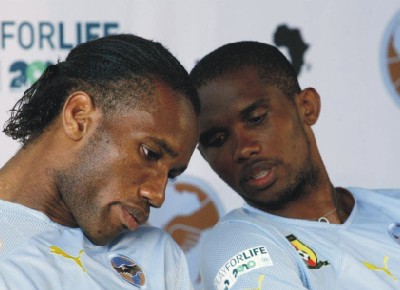
The committee has enlisted Ivory Coast legend and former Chelsea star Didier Drogba along with Cameroon international striker Samuel Eto’o to promote its bid.
The host will be chosen on Jun. 13, but the way the choice is made marks a change by FIFA, the sport’s world governing body.
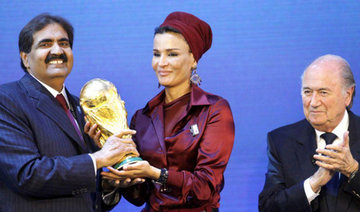
The decision used to be made by FIFA’s executive committee, but after suspicions over its selection of Russia and Qatar in December 2010, sparking a scandal that dethroned president Sepp Blatter, the committee was stripped of some powers and renamed the FIFA Council.
The new-look council must rubber-stamp the bids, but the final decision will be taken in a vote of the 211 national federations at a congress in Moscow.
Morocco’s bid committee hope to win support from the 53 members of the Confederation of African Football.
CAF president Ahmad Ahmad has urged the sport’s bodies across the continent to offer “free and massive support” to the kingdom.
The bid committee on Tuesday’s unveiled their leadership team, social media channels and logo: Red leaves on a black and white football surrounding a star that symbolizes “unity and brilliance.”
Responding to a question on human rights, newly added to FIFA’s selection criteria, Elalamy said Morocco had made progress on women’s and family rights.
The kingdom was “one of the safest countries in the world,” he added.
The committee also played up Morocco’s infrastructure, including a high-speed railway, ports, stadiums and hotel capacity.
They did not reveal how much was to be spent on the bid, but said each of the last two bids had cost around $15 million.

The ‘Porsche of off-road’: Ford CEO Jim Farley unveils vision for global lineup forged in Saudi sands

Updated 8 sec ago
Follow

The ‘Porsche of off-road’: Ford CEO Jim Farley unveils vision for global lineup forged in Saudi sands

  • Farley spoke to Arab News about creating a direct engagement between Ford and Dakar
  • He wants customers to feel like they are buying a piece of the world-famous rally with Ford vehicles

RIYADH: Ford’s leadership has signaled a new ambition to make the brand the “Porsche of off-road,” having used Saudi Arabia’s grueling Dakar Rally terrain to to hone their technology into a new lineup of off-road vehicles.

“Porsche has dominated the enthusiast automotive industry for a long time, and Ford, we have the ambition to be the Porsche of off-road,” Jim Farley, Ford Motor Company CEO, told Arab News. 

“There’s no more important off-road race in the world than Dakar,” he said, as the endurance event came to a close in Saudi Arabia at the weekend.

“We want to link the Dakar racing vehicles, our T1 Raptors to something that people can buy, not just a Raptor pickup truck, but a whole new lineup that people have not seen before. So, Dakar is really the inspiration for our future off-road lineup,” he added. 

Speaking on what the future holds for Ford racing and how Saudi Arabia’s terrain impacts vehicle innovation and engineering, Farley said: “I think it’s a story still playing out. The Baja race very much inspired the creation of a global Raptor brand.”

The CEO said that the company wants to create direct engagement between Ford and Dakar, so that consumers feel like they are purchasing a piece of Dakar when they buy a vehicle. 

“Toyota took the lead in off-road because the products were functional. And yes, they’ve been racing for a long time in Dakar. But I don’t think most people who buy the Toyota brand for off-road products imagine they’re buying a piece of Dakar.” 

The CEO highlighted the influential role Dakar plays in Ford’s future off-road lineup, describing the race as the Formula 1 and Le Mans of off-roading. 

“You’re going to see more and more products from Ford that are not utilitarian. Vehicles used to just get from point A to point B off road, but literally they’re designed to give people a piece of the racing technology similar to what portion Ferrari have done on the on road side.”

On the sidelines of the 2026 Dakar Rally, Farley reflected on what he called a “heartening” experience in the Saudi desert. After spending a night camping in a tent without electricity, he spoke of being moved by the profound solitude of the dunes and the deep dedication of the Saudi people to their cultural roots.

“I was very struck by the people I met in the desert the last couple of days. It’s just a sea of young people who kind of return to their roots as a culture out in the desert to enjoy this beautiful place as a social activity, and motorsports is that connection for them,” he said. 

“And I found that very appealing for me as an automobile executive that our industry is the kind of industry that can that can make a connection between the cultural, authentic cultural norms here in the Kingdom. 

“And it really struck me how interesting and important it is for the Saudi people to be connected to this beautiful desert, this beautiful resource you have, but doing so through motorsports, not necessarily through the traditional way of enjoying the desert. I found that very heartening in our world, where people had their shoes off, their feet in the sand and enjoying this beautiful place.”

Comparing a Dakar victory to winning Le Mans or a Formula 1 World Championship, Farley described the race as the “missing jewel” in its storied motorsports crown.

Highlighting why Dakar remains the most important off-road race in the world, the CEO said: “Because it’s global. If you go to Spain and Portugal, and Italy and France, and Thailand and South Africa, and around the world, people know what the Dakar race is.

“They know how difficult it is to win here. They understand the technology required to win here.

“It’s not something in North America. But if you want to create an off-road enthusiast brand for people who love the joy of driving off-road fast, there is no other event.

“But it’s equally compelling because it’s so difficult to win,” he said. 

Dakar came to a close on Saturday, after passing through AlUla, Hail, Wadi Ad-Dawasir, Bisha and Al-Henakiyah, and ending in Yanbu. 

Qatar’s Nasser Al-Attiyah won ​the Dakar Rally for the sixth time in the car category on Saturday as Argentina’s Luciano Benavides won by two seconds on two wheels, the narrowest margin ever.

Ford’s Nani Roma finished second, nine minutes and 42 seconds behind, and teammate Mattias Ekstrom was third after winning the final stage.

“There is an element about this race, like Le Mans, that comes down to kind of fortune and persistence. Do you try long enough and hard enough? Because it only takes one small mistake, one part to break, one driver error for navigation to lose the race,” Farley said.