

Syria regime accused of chemical attack in rebel enclave, US warns Russia

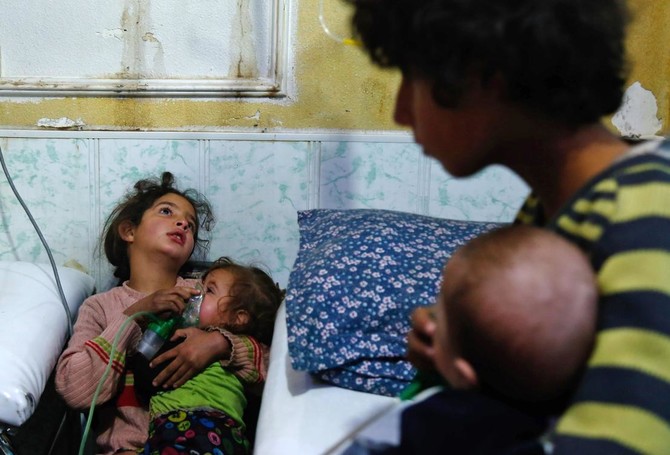
A Syrian girl holds an oxygen mask over the face of an infant at a make-shift hospital following a reported gas attack on the rebel-held besieged town of Douma in the eastern Ghouta region on the outskirts of the capital Damascus on January 22, 2018. (AFP)
Updated 23 January 2018
Follow

Syria regime accused of chemical attack in rebel enclave, US warns Russia

DOUMA, Syria: At least 21 people, including children, suffered breathing difficulties Monday, a monitor said, in a suspected Syrian regime chemical attack on a besieged rebel enclave near Damascus.
United Nations inspectors have accused President Bashar Assad’s regime of being behind multiple deadly poison gas attacks during the country’s devastating seven year war.
Monday’s attack targeted the city of Douma in the rebel-held region of Eastern Ghouta, the Syrian Observatory for Human Rights said.
“After regime forces fired rockets into the western part of the city of Douma, white smoke spread, causing 21 cases of suffocation,” it said.
An AFP correspondent at a hospital in the city saw people carrying babies wrapped in blankets, breathing through oxygen masks, some of them screaming.
Young girls and men sat on hospital beds, tears in their eyes, unable to stop coughing.
A doctor at the hospital who gave his first name as Bassil said patients were suffering “respiratory irritation, breathing difficulties, coughing and reddening of the eyes.”
“We noticed that they smelled like bleach, or chlorine, and we stripped them of their clothes,” he said.
Six children and six women were among those affected, the Observatory said
“Residents and medical sources talk of chlorine gas,” Observatory hear Rami Abdel Rahman said, adding that his group — which relies on a network of sources inside Syria could not confirm those reports.

Meanwhile, the United States sternly criticized Russia’s failure to rein in its Syrian ally Bashar Assad on Monday after the reports of a new regime chemical weapons strike emerged.
Washington is not yet in a position to confirm the latest report, but officials noted that Russia has hamstrung UN efforts to probe previous allegations of regime atrocities.
“Civilians are being killed and it is not acceptable,” Steve Goldstein, US assistant secretary of state for public affairs, told reporters in Washington.
Asked whether the United States would raise the issue at the UN Security Council, Goldstein said: “We’ll see tomorrow.”
“Russia had failed to rid Syria of chemical weapons, and they’ve been blocking chemical weapons organizations. Enough is enough,” he warned.
The United States has urged Russia to compel Assad to take a United Nations-brokered peace process in Geneva and Vienna seriously and come to the table.
But Moscow — along with Iran and Turkey — has been running a parallel peace initiative under its own auspices out of Astana and Sochi, and the eight-year-old civil war continues.
In 2013 the previous US administration, under president Barack Obama, balked at striking Syria over its alleged chemical arms use, choosing to work with Moscow on a disarmament plan.
But US military action in Syria has otherwise been focused on defeating Daesh — and thus-far ineffective diplomatic efforts to end the civil war.
On January 13, a similar attack targeted the outskirts of Douma and the Observatory reported seven cases of suffocation.
Days later, Human Rights Watch head Kenneth Roth accused the Syrian regime of using chlorine gas during the siege of Eastern Ghouta.
Besieged since 2013 by regime forces, the rebel stronghold’s 400,000 inhabitants are already experiencing a crushing humanitarian crisis and severe shortages of food and medicine.
The Organization for the Prohibition of Chemical Weapons (OPCW) and the United Nations blamed the Syrian air force for an April 2017 sarin gas attack on the opposition-held village of Khan Sheikhun which left scores dead.
The attack triggered an unprecedented American missile strike on the air base it is believed Syrian forces used to carry out the attack.
The regime is also accused of using chlorine gas in three areas of northern Syria in 2014 and 2015.
UN Secretary General Antonio Guterres has called for efforts to punish officials responsible for chemical attacks in Syria.
Syrian state TV said Monday that rebel mortar fire had killed nine people in two neighborhoods of Damascus.
Syria’s nearly seven-year war, which began as the regime brutally crushed anti-government protests, has claimed more than 340,000 lives, forced millions to flee their homes and left the country in ruins.
Israel orders Gaza families to move in first forced evacuation since ceasefire

Updated 58 min 21 sec ago
Follow

Israel orders Gaza families to move in first forced evacuation since ceasefire

  • Residents of Bani Suhaila, east of Khan Younis, said the leaflets were dropped on Monday on families living in tent encampments in the Al-Reqeb neighborhood

CAIRO: Israeli forces have ordered dozens of Palestinian families in the southern Gaza Strip to leave their homes in the first forced evacuation since October’s ceasefire, as residents and Hamas said on Tuesday the military was ​expanding the area under its control.
Residents of Bani Suhaila, east of Khan Younis, said the leaflets were dropped on Monday on families living in tent encampments in the Al-Reqeb neighborhood.
“Urgent message. The area is under IDF control. You must evacuate immediately,” said the leaflets, written in Arabic, Hebrew, and English, which the army dropped over the Al-Reqeb neighborhood in the town of Bani Suhaila.
In the two-year war before the US brokered ceasefire was signed in October, Israel dropped leaflets over areas that were subsequently raided or bombarded, forcing some families to move several times.
Residents and a source from the Hamas militant group said this was the first time they had been ‌dropped since then. ‌The Israeli military did not immediately respond to a request for comment.

SIDES FAR ‌APART ⁠ON ​NEXT PHASES
The ‌ceasefire has not progressed beyond its first phase, under which major fighting has stopped, Israel withdrew from less than half of Gaza, and Hamas released hostages in return for Palestinian detainees and prisoners.
Virtually the entire population of more than 2 million people are confined to around a third of Gaza’s territory, mostly in makeshift tents and damaged buildings, where life has resumed under control of an administration led by Hamas.
Israel and Hamas have accused each other of major breaches of the ceasefire and remain far apart on the more difficult steps planned for the next phase.
Mahmoud, a resident from the ⁠Bani Suhaila area, who asked not to give his family name, said the evacuation orders impacted at least 70 families, living in tents and homes, ‌some of which were partially damaged, in the area.
“We have fled ‍the area and relocated westward. It is maybe the ‍fourth or fifth time the occupation expanded the yellow line since last month,” he told Reuters by phone ‍from Khan Younis, referring to the line behind which Israel has withdrawn.
“Each time they move it around 120 to 150 meters (yards) inside the Palestinian-controlled territory, swallowing more land,” the father-of-three said.

HAMAS CITES STATE OF HUMANITARIAN DISRUPTION
Ismail Al-Thawabta, director of the Hamas-run Gaza government media office, said the Israeli military had expanded the area under its control in eastern Khan Younis five times since ​the ceasefire, forcing the displacement of at least 9,000 people.
“On Monday, 19 January 2026, the Israeli occupation forces dropped warning leaflets demanding the forced evacuation of the Bani Suhaila area in eastern ⁠Khan Younis Governorate, in a measure that falls within a policy of intimidation and pressure on civilians,” Thawabta told Reuters.
He said the new evacuation orders affected approximately 3,000 people.
“The move created a state of humanitarian disruption, increased pressure on the already limited shelter areas, and further deepened the internal displacement crisis in the governorate,” Thawabta added.
Israel’s military has previously said it has opened fire after identifying what it called “terrorists” crossing the yellow line and approaching its troops, posing an immediate threat to them.
It has continued to conduct air strikes and targeted operations across Gaza. The Israeli military has said it views “with utmost severity” any attempts by militant groups in Gaza to attack Israel.
Under future phases of the ceasefire that have yet to be hammered out, US President Donald Trump’s plan envisages Hamas disarming, Israel pulling out further, and an internationally backed administration rebuilding Gaza.
More than 460 Palestinians and three Israeli soldiers have been reported killed since the ceasefire took ‌effect.
Israel launched its operations in Gaza in the wake of an attack by Hamas-led fighters in October 2023 which killed 1,200 people, according to Israeli tallies. Israel’s assault has killed 71,000 people, according to health authorities in the enclave.