Iraq’s supreme court rules against election delay

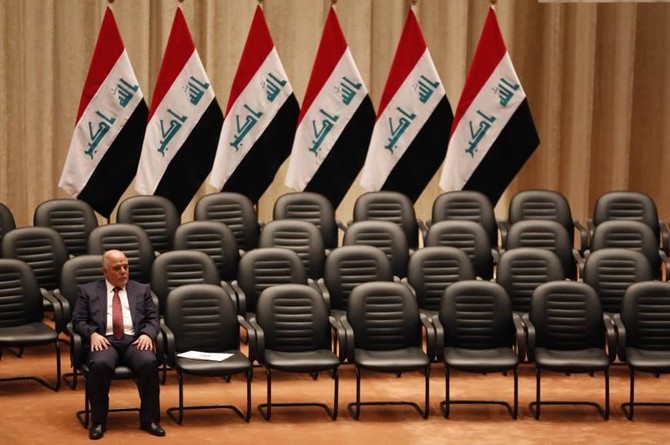
File photo pf Iraqi Prime Minister Haider al-Abadi attending a parliamentary session in Baghdad. (REUTERS)
Updated 21 January 2018
Follow

Iraq’s supreme court rules against election delay

BAGHDAD: Iraq’s Supreme Federal Court on Sunday ruled against calls by Sunni and Kurdish lawmakers to delay a parliamentary election, expected to be called for May, to allow hundreds of thousands of people displaced by war to return home.
Shiite politicians, including Prime Minister Haider Al-Abadi, argued delaying the election would be unconstitutional.
The election must be held “within the timeframe provided by the constitution,” the court said in a statement.
Parliament is expected to meet on Monday to validate May 12 as the date for the ballot, as suggested by the government, or agree another date in May.
Abadi is seeking re-election, building on a surge in his popularity among Iraq’s majority Shiite Arab community after leading the three-year fight against Daesh militants, supported by a US-led coalition.
“Postponing the elections would set a dangerous precedent, undermining the constitution and damaging Iraq’s long-term democratic development,” the US Embassy in Baghdad said in a statement on Thursday.
The United States had shown understanding for Abadi’s move in October to dislodge Kurdish fighters from the oil rich northern region of Kirkuk, even though the Kurds are traditional allies of Washington and played a key part in the war against Daesh militants.
Tens of thousands of Kurds were displaced as a result of the takeover of the ethnically mixed areas of Kirkuk and its surroundings by Iraqi forces supported by Iranian-backed paramilitary groups.
The United Nations estimates the total number of people who remain displaced in Iraq at 2.6 million, mostly Sunni Arabs from areas previously controlled by Daesh.
The role of prime minister is reserved for the Shiite Arabs under a power-sharing system set up after the 2003 U.S-led invasion that toppled Saddam Hussein, a Sunni Arab.
The largely ceremonial office of president is reserved for a Kurdish member of parliament, while the speaker of parliament is drawn from among Sunni Arab MPs.


Pakistan backs Yemen unity, supports Riyadh talks amid regional tensions

Updated 03 January 2026
Follow

Pakistan backs Yemen unity, supports Riyadh talks amid regional tensions

  • Pakistan urges Yemeni stakeholders to work ‘in good faith’ toward a negotiated political solution
  • Ishaq Dar discusses regional situation with the Saudi and Emirati foreign ministers from Beijing

ISLAMABAD: Pakistan on Saturday welcomed a call by Yemen’s Presidential Leadership Council for political dialogue in Riyadh among all factions on the ground, reaffirming its support for Yemen’s unity following a “limited” airstrike by a Saudi-led coalition targeting weapons shipments from the United Arab Emirates to the port city of Mukalla in southern Yemen.

The coalition forces spokesperson said the weapons were meant to support the Southern Transitional Council (STC) forces, backed by the UAE, in Yemen’s Hadramaut and Al-Mahra “with the aim of fueling the conflict.”

Rashad Al-Alimi, President of the Yemeni Presidential Leadership Council, requested the Saudi authorities hold a conference bringing together all factions in southern Yemen, prompting the Kingdom to invite them “to develop a comprehensive vision” for the future.

“Pakistan welcomes the call by Yemen’s Presidential Leadership Council to hold comprehensive talks in Riyadh and once again urges all Yemeni stakeholders to engage in good faith toward a negotiated political solution based on agreed parameters,” the foreign office said in a statement.

“Pakistan reaffirms its steadfast support for the unity and territorial integrity of Yemen,” it added.

The diplomatic messaging was reinforced by Pakistan’s Deputy Prime Minister and Foreign Minister Mohammad Ishaq Dar, who spoke separately by phone from Beijing with Saudi Foreign Minister Faisal bin Farhan and UAE Foreign Minister Abdullah bin Zayed Al Nahyan.

The foreign office said Dar welcomed the Saudi foreign ministry’s recent statement on Yemen and expressed appreciation for efforts by all sides to resolve the regional situation amicably, while also noting that dialogue and diplomacy had produced “tangible outcomes on the ground.”

Dar arrived in Beijing earlier in the day, where he is due to co-chair the 7th Pakistan-China Foreign Ministers’ Strategic Dialogue with Wang Yi on Sunday. He will also attend events marking the start of the 75th year of Pakistan-China diplomatic relations, with commemorative initiatives planned throughout 2026.