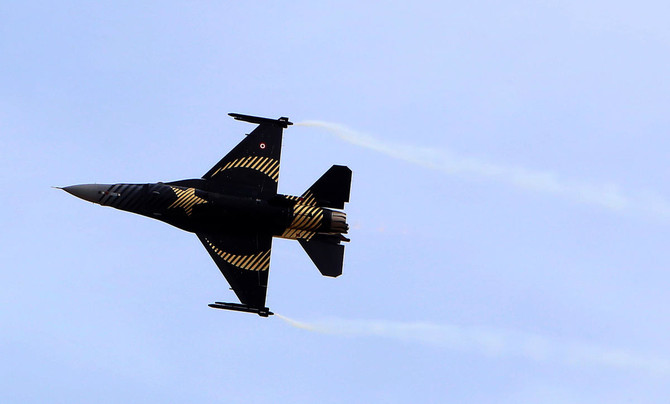
BEIRUT: The Syrian government on Thursday warned Turkey against launching a military operation in Syria’s northwestern region of Afrin and said that Syrian air defenses stood ready to defend against such an attack.
“We warn the Turkish leadership that if they initiate combat operations in the Afrin area, that will be considered an act of aggression by the Turkish army,” deputy foreign minister Faisal Meqdad said in a statement carried by the state media.
“The Syrian air defenses have restored their full force and they are ready to destroy Turkish aviation targets in Syrian Arab Republic skies,” he added.
Turkish Foreign Minister Mevlut Cavusoglu told CNN Turk in an interview on Thursday that Turkey would intervene in Afrin and Manbij to counter the Syrian Kurdish YPG militias.
Turkish forces are already deployed in areas of Syria on either side of the YPG-controlled Afrin. The Syrian army holds land to the south.
“The presence of any Turkish forces on Syrian lands is “totally rejected,” Meqdad added. He said that military action by Ankara would complicate its role as a party to diplomatic efforts and put it on “the same level as the terrorist groups.”
Meanwhile, Turkey dispatched its military chief to Moscow on Thursday, seeking approval for an air campaign in Afrin, although Damascus warned it could shoot down any Turkish planes in its skies.
Turkey’s foreign minister said the Moscow trip by Chief of Staff Hulusi Akar was part of talks with both Russia and Iran, the two main backers of Syrian President Bashar Assad, to allow Turkish planes to take part in an Afrin campaign.
The diplomacy was the strongest signal yet that Turkey plans direct military action against territory held by Kurdish militia, potentially opening a new front in Syria’s civil war.
It would mean confronting Kurds allied to the United States at a time when Turkey’s relations with Washington are reaching the breaking point.
“We will intervene in Afrin,” Mevlut Cavusoglu told broadcaster CNN Turk, adding he did not expect Russia to oppose any operation there. “We are meeting the Russians and Iran on the use of air space.”
Turkey has ratcheted up its threats to take military action in Afrin in the past week, in response to US plans to support setting up a 30,000-strong force to guard areas held by Kurdish-led fighters in a large part of Syria east of Afrin.

Syria vows to shoot down Turkish fighter jets
Sudan now has highest number of people in need ‘anywhere in the world,’ UN warns
- Spokesperson Stephane Dujarric presses states to provide urgent financial support to help meet humanitarian needs that have reached ‘extraordinary levels’
- 34m people expected to need aid this year; UN response plan calls for $2.9bn of funding to provide food, nutrition, clean water, health and protection services, and education
NEW YORK CITY: The UN on Friday pressed member states to provide urgent financial support to help stave off further suffering in war-torn Sudan, where nearly 34 million people are now expected to need assistance this year — the highest number anywhere in the world.
Spokesperson Stephane Dujarric said that despite the “extraordinary humanitarian needs,” operations remain perilously underfunded and aid workers face mounting risks.
The UN’s 2026 Humanitarian Response Plan for Sudan calls for $2.9 billion of funding to provide more than 20 million people with life-saving food, nutrition, clean water, health and protection services, and education. But funding lags behind needs, complicating efforts to scale up deliveries of aid.
The civil war between rival military factions in the country, which will enter its fourth year in April, is driving several overlapping emergencies, including acute food insecurity and outbreaks of disease.
According to the UN’s World Food Programme, more than 21 million people in Sudan face high levels of acute hunger, and famine conditions have been confirmed, or are feared to be present, in several regions.
Humanitarian workers continue to face “grave danger,” Dujarric said. In recent months, 92 of them, mostly Sudanese, have been killed, injured, kidnapped or detained, he added, and more than 65 attacks on healthcare providers and patients have been recorded.
Aid groups also warn that conflict-related obstacles, including blockades, drone strikes, and sporadic access restrictions, continue to hamper distribution efforts.
The UN has highlighted the fact that amid the growing displacement of people in North Darfur and North Kordofan, where hundreds of thousands of civilians have been uprooted, water and sanitation services are collapsing in affected areas.
The humanitarian crisis is compounded by regional spillover. Neighboring Chad has closed its border with Sudan amid security concerns, complicating the cross-border flow of aid and threatening already fragile refugee-support systems.
Dujarric warned that without increased donor support and improved access, the skills and commitment of aid workers will not be enough to keep pace with spiraling needs.
“Delivering aid at this scale requires flexible funding and guaranteed humanitarian access, so that workers can reach people in need and they can reach them safely and rapidly and without any obstruction,” he said.