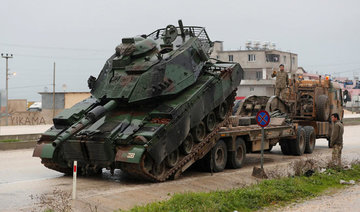
ANKARA: Turkish troops and tanks were seen on Wednesday near the Afrin region of Syria’s northwestern border with Turkey, suggesting Ankara’s long-threatened attack on US-backed Syrian Kurds is imminent. Turkey’s top security board also convened on Wednesday, under the leadership of President Recep Tayyip Erdogan, to discuss the prospective military offensive on Afrin.
The latest statements from Turkish officials suggest Ankara’s planned military operation may even extend beyond Afrin to the distant Arab-majority town of Manbij, west of the Euphrates, which is currently under the control of the predominantly Kurdish militia group Syrian Democratic Forces (SDF), dominated by the People’s Protection Units (YPG).
YPG is seen by Ankara as a terrorist organization and the Syrian offshoot of the outlawed Kurdistan Workers’ Party (PKK).
In a meeting with his US counterpart Rex Tillerson on Wednesday in Vancouver, Turkish Foreign Minister Mevlut Cavusoglu said Turkey’s “precautions” against YPG forces in Syria are not limited to Afrin, but could expand to Manbij.
Experts are divided over the likelihood and feasibility of such an operation, but they all agree that it could cause an abundance of problems for Turkey in terms of its relationship with other regional players.
Metin Gurcan, a security analyst at the Istanbul Policy Center, underlines the strategic location and regional significance of Manbij for both America and Russia.
“Manbij is a buffer zone and a bridgehead where Russia and the United States have interests,” he told Arab News. “The north of Manbij is under the control of the YPG, while the southern part is held by the (Syrian President Bashar) Assad regime.”
According to Gurcan, threatening an offensive against Manbij may be Turkey’s strategy to escalate tension “in a controlled way” and to show “determination” ahead of the military operation.
He stressed that any operation on Manbij is dependent on what happens in Afrin, and that an assault of Afrin is unlikely without the consent of Moscow.
“In military terms, it would be unfeasible and very tough to conduct an operation first by advancing to the west, and then turning in the opposite direction. It would be less effective because of its extended scope,” he noted.
“In Manbij, Turkey runs the risk of upsetting both Russia and the US. In that case, Ankara would have to negotiate with these two countries, and make concessions. This would further complicate the situation,” Gurcan explained.
According to Gurcan, Turkey is increasingly the subject of a power struggle between Moscow and Washington in the north of Syria.
On Tuesday, Ryan Dillon, spokesperson for the US-led coalition, announced that the Pentagon would not oppose any Turkish operation against Afrin, as the canton does not fall under the operation area of the coalition, a statement Gurcan describes as “a critical maneuver.”
“By taking an indifferent approach vis-a-vis Turkey’s impending operation in Afrin, the Pentagon has transferred the problem of the ties between Turkey and the YPG to Russia, while the latter has been unexpectedly quiet about Turkey’s military preparations, and has not withdrawn its soldiers from Afrin,” he said.
However, Serhat Erkmen, a Middle East expert at the Ankara-based 21st Century Turkey Institute, does not share Gurcan’s opinion that Turkey’s talk of a possible Manbij operation is just rhetoric.
“If Turkey can afford to (upset) the US, such an operation is completely possible, considering that the town of Manbij currently faces a lot of ethnic and management problems,” Erkmen told Arab News.
Manbij is of considerable strategic importance, Erkmen explained: “It controls the water supply to the region, which may be at grave risk of severe water shortages for drinking and agricultural purposes if instability continues,” Erkmen said.


![]()

Turkish forces converge on Syria border; attack on Afrin imminent
Turkish forces converge on Syria border; attack on Afrin imminent

Latest updates


Recommended


© 2026 SAUDI RESEARCH & PUBLISHING COMPANY, All Rights Reserved And subject to Terms of Use Agreement.