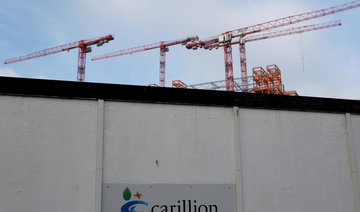
LONDON: Qatar’s refusal to settle a £200 million bill is said to have been one of the final nails in the coffin for UK construction giant Carillion, which went into liquidation on Monday.
Carillion claims payment is outstanding for work on a £500 million ($692 million) development deal related to the 2022 World Cup.
Rudi Klein, chief executive of the Specialist Engineering Contractors’ (SEC) Group, said the Qatar contract was among a small number of “big infrastructure projects that meant the end was nigh for Carillion.”
“The Qatari government will be now looking very urgently for alternative contractors to do this work and they may have to pay rather a lot more to do that,” Klein told Arab News.
The unsettled debt is the latest shadow to engulf preparations for the World Cup in 2022.
Controversy was initially cast over Qatar’s 2022 World Cup bid when allegations of corruption emerged followed by reports of exploitation from the construction sites, where workers complained of inhumane conditions and unpaid wages.
Contractors then warned of delays to World Cup projects in June 2017 when Gulf countries began the ongoing boycott of Qatar.
The Qatari government now faces further complications with the collapse of Carillon, which was involved in the $5.5 billion Msheireb redevelopment of Doha’s Downtown ahead of the World Cup.
In October 2017, City A.M. reported that top Carillion executives were making monthly trips to Doha to persuade Msheireb, backed by the Qatar Foundation, to settle the outstanding bill.
Msheireb, however, says it is owed a significant sum for contractural obligations it claims Carillon has failed to fulfil.
Carillion is one of the largest contractors operating in the Middle East, with projects including the Dubai Canal and the Royal Opera House in Oman, mostly through joint ventures.
The fall in oil prices contributed to a slow down in construction spending across the region, prompting Carillion to start pulling out of Middle East markets.
Commentators criticizing Carillion’s construction delivery model in the wake of its downfall emphasized the danger inherent in its practice of outsourcing on a large scale, particularly when operating in overseas markets.
“In the Middle East, where construction works are delivered very site-labor intensively and with high proportions of unskilled transient migrant labor, the delivery failure risks in terms of cost overruns, delays and quality problems can be magnified,” said Mark Farmer, CEO of Cast, a real estate and construction consultancy.
“This undoubtedly creates heightened risk for those contractors that are not able to adequately supervise or control and manage the construction process.”
Klein said Carillion’s role as a “middleman” left the company ill-equipped to supervise projects, which could be more efficiently managed by smaller, regional contractors. Klein added, “95 percent of what Carillion did was outsourced; they never did a thing.
“Now is time to get rid of the middleman and to look at how we engage directly with the people actually doing the work.”
The collapse of Carillion was a dramatic unraveling of the UK’s second-largest construction firm, which employs 43,000 people worldwide, including 19,000 workers in the Gulf.
British Prime Minister Theresa May on Wednesday defended the government’s decision to sign major deals with the company after it issued its first profit warning in July. Carillion has public sector and private partnership contracts worth £1.7 billion in the UK, including for services in the NHS and Ministry of Defense.
“We’re making sure in this case that public services continue to be provided, that workers in those public services are supported and taxpayers are protected,” May told MPs.
Labour leader Jeremy Corbyn accused the British government of “negligence” over Carillon and called on May to “end the costly racket of private companies running services for the public.”
Carillion’s demise is being compared to the impact of the Lehman Brothers’ collapse on the banking sector as the reverberations reach further down the supply chain.
Brian Berry chief executive of the Federation of Master Builders warned that the “domino effect” is already underway.
“This is the biggest thing that’s hit the construction industry since I can remember; it’s got the potential to be a disaster.”
Thousands of suppliers are owed money by Carillion, many of which are having to lay off workers as banks call in their debts. Shareholders are also among those suffering severe losses.
Along with the Qatar contract, three UK joint public and private contracts are also being blamed for the collapse. Two were for new hospitals and another for a road project in Scotland.


![]()

Qatar’s unpaid World Cup 2022 contract in spotlight amid anger over Carillion collapse
Qatar’s unpaid World Cup 2022 contract in spotlight amid anger over Carillion collapse


Latest updates


© 2026 SAUDI RESEARCH & PUBLISHING COMPANY, All Rights Reserved And subject to Terms of Use Agreement.