

High public sector pay no cure for Mideast unemployment: IMF

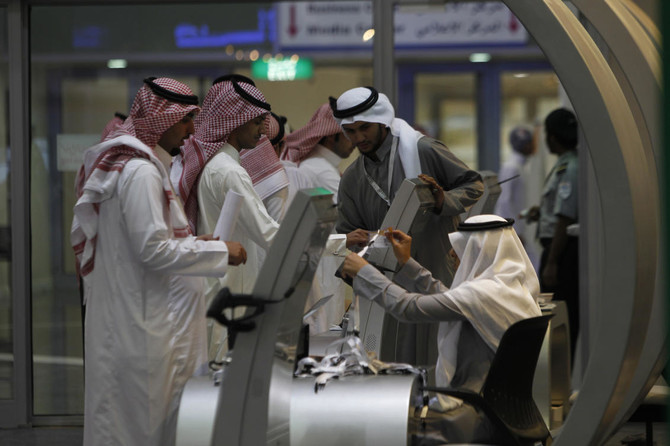
Jobseekers at a job fair in Riyadh in January 2012. Saudi Arabia’s Vision 2030 reform plan looks to drive ‘healthier employment opportunities for citizens.’ (Reuters)
Updated 16 January 2018
Follow

High public sector pay no cure for Mideast unemployment: IMF

LONDON: High wages in state-supported sectors in the Middle East, offering jobs aplenty to work-hungry citizens fail to tackle growing unemployment as population levels rise, and do not provide better public services, according to an IMF paper.

Public sector employment is being maintained as a result of high levels of public employment, unusually large compensation, or sometimes both, said the paper entitled “Public Wage Bills in the Middle East and Central Asia.”

The International Monetary Fund said labor markets become distorted in countries where public sector compensation “grossly” exceeds that in the private sector. Nor does it spur job creation, crucial in countries where significant numbers of young people are seeking employment, the IMF said.

A better solution to mitigate unemployment and population growth would be to foster “diversified private-sector-led growth.”

That path is already being followed in Saudi Arabia via its Vision 2030 reform plan, which stated: “We will improve the business environment, so that our economy grows and flourishes, driving healthier employment opportunities for citizens and long-term prosperity for all. This promise is built on cooperation and on mutual responsibility.”

The IMF pointed out that the capacity of Middle Eastern public sectors to absorb a growing labor force is increasingly limited, making private investment and job creation the only sustainable and inclusive way of addressing persistent unemployment and low employment that are big challenges in the region.

In an interview with Arab News, Jason Tuvey, GCC economist with Capital Economics, said the IMF has been calling for years for governments in the Gulf to get a grip on their public sector wage bills.

He said Saudi Arabia, for instance, needed to close the wage gap between Saudi nationals, who tend to dominate the public sector, and migrant workers who fill positions in low-wage, low productivity private sectors.

Saudi nationals need to move into higher-productivity parts of the private sector, “which in turn needs bolstering in order to diversify the economy away from oil dependency,” said Tuvey.

Saudi Arabia is already prioritizing private sector investment, flagged in Vision 2030, and, according to a recent budget statement, KSA’s non-oil revenues are rising as diversification away from oil gathers pace.

Tuvey said: “The IMF has talked about implementing wage subsidies for Saudi nationals, to encourage private sector firms to employ them. While there would be a cost to that, it would be much less than being forced to employ these workers in the public sector.”

KSA needs to push through reforms in education to provide young Saudis with a skills set to move into higher-productivity private segments of the economy, said Tuvey. The Kingdom has already committed to this via its education modernization programs, also outlined in Vision 2030.

Last year, Capital Economics said in a paper that privatizations should reduce the Saudi government’s dominant role in the economy. And a new bankruptcy law, as well as plans to make it easier to acquire permits, would address some of the issues that hinder the conduct of business in KSA. 


Speaking about the region generally, including countries in Central Asia, the IMF paper said the “disproportionate” size of national, public sectors, as well as large public wage bills have failed to improve the availability and quality of public services that are vital for addressing “economic development challenges.”

It added: “Unemployment insurance can better address the risk of unemployment while supporting well-functioning labor markets.

“Social safety nets can be developed to reduce poverty and social exclusion, as well as mitigate the cost of wage bill reforms,” said the IMF.


Six vital sectors drawing US investors to Saudi Arabia 

Updated 4 sec ago
Follow

Six vital sectors drawing US investors to Saudi Arabia 

RIYADH: Six vital sectors are drawing US investors, including entrepreneurs and small businesses, to Saudi markets as the Kingdom continues to develop its regulatory framework and foster innovation, Deborah Lehr, interim CEO of the Meridian International Center, said in an interview with Al-Eqtisadiah. 

Lehr, who is heading a trade and investment delegation to Saudi Arabia in her capacity as an economic advisor affiliated with the White House, stated that the six sectors include hospitality, luxury goods, and tourism, as well as culture, technology, and others. 

She noted that Saudi Arabia has significantly eased the process for foreign companies to establish a presence, a critical factor for small and medium-sized enterprises that may not yet have the scale to expand, making the Kingdom an attractive market for both large and innovative small companies. 

Following the success of the Saudi Crown Prince’s recent visit to Washington, she said, Meridian organized a US trade delegation to explore tangible and growing opportunities for US businesses in Saudi Arabia. 

Translating Vision 2030 priorities into real partnerships 

The delegation, which included representatives from Delta, Intel, Pernod Ricard, and Basilinna, among others, met a wide range of government officials, private-sector leaders, and entrepreneurs to explore how US companies can participate in Saudi market growth. 

According to Lehr, discussions were practical and forward-looking, focusing on translating Vision 2030 priorities into real business partnerships. 

She highlighted that most of the companies in the delegation were large enterprises operating across various sectors, underscoring the diversity of businesses active in Saudi Arabia. 

She pointed out that these companies joined the mission because they see the potential to scale their operations in Saudi Arabia — whether by increasing flight routes, enhancing airport security, offering advisory services to firms entering the Saudi or US markets, or exploring opportunities in the beverage sector. 

Relationship increasingly taking economic dimension 

Lehr hinted to the Saudi minister of investment that the US-Saudi relationship is also increasingly taking on an economic dimension. 

She noted that bilateral trade stands at around $40 billion, compared with Saudi-China trade of approximately $110 billion, highlighting untapped growth potential between the two countries, especially as diplomatic and political ties continue to strengthen. 

She said the reforms present valuable opportunities for US companies across multiple sectors, including advanced manufacturing, technology and logistics, as well as aviation, tourism and culture, alongside a wide range of services. 

With the regulatory environment being modernized and business stability increasing, the scope of US investment is set to expand further. More importantly, she added, the greater the engagement of companies, the stronger and more resilient the bilateral relationship will become in the years ahead. 

She emphasized that Saudi Arabia has undergone deep social and economic transformations, including increased female participation in the workforce and entrepreneurship, while emerging as a cultural hub with a thriving arts scene and new platforms for creative expression. 

Lehr further said that the world will witness growing global interest from companies and institutions eager to be part of Saudi Arabia’s remarkable transformation, amid increasing openness and a willingness to share its history, culture, and ambitions with the world. 

Saudi agenda offers tangible opportunities  

Lehr highlighted that during her visit, she focused on three key economic priorities. The first is Saudi Arabia’s strategic shift of capital from the oil and gas sector toward technology and innovation, a move that signifies not only economic diversification but also the Kingdom’s emergence as a globally competitive player. 

Second, the Kingdom’s reform agenda has provided tangible opportunities for foreign companies, reflecting real changes that facilitate international participation in Saudi growth. 

The third point she focused on was that the strong geopolitical and economic ties between the US and Saudi Arabia have bolstered investor confidence. As the Kingdom strengthens its global role and deepens relationships with partners such as the US, its attractiveness for long-term foreign direct investment continues to grow. 

She noted that sectors such as artificial intelligence, gaming and entertainment, advanced manufacturing, and the technology ecosystem are areas in which the US has strong competitive advantages, at a time when US firms are seeking new markets that offer stability and long-term potential. 

Giga-projects in Saudi Arabia, including AlUla and NEOM, have attracted global attention and highlighted emerging opportunities across the country. 

These projects demonstrate the Kingdom’s ambitious vision and its creation of entirely new sectors rather than merely expanding existing ones.