ANKARA: Turkey’s preparation for an imminent military operation in the Syrian Kurd province of Afrin could raise the complex and delicate question of who are Ankara’s partners and who are its rivals?
The operation against a US-backed Kurdish militia, which Turkey considers a terrorist group, will take place amid escalating tensions between Ankara and Washington over their Syria policies.
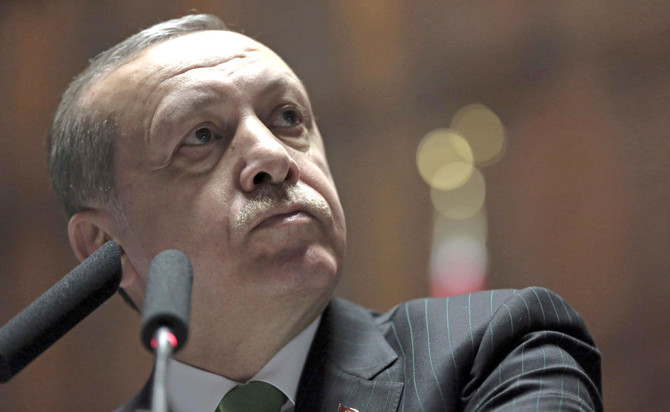
President Recep Tayyip Erdogan on Tuesday said the offensive against the “nests” of terror in Afrin and Manbij towns would begin on Wednesday or Thursday. The attack will take place in partnership with Syrian opposition fighters allied to Turkey.
But the ever-changing dynamics in the nearly seven year conflict may oblige Turkey to go it alone in terms of its international allies — a risky option given the uncertainty as to how regional actors will react.
For now, Russia seems muted but would prefer Turkey to increase its presence in the de-escalation zone in Idlib by launching more observation posts to monitor a cease-fire. People’s Protection Units
The northwestern Afrin province, which borders Turkey, is currently under the control of the US-backed Kurdish militia People’s Protection Units (YPG) seen as a terrorist organization by Turkey because of its links with the Kurdistan Workers’ Party (PKK), that has waged a decades-long insurgency inside Turkey.
Moreover, the US-led international coalition against Daesh announced on Sunday that it is training a new border security force in Syria to protect the Turkish-Syrian border.
The surprise initiative infuriated Turkey and Erdogan vowed on Monday to “kill such a terrorist army before it is born.”
On Tuesday, he called on NATO, of which both Turkey and the US are members, to stand with Ankara “in the “event of any border aggression.”
Likewise, Prime Minister Binali Yildirim said that with this move the US showed that it is treating Turkey as its “enemy”.
Crucially, it will be how Moscow reacts that could determine how Turkey emerges from the offensive.
Russian Foreign Minister Sergei Lavrov warned on Monday that any formation of a zone under the control of Kurdish militants could lead to the partition of Syria and may impede finding an end to the conflict Syria.
“We are talking about an extremely complicated geopolitical picture here,” Emre Ersen, a Syria analyst at Marmara University in Istanbul, told Arab News.
“Although it is true that the PYD (the YPG’s political wing) has built closer links with the US, it has not refrained from developing special relations with Russia particularly in the last couple of years.”
Ersen said that despite Moscow’s move to improve relations with Turkey, “Russia still believes the PYD can be eventually convinced to make a deal with the Assad regime.”
Russia is unlikely to be easily persuaded by Turkey to abandon its plans for the PYD’s role in Syria. An agreement between the Kurdish group and the Syrian regime was one of the main goals of Moscow’s Syrian National Dialogue Congress proposal.
Ersen thinks the US announcement of a new border army in Syria is perceived by Moscow as a major challenge to the rising Russian political and military influence in the Middle East.
“Therefore, this development will probably bring Turkey and Russia closer in Syria, although they recently hasd some important disagreements regarding the situation in Idlib,” he said.
There has been speculation that Turkey made a deal with Russia over its increased presence in Idlib in exchange for Moscow’s consent for its military operation in Afrin.
When Turkey staged its previous offensive into Syria to clear the border of YPG and Daesh threats, Russia did not initially oppose Ankara’s military aircraft using Syrian airspace.
This gave implicit support to the seven-month Operation Euphrates Shield, which ended in March 2017, and Russia even provided Turkey with some air support of its own.
Russia now controls the airspace over Idlib and Afrin, and without its approval Ankara will not be able to support its fighters in their operation – a key factor that will determine the success of the offensive.
“It will be extremely difficult for the Turkish forces to achieve the goals of the Afrin operation without Russia’s implicit or explicit support,” Ersen said. “On the other hand, any kind of Turkish-Russian cooperation in Afrin will most probably alienate the PYD from Moscow, which contradicts Russia’s long-term plans in Syria.”
Syria’s Afrin has been in Turkey’s sights. The south of the province is monitored by Turkey’s observation posts in Idlib, and the eastern part was sealed during the Euphrates Shield.
On Tuesday, Turkish Chief of General Staff Gen. Hulusi Akar attended a NATO meeting of defense chiefs in Brussels, and during his speech he said, “NATO should not make discrimination between terror groups in the fight against terrorism.”
Erol Bural, a former military officer and terrorism expert at the 21st Century Turkey Institute, said it is time for Turkey to use more efficient diplomacy at NATO and the UN to prevent the escalation of this crisis and to strengthen its hand.
“The US-led border security initiative intends to monitor the Turkey-Syria border, which means NATO’s own borders are under a serious threat,” Bural told Arab News.
Bural thinks that an operation into Afrin against the PKK-linked YPG terror group may trigger domestic security threats inside Turkey.
“For the moment Turkey has not announced any exit strategy from such an operation. We don’t know how long Turkish soldiers will stay there,” he said. “it seems that the political objectives are the same with military and state: clearing the area from terrorist threat.
But, Bural warned that if the operation extends to the east of the Euphrates River, it may lead to direct combat with the US, which controls that zone.


![]()
Afrin offensive could risk Turkey’s relations with Russia
Afrin offensive could risk Turkey’s relations with Russia

Latest updates


© 2026 SAUDI RESEARCH & PUBLISHING COMPANY, All Rights Reserved And subject to Terms of Use Agreement.