Violent protests resume in Tunisia after two days of calm

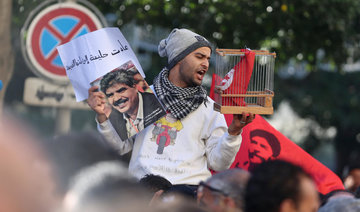
People wave national flags during demonstrations on the seventh anniversary of the toppling of president Zine El-Abidine Ben Ali, in Tunis, Tunisia on Sunday. (REUTERS)
Updated 15 January 2018
Follow

Violent protests resume in Tunisia after two days of calm

TUNIS: Violent protests erupted again on Sunday in two areas of the capital Tunis and another town after a relatively calm two days, the latest protests in the country against austerity measures.
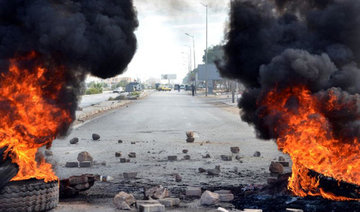
After nearly a week of at times violent protests, police used tear gas against dozens of young protesters in the Ettadamen district of Tunis in renewed demonstrations over a tax hike.
A Reuters witness saw youths around 20 years old throwing stones at police cars and setting fire to tires before security forces drove them back with tear gas.
Witnesses told Reuters that violent protests were also taking place in Kram district in the capital.
Protesters in Feriana city near the Algerian border tried to cut off roads and police were chasing protesters in the streets of the city and firing gas bombs.
Protests erupted last Monday in several towns and cities across Tunisia following tax and price hikes imposed on Jan. 1 by a government seeking to reduce a budget deficit to meet an agreement with its international donors.
Earlier on Sunday, hundreds of Tunisians demonstrated peacefully against government austerity measures in the capital, the seventh anniversary of the ousting of former President Zine El Abidine Ben Ali.
Almost 800 people have been arrested for vandalism and acts of violence, including throwing petrol bombs at police stations, according to the interior ministry.
The government late on Saturday pledged extra aid for poor families and those in need in response to the demonstrations but protesters still took to the streets, holding banners with slogans against rising prices and new taxes.
One rally took place in front of the Labor Union (UGTT) headquarters and several other protests were held along the central Habib Bourguiba Avenue, where hundreds of riot police had been deployed.
“This is what the government has done to us,” said one a protester named Fouad. “Pockets are empty because of unfair decisions by the government ... I am a professor and my wife is a teacher, but we are suffering today to meet our needs.”
“We have only won the freedom of expression after the 2011 revolution ... but we will remain in the streets until we win our economic rights just as we have our freedom,” he added.
Police were seeking to separate supporters of the opposition Popular Front party and the Islamist Ennahda party, which is part of the ruling coalition. The government and Ennahda accuse the PF of being behind some of the violence last week.
Prices have increased for fuel and some consumer goods, while taxes on cars, phone calls, the Internet, hotel accommodation and other items have also gone up.
Tunisia has been hailed as the only democratic success of the Arab Spring: the one Arab country to topple a long-serving leader in that year’s uprisings without triggering widespread violence or civil war.

But Tunisia has had nine governments since Ben Ali’s overthrow, none of which have been able to resolve deep-rooted economic problems. The economy has worsened since a vital tourism sector was nearly wiped out by a wave of deadly militant attacks in 2015, and has yet to recover despite improved security. 

Spain highlights importance of Gaza reconstruction

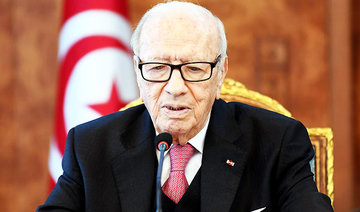
Palestinian prime minister, Mohammed Mustafa, and the Spanish foreign minister, Jose Manuel Albares. (AP)
Updated 02 January 2026
Follow

Spain highlights importance of Gaza reconstruction

  • Spain officially recognized Palestine as a state in May 2024, in a coordinated move alongside Ireland and Norway

RAMALLAH: The Palestinian prime minister, Mohammed Mustafa, and the Spanish foreign minister, Jose Manuel Albares, on Friday discussed the latest developments in the West Bank and Gaza Strip.
During their telephone conversation they emphasized the need to intensify international efforts to end the Israeli occupation and halt attacks and settler violence, and to secure the release of Palestinian funds held by Israeli authorities.
They affirmed the importance of ongoing efforts relating to plans for the reconstruction of Gaza, and Europe’s significant role in this process. Mustafa and Albares highlighted the need to unify Palestinian institutions in Gaza with those in the West Bank, with the aim of establishing a Palestinian state in line with international resolutions, including last year’s New York Declaration.
They also discussed coordination between their countries, and the strengthening of Spain’s political, diplomatic and financial support for Palestine, and Mustafa thanked Spain for its ongoing support.
Spain officially recognized Palestine as a state in May 2024, in a coordinated move alongside Ireland and Norway. Estephan Salameh, the Palestinian finance and planning minister, is set to visit Spain this month to discuss enhanced cooperation, particularly in the areas of development and reconstruction. Meanwhile, Israel continues operating in the occupied West Bank.
The Palestinian Prisoners media office said on Friday that Israel carried out numerous raids across the territory, including the major cities of Ramallah and Hebron, according to The Associated Press.
Nearly 50 people were detained, following the arrest of at least 50 other Palestinians on Thursday, most of those in the Ramallah area.
As 2026 begins, the shaky 12-week-old ceasefire between Israel and Hamas has largely ended large-scale Israeli bombardment of Gaza. 
But Palestinians are still being killed by Israeli fire, especially along the so-called Yellow Line that delineates areas under Israeli control, and the humanitarian crisis is compounded by frequent winter rains and colder temperatures.
On Friday, American actor and film producer Angelina Jolie visited the Rafah border crossing between Egypt and the Gaza Strip. 
The only crossing between the territory and a country other than Israel, it remains closed despite Palestinian requests to reopen it to people and aid.
Jolie met with members of the Red Crescent on the Egyptian side of the Rafah border crossing and then visited a hospital in the nearby city of Arish to speak with Palestinian patients on Friday, according to Egyptian officials.
Aid groups say not enough shelter materials are getting into Gaza during the truce.