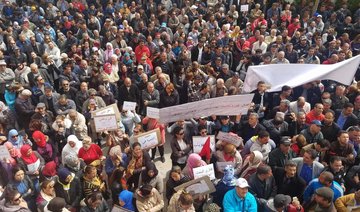
SIDI BOUZID: Shouting slogans and holding up placards outside a government office in the impoverished Tunisian city of Sidi Bouzid, university graduates have a message for officials — give us jobs or you will face trouble.
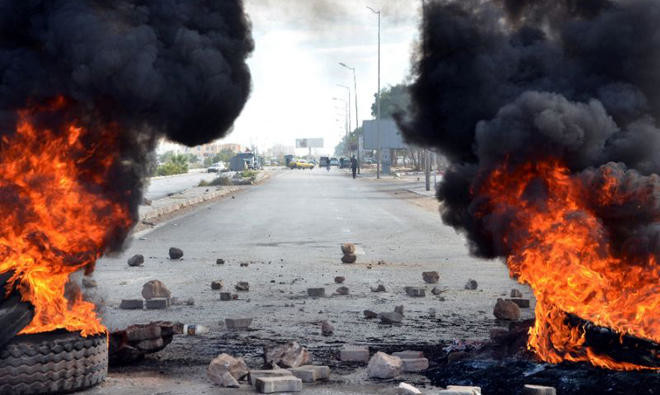
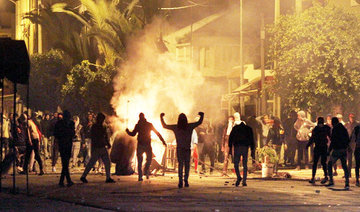
They are part of the spasm of anti-government unrest that spread nationwide this week, stoking another political crisis in a nation in turmoil as austerity bites hard under pressure from foreign lenders to get Tunisia’s finances in order.
It was in Sidi Bouzid that mass protests erupted seven years ago and rapidly engulfed the rest of the North African country, sweeping away autocrat Zine El-Abidine Ben Ali in the first of the Arab Spring uprisings.
Now the young men and women who spearheaded the outbreak of unrest in Sidi Bouzid are back in the streets of the dusty, dilapidated provincial city, complaining that they never reaped the benefits promised by the 2011 revolution.
Tunisia is the only democratic success story of the 2011 uprisings, with a unity government comprising secular centrists, moderate right and independents, but — materially — most people are worse off than before.
Several deadly militant attacks have scared off much of the foreign tourism and investment critical to the economy, knocking the currency down 60 percent since 2011 and driving up inflation to a three-and-half-year high.
Disillusionment
“We had hoped that our lives would become better, that we get jobs and housing, but everything has turned for the worse,” said Bashir Hussein, one of the disgruntled graduates.
He is embarrassed that at 32 he still lives at home, unable to find a good job since graduation a decade ago — a fate shared by many in a country where unemployment among the young runs around 30 percent. “I cannot afford to marry. I don’t have hopes anymore that things will improve,” Hussein said.
He and his friends had hoped the 2011 revolution would translate into new jobs in public services, which Ben Ali had steadily expanded to buy loyalty — Tunisia’s spend on public wages is around 15 percent of GDP, one of the highest levels worldwide.
But that model has crumbled as a fall in phosphate exports due to blockages by protesters demanding jobs, as well as the decline in tourism revenue, have forced Tunisia to take on loans from the International Monetary Fund and Western countries.
Creditors want the government to stop spending almost two-thirds of the budget on public salaries and focus on education and infrastructure to create jobs over the long term.
The Sidi Bouzid protesters say authorities pledged to hire some 60 graduates from the town back in 2015 in what analysts say is a common gesture to discourage dissent. But the jobs have never transpired due to austerity-driven hiring freezes.
“We had a promise but officials have backtracked,” Hussein said. “We will keep protesting.”
The government has bowed to pressure from labor unions not to lay off civil servants, leaving no room for new hires.
To help fulfill foreign creditors’ demands to lower the deficit, the Tunis government from Jan. 1 hiked taxes and prices affecting many common items from petrol to mobile phone calls, hitting the unemployed hardest.
While protests have been smaller than in 2011, investors and Western diplomats are concerned they could still pressure the government into watering down reforms, as before, to secure social peace.
Stoking such worries, the Ennahda party, part of the governing unity coalition, has endorsed calls from labor unions to roll back some of the reforms including subsidy cuts.
“I suspect they will have to give in (at least partially) on the wage demands and postpone the hikes in prices,” said Charlie Robertson, global chief economist at Renaissance Capital.
Lack of money raises graft suspicions
Sidi Bouzid is located just 200 km inland from coastal Tunis but it takes four hours to reach the city of 300,000 people by car as there is no highway or railway service.
This forces motorists to rely on slow, pothole-ridden roads winding through village after village.
“We’ve demanded many times a link to the highway or railway so investors can come but we are told there is no money,” said Attia Athmouni, an activist who was one of the first to call for protests in Sidi Bouzid after a young street vendor immolated himself when bribe-seeking police confiscated his fruit cart.
“The money is there. It is just not distributed to the people because we still have corruption,” he said, pointing to crumbling housing as evidence of what he called graft siphoning off funds needed to invest in infrastructure.
Government officials deny such accusations and say Prime Minister Youssef Chahed has made it a priority to fight graft.
Eight officials have been jailed so far but Parliament passed an amnesty last year for old, Ben Ali regime figures accused of graft, which upset many ordinary people.
With a public hiring freeze in place, some find work as farmhands but many youth spend the day idle in cafes.
Desperate resort to Libya for jobs
Many families used to get by on the earnings of male relatives working in neighboring oil-rich Libya until dictator Muammar Qaddafi was toppled in a rebellion that was inspired by Tunisia’s uprising but dragged the country into chronic chaos.
Most Tunisians have left Libya but with annual inflation for meat and other food items rising by more than 10 percent, some have returned despite the dangers posed by factional violence.
“I just came from Libya and will probably go back in two weeks,” said 24-year old Mahran Alaoui, sitting with an employed friend in a Sidi Bouzid cafe. Alaoui said he works in a shop in on a coastal road in the western Libyan city of Zawiya notorious for shootouts between armed factions.
“There are risks in Libya but in Tunisia I can’t find a job, and prices are very high,” he said.
Athmouni, the protest activist, said thousands of youth had left Sidi Bouzid since 2011 seeking work abroad, often as illegal migrants going by boat to Europe, or joining Daesh militants in Libya, Iraq or Syria.
“If you are desperate, people do anything,” he said.

In cradle of Tunisia’s revolution, new unrest over broken promises
Gaza hospital says receives fuel but only for about two days
KHAN YUNIS: A major Gaza hospital that had suspended several services due to diesel shortages said it resumed some operations on Friday after receiving fuel but warned the supplies would only last about two days.
Ravaged by more than two years of war, the Al-Awda Hospital in central Gaza’s Nuseirat district cares for around 60 in-patients and receives nearly 1,000 people seeking medical treatment each day.
Earlier Friday, a senior official involved in managing the hospital, Ahmed Mehanna, said “most services have been temporarily stopped due to a shortage of the fuel needed for the generators.”
“Only essential departments remain operational: the emergency unit, maternity ward and paediatrics,” he had told AFP, adding that the hospital rented a small generator to keep those services running.
He had warned that a prolonged fuel shortage “would pose a direct threat to the hospital’s ability to deliver basic services.”
Under normal conditions, Al-Awda Hospital consumes between 1,000 and 1,200 liters of diesel per day, but it only had some 800 liters available.
Later Friday, Mehanna said that “this evening, 2,500 liters of fuel arrived from the World Health Organization, and we immediately resumed operations.”
“This quantity of fuel will last only two and a half days, but we have been promised an additional delivery next Sunday.”
Mohammed Salha, the hospital’s acting director, accused Israeli authorities of deliberately restricting fuel supplies to hospitals in Gaza.
“We are knocking on every door to continue providing services, but while the occupation allows fuel for international institutions, it restricts it for local health facilities such as Al-Awda,” Salha told AFP.
Health hard hit
Despite a fragile truce observed since October 10, the Gaza Strip remains engulfed in a severe humanitarian crisis.
While the ceasefire agreement stipulated the entry of 600 aid trucks per day, only 100 to 300 carrying humanitarian assistance can currently enter, according to the United Nations and non-governmental organizations.
The remaining convoys largely transport commercial goods that remain inaccessible to most of Gaza’s 2.2 million people.
Earlier Friday, Khitam Ayada, 30, who has taken refuge in Nuseirat, said she had gone to Al-Awda hospital after days of kidney pain.
But “they told me they didn’t have electricity to perform an X-ray... and that they couldn’t treat me,” the displaced woman said.
“We lack everything in our lives, even the most basic medical services,” she told AFP.
Gaza’s health sector has been among the hardest hit by the war.
During the fighting, the Israeli miliary repeatedly struck hospitals across Gaza, accusing Hamas of operating command centers there, an allegation the group denied.
International medical charity Doctors Without Borders now manages roughly one-third of Gaza’s 2,300 hospital beds, while all five stabilization centers for children suffering from severe malnutrition are supported by international NGOs.
The war in Gaza was sparked by an unprecedented Hamas attack on Israel on October 7, 2023 that resulted in the deaths of 1,221 people, most of them civilians, according to an AFP tally based on official Israeli figures.
In Israel’s ensuing military campaign in Gaza, at least 70,942 people — also mostly civilians — have been killed, according to the health ministry in the Hamas-run territory.
These figures are considered reliable by the United Nations.
Ravaged by more than two years of war, the Al-Awda Hospital in central Gaza’s Nuseirat district cares for around 60 in-patients and receives nearly 1,000 people seeking medical treatment each day.
Earlier Friday, a senior official involved in managing the hospital, Ahmed Mehanna, said “most services have been temporarily stopped due to a shortage of the fuel needed for the generators.”
“Only essential departments remain operational: the emergency unit, maternity ward and paediatrics,” he had told AFP, adding that the hospital rented a small generator to keep those services running.
He had warned that a prolonged fuel shortage “would pose a direct threat to the hospital’s ability to deliver basic services.”
Under normal conditions, Al-Awda Hospital consumes between 1,000 and 1,200 liters of diesel per day, but it only had some 800 liters available.
Later Friday, Mehanna said that “this evening, 2,500 liters of fuel arrived from the World Health Organization, and we immediately resumed operations.”
“This quantity of fuel will last only two and a half days, but we have been promised an additional delivery next Sunday.”
Mohammed Salha, the hospital’s acting director, accused Israeli authorities of deliberately restricting fuel supplies to hospitals in Gaza.
“We are knocking on every door to continue providing services, but while the occupation allows fuel for international institutions, it restricts it for local health facilities such as Al-Awda,” Salha told AFP.
Health hard hit
Despite a fragile truce observed since October 10, the Gaza Strip remains engulfed in a severe humanitarian crisis.
While the ceasefire agreement stipulated the entry of 600 aid trucks per day, only 100 to 300 carrying humanitarian assistance can currently enter, according to the United Nations and non-governmental organizations.
The remaining convoys largely transport commercial goods that remain inaccessible to most of Gaza’s 2.2 million people.
Earlier Friday, Khitam Ayada, 30, who has taken refuge in Nuseirat, said she had gone to Al-Awda hospital after days of kidney pain.
But “they told me they didn’t have electricity to perform an X-ray... and that they couldn’t treat me,” the displaced woman said.
“We lack everything in our lives, even the most basic medical services,” she told AFP.
Gaza’s health sector has been among the hardest hit by the war.
During the fighting, the Israeli miliary repeatedly struck hospitals across Gaza, accusing Hamas of operating command centers there, an allegation the group denied.
International medical charity Doctors Without Borders now manages roughly one-third of Gaza’s 2,300 hospital beds, while all five stabilization centers for children suffering from severe malnutrition are supported by international NGOs.
The war in Gaza was sparked by an unprecedented Hamas attack on Israel on October 7, 2023 that resulted in the deaths of 1,221 people, most of them civilians, according to an AFP tally based on official Israeli figures.
In Israel’s ensuing military campaign in Gaza, at least 70,942 people — also mostly civilians — have been killed, according to the health ministry in the Hamas-run territory.
These figures are considered reliable by the United Nations.
© 2025 SAUDI RESEARCH & PUBLISHING COMPANY, All Rights Reserved And subject to Terms of Use Agreement.