

Tunisian government announces social reforms after week of unrest

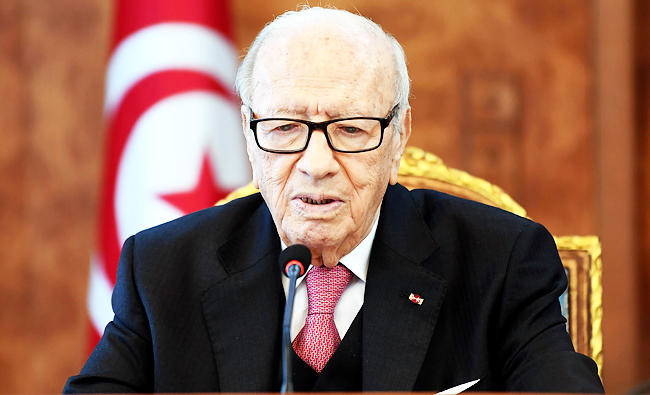
Tunisian President Beji Caid Essebsi attends a meeting with political parties, unions and employers on January 13, 2018 in Tunis, following unrest triggered by austerity measures. (AFP)
Updated 14 January 2018
Follow

Tunisian government announces social reforms after week of unrest

TUNIS: Tunisia’s government on Saturday announced an increase in aid to the needy and improved health care as part of social reforms following a week of unrest triggered by austerity measures.
Social Affairs Minister Mohamed Trabelsi told reporters that monthly aid to needy families would rise from 150 dinars (50 euros) to between 180 and 210 dinars (60 and 70 euros).
He said reforms which have been in the pipeline for several months would guarantee medical care for all Tunisians, without elaborating, and also provide housing to disadvantaged families.
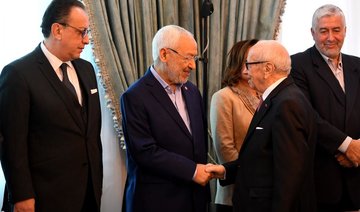
The announcement came after President Beji Caid Essebsi consulted with political parties, unions and employers.
The North African country has been shaken by a wave of protests over poverty and unemployment during which hundreds of people were arrested before the unrest tapered off.
“It’s a very advanced legal project, which was submitted to parliament and will be discussed over the next week,” said a government source who requested anonymity.
At the opening of his consultations, Essebsi accused the foreign press of “amplifying” the social unrest and damaging the country’s image in its coverage of protests.
The president said he would visit a disadvantaged neighborhood of Tunis that had been the scene of street protests.
Tunisia, whose economy has been hit by a collapse in tourism revenues following a wave of jihadist attacks in 2015, has secured a 2.4-billion-euro ($2.9-billion) IMF loan in return for a reduction in its budget deficit and financial reforms.
The two-hour crisis talks at the presidential palace brought together Essebsi, representatives of political parties, the powerful UGTT trade union and the UTICA employers’ federation.
“We discussed the general situation in the country and the reforms, especially socio-economic, that must be adopted to overcome the current problems,” UTICA head Wided Bouchamaoui told reporters.
Proposals were raised “to pull out of this tension” without scrapping a contested 2018 budget, said Rached Ghannouchi, head of the Islamist movement Ennahda in Tunisia’s ruling coalition, without elaborating.
UTICA and UGTT shared the 2015 Nobel Peace Prize for their work during Tunisia’s transition toward democracy after the revolution.
The demonstrations broke out ahead of Sunday’s seventh anniversary of the toppling of veteran dictator Zine El Abidine Ben Ali in a revolt that sparked uprisings across the Arab region.
The trigger for the protests on January 7 was the budget imposing tax hikes after a year of rising prices.
A man in his 40s died in unrest on Monday night in the northern town of Tebourba, though police have insisted they did not kill him.

Interior ministry spokesman Khlifa Chibani on Saturday said a total of 803 people suspected of taking part in acts of violence, theft and looting were arrested this week.
Some 97 security forces and members of civil protection units were also injured, he said. There was no immediate toll for the number of protesters injured in the unrest.
Calm returned to the country on Thursday night and there was “no attack against public or private property” in the night of Friday to Saturday, Chibani said.
AFP correspondents reported one small protest overnight Friday in the central city of Sidi Bouzid — the cradle of the 2011 Arab Spring uprising — and said police fired tear gas to disperse the demonstrators.
Tunisia is considered a rare success story of the Arab Spring uprisings that began in the North African country in 2011 and spread across the region, toppling autocrats.
But the authorities have failed to resolve the issues of poverty and unemployment.
“These demonstrations reveal the anger felt by the same people who mobilized in 2011 and got nothing in terms of social and economic rights,” said political analyst Olfa Lamloum.
Protests are common in Tunisia in January when people mark the anniversary of the revolution that ousted Ben Ali.
This year, the country has seen rising anger after the government adopted the 2018 budget which includes hikes in value-added tax, on mobile phones and real estate as well as in social contributions.
UN must ‘carefully’ heed Lebanese views as it weighs post-UNIFIL options, peacekeeping chief says

Updated 14 sec ago
Follow

UN must ‘carefully’ heed Lebanese views as it weighs post-UNIFIL options, peacekeeping chief says

  • Jean Pierre Lacroix tells Arab News he heard nothing while visiting the country that cast doubt on the political will of authorities to disarm Hezbollah and implement UN resolution
  • Frequency of Israeli attacks ‘has been quite high and has been increasing,’ he says, warning that some of them could have had ‘very tragic consequences’

NEW YORK CITY: The UN must take its lead from authorities in Lebanon as it weighs its options for international support after the UN’s peacekeeping mission in the country ends, the head of UN peace operations said on Friday.
The views of Beirut must be central to any future arrangement, he stressed.
“We have to listen carefully to the Lebanese authorities,” Jean-Pierre Lacroix, the UN under-secretary-general for peace operations, told Arab News during a virtual press conference from Saudi Arabia, in reference to discussions about what UN support for the country might look like when the UN Interim Force in Lebanon’s peacekeeping mandate ends.
He was speaking during a regional tour that has taken him to Lebanon, Syria, Jordan and Israel, during which he met senior political and military officials as well as members of the UN peacekeeping force on the ground.
UNIFIL will continue to operate in Lebanon until its current mandate expires on Dec. 31 this year, with all forces remaining in place until then, Lacroix said. “There is no predrawdown mandate,” he added.
The UN Security Council voted in August last year to grant one final extension to the UNIFIL mandate through the end of 2026, despite Lebanon’s objections. It came as Israel and the US pressed for an end to the decades-old peacekeeping mission, established in 1978, and amid a renewed push to enforce Resolution 1701.
The resolution ended the 2006 war between Israel and Hezbollah. It also underpins their current truce, and calls for the Lebanese state to assert exclusive control over security in the south of the country and to disarm all non-state armed groups.
Lacroix said the relationship between UNIFIL and Lebanese authorities was “excellent,” and cooperation with the Lebanese Armed Forces remained strong. He praised what he described as the political will in Beirut to advance the full implementation of Resolution 1701, citing in particular the recent announcement by Lebanese authorities outlining the first phase of their efforts to establish operational control south of the Litani River. He also acknowledged that significant work remains to be done.
Asked about the disarmament of Hezbollah, Lacroix told Arab News he had heard nothing during his visit that casts doubt on the political will of Lebanese authorities to achieve this, while acknowledging that there are differing assessments among interlocutors about the pace of progress and the risk of rearmament.
“The bottom line for us is that there is momentum,” he said, adding that the UN’s role was to support Lebanese efforts through both its peacekeeping mission and political engagement.
The Security Council has asked UN Secretary-General Antonio Guterres to present options for post-UNIFIL support for Resolution 1701 by June 1. Work on that is ongoing, he said, and includes consultations with Lebanese and Israeli authorities, as well as members of the Security Council.
While Lebanese leaders have expressed concern about the end of UNIFIL’s mission and interest in maintaining some form of UN presence in the country, Lacroix said any successor arrangement would be decided by the Security Council.
He declined to speculate about the form or size of any future force. Several factors would need to be assessed, he said, including the security environment and the level of international support for the Lebanese Armed Forces.
However, he repeatedly emphasized the need for greater backing of the Lebanese army from international partners, describing such support as “more important than ever.”
Lacroix described the “appalling” widespread destruction he had witnessed during his visit to southern Lebanon along the Blue Line that separates the country from Israel. Many villages had been heavily damaged and Lebanese civilians were still unable to return to their homes, he said, warning that this complicates the prospects for rehabilitation and reconstruction.
He also raised concerns about the safety of UN peacekeepers as their operating environment had become increasingly dangerous. While relations with local communities were generally good, he said UNIFIL had faced a growing number of hostile incidents involving the Israeli army.
“The frequency of (Israeli attacks) has been quite high and has been increasing,” he said, warning that some of them could have had “very tragic consequences.”
He said he had raised this issue directly with Israeli officials, and called for action to be taken to prevent further incidents, stressing that all parties have a responsibility to ensure the safety of peacekeepers.
Turning to Syria, Lacroix said the Israeli military presence in the UN-monitored area of separation has become the main challenge for peacekeepers, as Israeli forces occupy 10 positions in a zone reserved under a 1974 agreement for UN troops only. Daily liaison with Israeli forces had helped limit the effects on civilians, he added.
“Our objective remains a return to full implementation of the 1974 agreement,” Lacroix said, and he welcomed US-mediated talks between Israel and Syria.
He also addressed the effects of budget cuts on UN peacekeeping missions. Financial shortfalls had forced missions, including UNIFIL, to reduce patrols and prioritize certain areas, he said, limiting their ability to support national forces and protect civilians.
Jordanian officials have expressed support for Lebanon’s efforts and are providing assistance, he added, including training for members of the Lebanese Armed Forces.
Lacroix said he had yet to meet Saudi officials but expected to discuss Lebanon with them during upcoming talks. He also noted Saudi Arabia’s role in discussions about a possible international conference to support the Lebanese army.