NEW DELHI: Searchers have recovered two more bodies from the wreckage of a helicopter that crashed off India’s west coast, taking the death toll to six, an official said Sunday.
The helicopter went down Saturday shortly after take-off from the country’s financial capital Mumbai with two pilots and five employees of India’s state oil and gas firm ONGC.
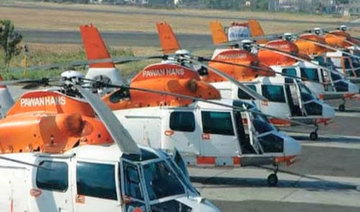
“So far the hospital has said that six bodies have been recovered from the crash. One person is still missing,” BP Sharma, chairman of state helicopter company Pawan Hans that leased the aircraft, told AFP.
“Search and rescue operations continued overnight and are still underway. More parts of the helicopter have also been found.”
The helicopter lost contact with air traffic control at around 10:30am roughly 40 nautical miles off the west coast of India above the Arabian Sea.
It was supposed to land at the offshore oil rig Bombay High at 11:00 am.
Images from the Indian navy Sunday showed rescue crews near floating debris. Divers were to search for the missing passenger, the navy said.
The navy and coast guard had sent ships and planes Saturday to search for the downed helicopter.
India’s civil aviation minister said air crash investigators would launch an inquiry.
ONGC, India’s top oil producer, has oil and gas fields off the coast of Mumbai.
Pawan Hans helicopters routinely ferry ONGC employees and officers to Bombay High, some 160 kilometers (100 miles) offshore.
In 2015 a Pawan Hans chopper crashed after taking off from the oil rig and killed two pilots.
In 2003 a helicopter hired by ONGC crashed off the Mumbai coast, killing 28 people aboard.


Death toll from Indian helicopter crash rises to six: official

Death toll from Indian helicopter crash rises to six: official

End of US-Russia nuclear pact a ‘grave moment’: UN chief
- Guterres urged Washington and Moscow “to return to the negotiating table without delay and to agree upon a successor framework”
UNITED NATIONS, United States: UN chief Antonio Guterres on Wednesday urged the United States and Russia to quickly sign a new nuclear deal, as the existing treaty was set to expire in a “grave moment for international peace and security.”
The New START agreement will end Thursday, formally releasing both Moscow and Washington from a raft of restrictions on their nuclear arsenals.
“For the first time in more than half a century, we face a world without any binding limits on the strategic nuclear arsenals of the Russian Federation and the United States of America,” Guterres said in a statement.
The UN secretary-general added that New START and other arms control treaties had “drastically improved the security of all peoples.”
“This dissolution of decades of achievement could not come at a worse time — the risk of a nuclear weapon being used is the highest in decades,” he said, without giving more details.
Guterres urged Washington and Moscow “to return to the negotiating table without delay and to agree upon a successor framework.”
Russia and the United States together control more than 80 percent of the world’s nuclear warheads but arms agreements have been withering away.
New START, first signed in 2010, limited each side’s nuclear arsenal to 1,550 deployed strategic warheads — a reduction of nearly 30 percent from the previous limit set in 2002.
It also allowed each side to conduct on-site inspections of the other’s nuclear arsenal, although these were suspended during the Covid-19 pandemic and have not resumed since.


