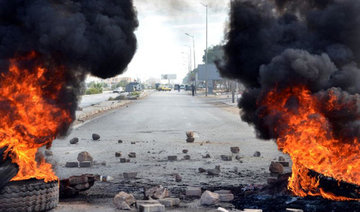
TUNIS: Tunisia’s government on Saturday announced an increase in aid to the needy and improved health care as part of social reforms following a week of unrest triggered by austerity measures.
Social Affairs Minister Mohamed Trabelsi told reporters that monthly aid to needy families would rise from 150 dinars (50 euros) to between 180 and 210 dinars (60 and 70 euros).
He said reforms which have been in the pipeline for several months would guarantee medical care for all Tunisians, without elaborating, and also provide housing to disadvantaged families.
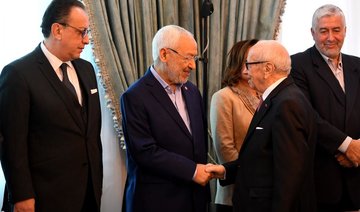
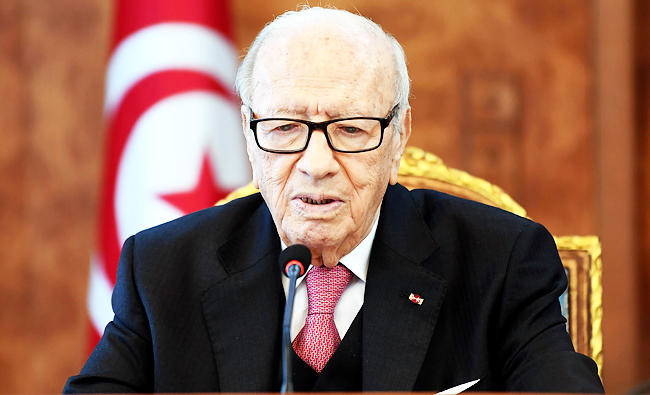
The announcement came after President Beji Caid Essebsi consulted with political parties, unions and employers.
The North African country has been shaken by a wave of protests over poverty and unemployment during which hundreds of people were arrested before the unrest tapered off.
“It’s a very advanced legal project, which was submitted to parliament and will be discussed over the next week,” said a government source who requested anonymity.
At the opening of his consultations, Essebsi accused the foreign press of “amplifying” the social unrest and damaging the country’s image in its coverage of protests.
The president said he would visit a disadvantaged neighborhood of Tunis that had been the scene of street protests.
Tunisia, whose economy has been hit by a collapse in tourism revenues following a wave of jihadist attacks in 2015, has secured a 2.4-billion-euro ($2.9-billion) IMF loan in return for a reduction in its budget deficit and financial reforms.
The two-hour crisis talks at the presidential palace brought together Essebsi, representatives of political parties, the powerful UGTT trade union and the UTICA employers’ federation.
“We discussed the general situation in the country and the reforms, especially socio-economic, that must be adopted to overcome the current problems,” UTICA head Wided Bouchamaoui told reporters.
Proposals were raised “to pull out of this tension” without scrapping a contested 2018 budget, said Rached Ghannouchi, head of the Islamist movement Ennahda in Tunisia’s ruling coalition, without elaborating.
UTICA and UGTT shared the 2015 Nobel Peace Prize for their work during Tunisia’s transition toward democracy after the revolution.
The demonstrations broke out ahead of Sunday’s seventh anniversary of the toppling of veteran dictator Zine El Abidine Ben Ali in a revolt that sparked uprisings across the Arab region.
The trigger for the protests on January 7 was the budget imposing tax hikes after a year of rising prices.
A man in his 40s died in unrest on Monday night in the northern town of Tebourba, though police have insisted they did not kill him.
Interior ministry spokesman Khlifa Chibani on Saturday said a total of 803 people suspected of taking part in acts of violence, theft and looting were arrested this week.
Some 97 security forces and members of civil protection units were also injured, he said. There was no immediate toll for the number of protesters injured in the unrest.
Calm returned to the country on Thursday night and there was “no attack against public or private property” in the night of Friday to Saturday, Chibani said.
AFP correspondents reported one small protest overnight Friday in the central city of Sidi Bouzid — the cradle of the 2011 Arab Spring uprising — and said police fired tear gas to disperse the demonstrators.
Tunisia is considered a rare success story of the Arab Spring uprisings that began in the North African country in 2011 and spread across the region, toppling autocrats.
But the authorities have failed to resolve the issues of poverty and unemployment.
“These demonstrations reveal the anger felt by the same people who mobilized in 2011 and got nothing in terms of social and economic rights,” said political analyst Olfa Lamloum.
Protests are common in Tunisia in January when people mark the anniversary of the revolution that ousted Ben Ali.
This year, the country has seen rising anger after the government adopted the 2018 budget which includes hikes in value-added tax, on mobile phones and real estate as well as in social contributions.