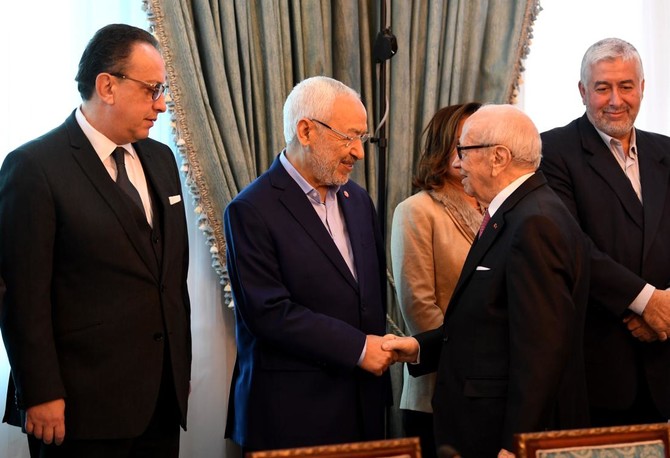
TUNIS: Tunisian President Beji Caid Essebsi was to hold talks Saturday with political parties, unions and employers to discuss means to overcome unrest triggered by austerity measures.
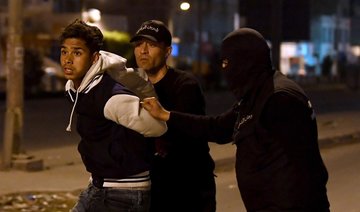
The North African country has been shaken by a wave of protests over poverty and unemployment during which hundreds have been arrested before the unrest tapered off.
The demonstrations broke out ahead of Sunday’s seventh anniversary of the toppling of veteran dictator Zine El Abidine Ben Ali in a revolt that sparked uprisings across the Arab region.
The trigger of the protests last Sunday was a finance law imposing tax hikes after a year of rising prices.
A man in his 40s died in unrest on Monday night in the northern town of Tebourba though police have insisted they did not kill him.
Interior ministry spokesman Khlifa Chibani on Saturday said a total of 803 people suspected of taking part in acts of violence, theft and looting have been arrested this week.
Some 97 security forces and members of civil protection units were also injured, he said. There was no immediate toll for the number of protesters injured in the unrest.
Calm returned to the country on Thursday night and there was “no attack against public or private property” in the night of Friday to Saturday, Chibani said.
AFP correspondents reported one small protest overnight Friday in the central city of Sidi Bouzid — the cradle of the 2011 Arab Spring uprising — and said police fired tear gas to disperse the demonstrators.
Tunisia is considered a rare success story of the Arab Spring uprisings that began in the North African country in 2011 and spread across the region, toppling autocrats.
But the authorities have failed to resolve the issues of poverty and unemployment.
Essebsi was expected to discuss a way out of the latest crisis with representatives of political parties, the powerful UGTT trade union and the UTICA employers federation.
In 2015, UTICA — an acronym for the Confederation of Industry, Trade and Handicrafts — shared a Nobel Prize with the UGTT for their work during Tunisia’s transition toward democracy after the revolution.
Protests are common in Tunisia in January, when people mark the anniversary of the revolution that ousted Ben Ali.
This year, the country has seen rising anger after the government adopted the 2018 budget which includes hikes in value-added tax, on mobile phones and real estate as well as in social contributions.

Tunisia president to meet unions, employers after unrest
Russian forces begin pulling out of bases in northeast Syria
- Despite having been on opposite sides of the battle lines during the civil war, the new rulers in Damascus have taken a pragmatic approach to relations with Moscow
QAMISHLI, Syria: Russian forces have begun pulling out of positions in northeast Syria in an area still controlled by the Kurdish-led Syrian Democratic Forces after the group lost most of its territory in an offensive by government forces.
Associated Press journalists visited one base next to the Qamishli airport Tuesday and found it guarded by SDF fighters who said the Russians had begun moving their equipment out in recent days.
Inside what had been living quarters for the soldiers was largely empty, with scattered items left behind, including workout equipment, protein powder and some clothing.
Ahmed Ali, an SDF fighter deployed at the facility, said the Russian forces began evacuating their positions around the airport five or six days ago, withdrawing their equipment via a cargo plane.
“We don’t know if its destination was Russia or the Hmeimim air base,” he said, referring to the main Russian base on Syria’s coast. “They still have a presence in Qamishli and have been evacuating bit by bit.”
A UN humanitarian convoy from Damascus reached Qamishli on Tuesday, UN spokesman Stéphane Dujarric said.
“It delivered food, warm clothes and blankets, among other supplies,” he told UN reporters. “More convoys are planned in the coming days.”
Dujarric said the UN is also continuing to distribute food, bread and cash elsewhere including displacement sites.
There has been no official statement from Russia about the withdrawal of its forces from Qamishli.
Russia has built relations with the new central Syrian government in Damascus since former President Bashar Assad was ousted in December 2024 in a rebel offensive led by now-interim President Ahmad Al-Sharaa — despite the fact that Moscow was a close ally of Assad.
Moscow’s scorched-earth intervention in support of Assad a decade ago turned the tide of Syria’s civil war at the time, keeping Assad in his seat. Russia didn’t try to counter the rebel offensive in late 2024 but gave asylum to Assad after he fled the country.
Despite having been on opposite sides of the battle lines during the civil war, the new rulers in Damascus have taken a pragmatic approach to relations with Moscow. Russia has retained a presence at its air and naval bases on the Syrian coast.
Al-Sharaa is expected to visit Moscow on Wednesday and meet with Putin.
Fighting broke out early this month between the SDF and government forces after negotiations over a deal to merge their forces together broke down. A ceasefire is now in place and has been largely holding.
After the expiration of a four-day truce Saturday, the two sides announced the ceasefire had been extended by another 15 days.
Syria’s defense ministry said in a statement that the extension was in support of an operation by US forces to transfer accused Daesh militants who had been held in prisons in northeastern Syria to detention centers in Iraq.