UAE minister: Qatar ‘conspired against’ Saudi Arabia’s King Abdullah

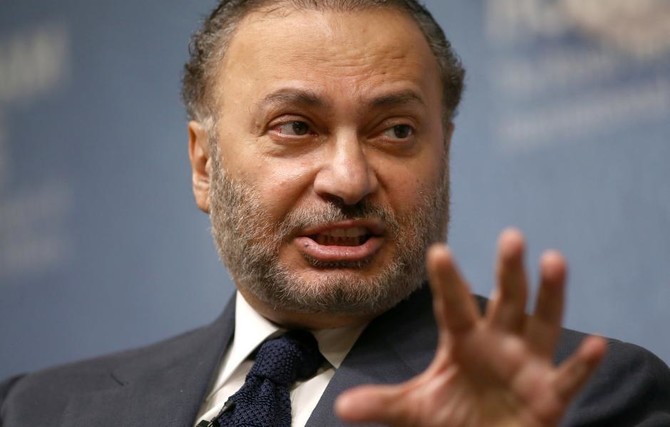
UAE foreign minister Anwar Gargash said that Doha chose to be isolated and argued its denials of supporting extremism and terrorism is a media tactic. (Reuters)
Updated 11 January 2018
Follow

UAE minister: Qatar ‘conspired against’ Saudi Arabia’s King Abdullah

DUBAI: The UAE’s foreign minister said on Wednesday that Qatar must change its policies that have damaged both itself and the region, adding that Doha had “conspired against” the late Saudi King Abdullah.
In a series of tweets, Anwar Gargash said that Doha chose to be isolated and argued its denials of supporting extremism and terrorism is a media tactic.
The minister stated that Egyptian Islamic scholar Yusuf Al-Qaradawi called for the targeting of the UAE from Qatari territory and was part of the incitement of the 2014 GCC diplomatic crisis.
“We have been used to the duality of the Qatari political discourse. For it is Qatar that hosted Al-Qaeda which bombed Iraq and supported Hamas and created warm relations with Israel,” he tweeted. “And it communicated with Saudi Arabia while it conspired against King Abdullah.”
Gargash stated that the political solution called for by the four countries that cut ties with Qatar — Saudi Arabia, the UAE, Egypt and Bahrain — clearly demands a framework for negotiations.
“The Qatari crisis cannot be solved without changing its orientation that supports extremism, terrorism and conspiracy against its neighbors and countries in the region,” he said.
The foreign minister pointed out that Qatar’s crisis and isolation continue, stating that the country’s leadership “is confused and does not wish to address the core issue.”
Qatar was a “great neighbor” prior to 1995, he added.
“The solution is for them to change the orientations that have hurt Qatar, damaged it and isolated it from its neighbors,” Gargash added.


Iran FM criticizes Israel for ‘doctrine of domination’

Updated 07 February 2026
Follow

Iran FM criticizes Israel for ‘doctrine of domination’

  • Doctrine allows Israel to expand its military arsenal while pressuring other countries in the region to disarm
  • His remarks came a day after renewed nuclear talks with Washington in Oman

DOHA: Iran’s Foreign Minister Abbas Araghchi on Saturday criticized what he said was a “doctrine of domination” that allows Israel to expand its military arsenal while pressuring other countries in the region to disarm.
His remarks came a day after renewed nuclear talks with Washington, with previous talks collapsing when Israel launched an unprecedented bombing campaign against Iran last June that triggered a 12-day war.
Araghchi was speaking at the Al Jazeera Forum conference in Qatar but made no reference to Friday’s talks with the United States.
“Israel’s expansionist project requires that neighboring countries be weakened: militarily, technologically, economically and socially,” Araghchi said.
“Under this project Israel is free to expand its military arsenal without limits ... Yet other countries are demanded to disarm. Others are pressured to reduce defensive capacity. Others are punished for scientific progress,” he added.
“This is a doctrine of domination.”
During the 12-day war Israel targeted senior Iranian military officials, nuclear scientists and sites as well as residential areas, with the US later launching its own attacks on key nuclear facilities.
Iran responded at the time with drone and missile attacks on Israel, as well as by targeting the largest US military base in the Middle East, located in Qatar.
On Friday, Araghchi led the Iranian delegation in indirect nuclear talks with US Middle East envoy Steve Witkoff in Muscat.
The top Iranian diplomat later described the atmosphere as having been “very positive,” while US President Donald Trump said the talks were “very good,” with both sides agreeing to proceed with further negotiations.
The talks followed threats from Washington and its recent deployment of an aircraft carrier group to the region following Iran’s deadly crackdown on anti-government protests last month.
The United States has sought to address Iran’s ballistic missile program and its support for militant groups in the region — issues which Israel has pushed to include in the talks, according to media reports.
Tehran has repeatedly rejected expanding the scope of negotiations beyond the nuclear issue.