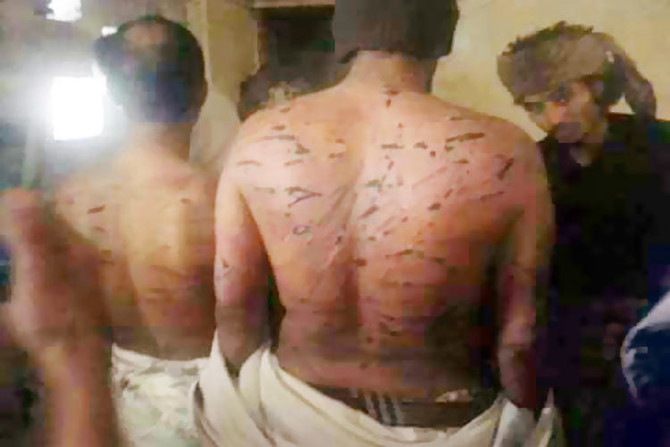
THE HAGUE: At least 113 people have been tortured to death in detention centers in Yemen run by the Houthis since the coup began, according to a human rights report.
The Netherlands-based foundation for human rights in the Arab world, Rights Radar (RR), announced on Tuesday that 113 detainees had been killed in Houthi centers since Sept. 21, 2014 and said some cases may qualify as war crimes.
RR said that it had investigated 113 killings under torture in illegal detention centers run by the Houthis in the capital Sanaa and other cities under Houthi control, along with the deaths of civilian detainees in prisons run by Yemeni forces loyal to the UAE in the governorates of Aden and Hadramout in southern Yemen.
Responding to the report, Yemeni Human Rights Minister Mohammed Askar told Arab News that the figures in the report were only estimates, and that the real figures were much higher.
Askar said that the number of cases of abduction and arbitrary detention in 2017 reached 1,930, including 400 forced-absence cases, which made last year the highest for the number of abductions.
He said that there had been more than 18,000 abductions since the beginning of the coup.
Askar said that the Yemeni government had documented arbitrary detention cases against members of the General People’s Congress after the assassination of Ali Abdullah Saleh, and confirmed the presence of hundreds of detention centers full of men and women who were tortured by Houthi militias, including leaders and members of the General People’s Congress and the Republican Guards.
Askar said that there were a large number of torture victims of these militias in Sanaa, Taiz, Hajjah and Dhamar, noting that Dhamar houses the biggest detention center in Yemen.
He said that the Yemeni government had sent a letter to the UN High Commissioner for Human Rights, which included initial figures of detainees, and noted that the government would publish a detailed report about the main violations against leaders and members of General People’s Congress and the Republican Guards.
Askar said that the Houthi militias were criminal groups who practiced state terrorism and did not respect human rights international norms, and that the Yemeni government had issued many reports about the number of people detained by them.
The RR report said that sources from human rights NGOs estimated the number of people inside Houthi detentions at 7,000, distributed over 643 illegal prisons across Yemen. Most of these detainees belong to the Yemeni Islah Party. Their number recently grew with new detainees, members of the General People’s Congress (GPC) of former President Ali Abdullah Saleh after the Houthi militants assassinated Saleh on Dec. 4, 2017 and started to arrest GPC supporters in Sanaa city.
International relations officer for Rights Radar, Gerard van der Kroon, said “the cases of murder under torture are serious violations of human rights that should be qualified as war crimes leading to individual criminal responsibility under the international criminal law and that should not go unpunished.”
He said RR strongly condemned the frequent torture-related deaths in Houthi detention centers as serious violations of human rights that the international community should no longer tolerate.
Van der Kroon called on the international community, and the UN in particular, to take deterrent measures against the perpetrators and to hold them accountable for those who were victims of the weakness of the failing Yemeni state authorities who were not able to defend the safety of their population and guarantee compliance to the laws of war by the warring parties.
“The persistence of the international community’s silence over these grave violations of human rights and breaches of international legislation pertaining to war crimes in Yemen encourages perpetrators to repeat and continue their malpractices. The international community should do anything that is in their power to stop these horrific crimes,” Van der Kroon said.


![]()
113 detainees killed by Houthi torture: Human rights report
113 detainees killed by Houthi torture: Human rights report


Latest updates


© 2026 SAUDI RESEARCH & PUBLISHING COMPANY, All Rights Reserved And subject to Terms of Use Agreement.