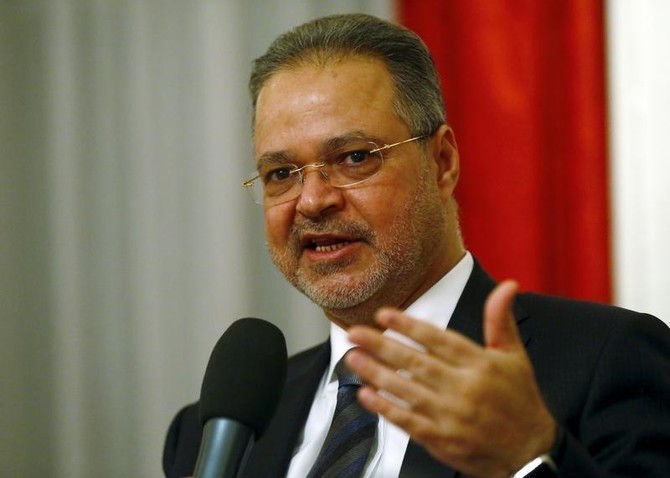
SANAA: Deputy prime minister and foreign minister Abdulmalik Al-Mekhlafi said the Iran-backed rebels must immediately stop all crimes committed against politicians and civilians in Yemen.
The rebels, who sparked the war in Yemen when they seized the capital in 2014, must also release all detainees and stop launching missiles, Al-Mekhlafi told Asharq Al-Awsat.
The other conditions for talks include a call for the rebels to stop attacking and besieging cities and allowing humanitarian aid to reach civilians.
Al-Mekhlafi said the rebels must also back the three references for a political solution in Yemen, including the Gulf Initiative, outcomes of the Comprehensive National Dialogue and Security Council Resolution 2216.
“The current situation stipulates the need for rebels to show good intention, as there will be no return for talks in the way they went before,” he said.
The minister stressed that Houthis have “proved they are no partners in peace, and are not ready to currently engage in peace”.
UN-sponsored talks in Kuwait in 2016 broke down with the two sides deadlocked and the Houthis and their then ally, former president Ali Abdullah Saleh were condemned for attempting to form a a political council to run the country.
Last year the Houthi’s alliance with Saleh crumbled, and the rebels killed the former president in December.
Al-Mekhlafi said the rebels’ unwillingness to find a political solution was also down to their backing by Iran.
“Iran considers the Houthis and their battle in Yemen as part of its war to control the Arab region, and therefore behave accordingly,” he said.

Yemen government sets conditions for Houthi talks
Israel aims to bring ‘permanent demographic change’ to West Bank, Gaza: UN
- UN rights chief Volker Turk says Israeli military operation in West Bank’s north has displaced 32,000 Palestinians
GENEVA: Israel’s actions in the occupied West Bank and the Gaza Strip seem aimed at creating “permanent demographic change,” UN rights chief Volker Turk said on Thursday.
“Taken together, Israel’s actions appear aimed at making a permanent demographic change in Gaza and the West Bank, raising concerns about ethnic cleansing,” Turk said in a speech before the UN’s Human Rights Council in Geneva.
Turk pointed in particular to an ongoing, year-long Israeli military operation in the West Bank’s north that has caused the displacement of 32,000 Palestinians.
Elsewhere in the West Bank, entire Bedouin herder communities have been displaced by increasing harassment and violence from Israeli settlers, including near Mikhmas to the east of Ramallah, and Ras Ein Al-Auja, in the Jordan Valley, since the start of the year.
In addition to roughly three million Palestinians, more than 500,000 Israelis live in settlements and outposts in the West Bank, which are considered illegal under international law.
Israel has approved a series of initiatives this month backed by far-right ministers, including launching a process to register land in the West Bank as “state property” and allowing Israelis to purchase land there directly, in a move condemned by several countries as well as Hamas.
Israel’s current government has accelerated settlement expansion, approving a record 54 settlements in 2025, according to Israeli settlement watchdog NGO Peace Now.
Israel has occupied the West Bank since 1967.
‘Maximum land, minimum Arabs’
In the Gaza Strip, most of the territory’s 2.2 million inhabitants have been displaced at least once since the start of the war sparked by Hamas’s unprecedented attack against Israel on October 7, 2023.
“Intensified attacks, the methodical destruction of entire neighborhoods and the denial of humanitarian assistance appeared to aim at a permanent demographic shift in Gaza,” the UN human rights office said in a report last week.
Israeli far-right Finance Minister Bezalel Smotrich also vowed to encourage “emigration” from the Palestinian territories in February.
“We will finally, formally and in practical terms nullify the cursed Oslo Accords and embark on a path toward sovereignty, while encouraging emigration from both Gaza and Judea and Samaria,” he said, using the Biblical term for the West Bank.
“There is no other long-term solution,” added Smotrich, who himself lives in a settlement in the West Bank.
“They want maximum land and minimum Arabs,” Fathi Nimer, a researcher with Palestinian think tank Al-Shabaka, told AFP, referring to a commonly used phrase used to describe Israeli settlement tactics.