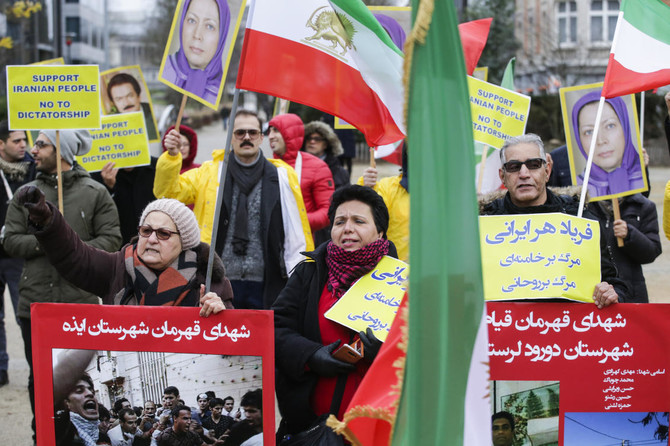
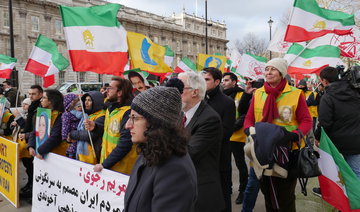
BRUSSELS: Protests against the Iranian government were held in Brussels on Wednesday ahead of a meeting between European powers and Iran on the nuclear deal.
The meeting on Thursday with Iran foreign minister Mohammad Javad Zarif comes on the eve of a deadline for the US president to decide whether to reimpose oil sanctions lifted under the agreement.
Iran, Britain, France, and Germany are expected to reaffirm their support for the deal that Donald Trump has rejected, EU diplomats told Reuters.
The deal aimed to curb Iran’s pursuit of nuclear weapons in return for an end to some sanctions placed upon it.
Donald Trump has sworn to tear up the deal in a tougher stance against Iran than his predecessor. He also strongly supported recent anti-government protests held across Iran that were sparked by economic hardship and corruption but spiralled into calls for the downfall of the clerical leadership.
Members of the Iranian community in Belgium, supporters of the People’s Mojahedin Organization of Iran and the National Council of Resistance of Iran (NCRI) protested in Brussels against Mr.Zarif’s visit.
The protest was held outside the European Commission and European Council buildings, where the meetings will take place.
The protesters called on the European Union to cancel the meeting and for the EU to support the ongoing protests and regime change in Iran and condemn the killings of demonstrators.
During the meeting convened by the EU’s top diplomat Federica Mogherini, the European powers that helped negotiate the 2015 accord will reassure Tehran they remain committed to it, the diplomats said.
They will also urge Iran to continue to comply with international inspectors.
“The aim is to send a message to Washington that Iran is complying and that it is better to have the nuclear agreement than to isolate Tehran,” one diplomat said.
A spokesman for Iran’s atomic energy agency said on Wednesday that a reimposition of sanctions by the United States would be a violation of the nuclear deal and added that the Islamic Republic had the capacity to greatly increase its enrichment of uranium.
In October Trump decided not to certify that Tehran is meeting the terms of the pact.
The US president must decide by mid-January whether to continue waiving US sanctions on Iran’s oil exports under the terms of the deal. The State Department said on Tuesday the Trump administration was expected to decide on Friday.

Protests in Brussels ahead of Iran nuclear meeting
US not expanding military objectives in Iran, Hegseth says
- Iran’s regional retaliation strengthen US alliances, Hegseth says
- US forces destroy 30 Iranian warships, including drone carrier
TAMPA, Florida: US Defense Secretary Pete Hegseth said on Thursday the United States was not expanding its military objectives in Iran, after President Donald Trump told Reuters the United States must be involved in choosing the next leader of Iran.
The Pentagon earlier this week said the military campaign, known as Operation Epic Fury, is focused on destroying Iran’s offensive missiles, missile production and navy, while not allowing Tehran to have a nuclear weapon.
“There’s no expansion in our objectives. We know exactly what we’re trying to achieve,” Hegseth said.
He added that Trump was “having a heck of a say in who runs Iran given the ongoing operation.”
In a telephone interview with Reuters on Thursday, Trump said the United States would have to help pick the next person to lead the country. The US and Israeli military campaign that started on Saturday has hit targets across the country and triggered Iranian retaliatory strikes in the region as Tehran seeks to impose a high cost on the United States, Israel and their allies.
Iran has attacked countries including Israel, the United Arab Emirates and Qatar. Fire crews in Bahrain extinguished a blaze at a refinery following a missile strike.
Azerbaijan became the latest country drawn in, as it accused Iran of firing drones at its territory and ordered its southern airspace closed for 12 hours.
Hegseth said by striking countries in the region, Iran would only bring them closer to the United States.
“It’s actually firming up the unity of the resistance in order to focus exactly where we need to,” Hegseth said.
Next phase of operations
The United States has hit more than 2,000 targets in Iran, including Iranian warships. Admiral Brad Cooper, the head of US Central Command, said US forces had destroyed 30 Iranian warships, including an Iranian drone carrier ship earlier on Thursday.
Cooper said the United States was hitting Iran’s ability to rebuild.
“As we transition to the next phase of this operation, we will systematically dismantle Iran’s missile production capability for the future, and that’s absolutely in progress,” Cooper said, adding that it would take some time.
The US military has identified the six US Army Reserve soldiers killed when a drone slammed into a US military facility in Port Shuaiba, Kuwait.
Trump and other senior officials have warned the Iran conflict will result in more US military deaths.
Hegseth, during the press conference, said Iran was making a mistake if it believed that the United States could not sustain the ongoing war, adding that Washington had just begun to fight.
“Iran is hoping that we cannot sustain this, which is a really bad miscalculation,” Hegseth said. “We set the timeline.”